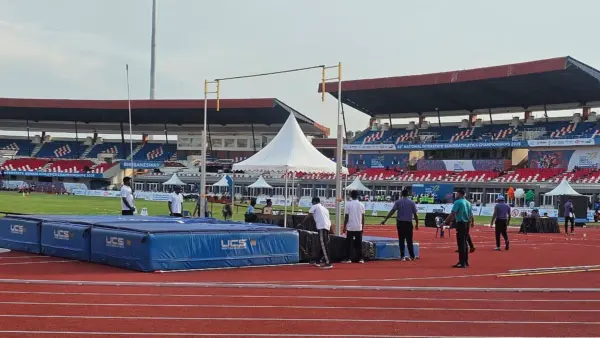
Bengaluru: Indian athletics’ preparations for the Asian Games came under the anti-doping scanner on Sunday when the World Anti-Doping Agency’s (WADA) Athletics Integrity Unit conducted surprise testing at the national camp in Bhubaneswar in the early hours of Sunday.
AIU officials, accompanied by local volunteers, arrived at the Kalinga Stadium campus and other camp locations around 5.00 am, catching athletes and officials off guard as the anti-doping body carried out an unannounced testing operation.
DH has learnt that three types of samples – dry blood, wet blood and urine – were collected from athletes at the camp. Around 70-80 per cent of the 45 athletes currently training in Bhubaneswar are understood to have been tested, with the exact number of athletes to be ascertained. The athletics camp is also being held in Patiala and Bengaluru, with Bhubaneswar housing the largest group.
It is further learnt that sprinters were specifically among the athletes on the testing list which was not shared with the Indian authorities present at the venue.
The samples collected in Bhubaneswar are unlikely to be analysed at India’s National Dope Testing Laboratory (NDTL) and are expected to be sent overseas for analysis at a WADA-accredited laboratory.
The development comes at a time when Indian athletics faces international scrutiny over its anti-doping record. In April, the AIU moved the Athletics Federation of India from Category B to Category A, its highest-risk bracket, citing India’s ‘extremely high’ doping risk. India ranked among the top two countries for athletics anti-doping rule violations from 2022 to 2025, including topping the list in 2024 and 2025.
Surprise, out-of-competition testing is a key part of the global anti-doping system, with WADA rules allowing athletes to be tested without prior notice. A similar surprise testing operation was conducted during India’s Commonwealth Games preparatory camp in Czech Republic. However, no athlete from that camp has returned a positive result so far.