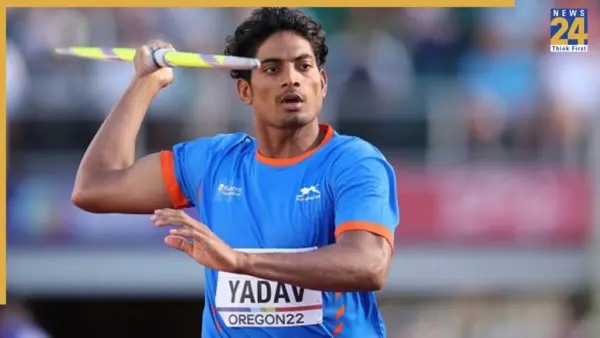
Rohit Yadav has found it hard to sleep since returning from the Commonwealth Games. He finished seventh among 12 competitors in the men’s javelin final after recording a best throw of 81.56 metres in Glasgow.
How did Rohit Yadav perform compared to the other Indian throwers?
Of the three Indians in the final, Rohit Yadav had the shortest throw. Neeraj Chopra won silver, while Yashvir Singh took bronze, with both athletes crossing the 85-metre mark. Neeraj Chopra’s best throw of 85.83m and Yashvir’s personal best of 85.41m were both lower than Rohit’s 87.05m throw before the Commonwealth Games. Knowing that he could not match that distance in Glasgow still bothers Rohit.
How did Rohit Yadav bounce back after his Commonwealth Games disappointment?
The 25 years old athlete from Dabhiya village in Machhlishahr bounced back just a few weeks later. He recorded an impressive 87.68m throw at the Continental Tour Silver meet in Bhubaneswar. The throw was important as it moved Rohit to second among India’s top javelin throwers, with only Neeraj Chopra ahead of him. However, the achievement still did not bring him much joy. ‘What is the point of throwing here? I need to throw big in bigger competitions, that is my goal,’ Rohit Yadav told IndiaToday.in in an exclusive interview. ‘I was really sad and irritated with my throw in Glasgow. I am not happy with this personal best as well,’ he added.
Why is Rohit Yadav now India’s primary medal hope for the Asian Games?
Although Rohit is still disappointed with his Commonwealth Games result, his strong performance at the Continental Tour in August has made him a serious medal contender for the 2026 Asian Games in Japan next month. With Neeraj Chopra ruled out because of an ankle injury that has ended his season, Rohit is now India’s biggest hope of winning another javelin medal in 2026.
How rare is it for an athlete to throw a javelin beyond 90 metres?
Throwing the javelin beyond 90 metres is extremely difficult. Javelin became an Olympic event in 1908, and only 28 athletes have crossed 90 metres so far. Germany has produced the most 90m-plus throwers, with seven athletes reaching that mark. This makes Neeraj Chopra’s 90.23m throw in Doha even more impressive, as he remains the only Indian athlete to cross 90 metres.
What do experts say about Rohit Yadav’s potential to cross 90 metres?
But what happens after Neeraj Chopra? What will India’s javelin scene look like when he gets older and eventually retires? This is where Rohit Yadav could play a key role. After throwing beyond 87 metres twice in 2026, people have started asking if he can also reach the 90-metre mark. His former coach, Michael Musselmann who worked with him in the early part of his career, believes Rohit has special ability and a naturally strong throwing arm that can help him produce longer distances.
What natural physical traits make Rohit Yadav a standout athlete?
‘He’s a very impressive talent. He’s not tall, not strong in terms of weightlifting, but naturally very strong and has an amazing arm,’ Michael says from Peru, where he trains athletes across the globe online.
Where did Rohit Yadav derive his natural throwing technique?
‘Rohit is a very natural thrower. I think it comes from cricket, or maybe he just had it in his system. He knew how to use his legs, his upper body, the rotation, and the follow-through, and he always had a good feel for the javelin.’ ‘I think he has 90 metres in his body.’
How did a bamboo stick kickstart Rohit Yadav’s javelin journey?
Rohit Yadav’s natural ability with the javelin did not begin at a top training centre. It started at his home when he was a child. His journey began in 2012, when he was in Class 5. His father, who had competed in the decathlon at the state level, cut a piece of bamboo that looked like a javelin.
‘I remember one day in the village when my dad (Sabhajee Yadav) brought home a bamboo stem. He was showing me how to throw it. When the stick fell, it didn’t lie flat; it stuck into the ground and stood up. The 11 years old kid in me was fascinated,’ Rohit recalled. ‘I took up javelin from there. I was training at home then, and I worked with Michael online after that,’ Rohit added.
What is Rohit Yadav’s primary focus moving forward?
Rohit is determined to keep improving. For now, he is not thinking too much about the 90-metre mark. His main focus is the Asian Games, where he will have a chance to turn his recent improvement into a major medal.
Why does Rohit Yadav attach less value to non-major competitions?
His 87.68m effort in Bhubaneswar lifted him to second place among Indian javelin throwers, behind only Neeraj Chopra. It was also one of the longest throws in the world this season and brought him closer to the 90m mark reached by only the top athletes. However, Rohit is not too concerned about what the distance means outside major competitions.
He knows that the throw came at a Continental Tour event and not at the Olympics, World Championships or Asian Games. That difference is important to him. His poor result in Glasgow still bothers him. He threw only 81.56m at the Commonwealth Games despite having a best of 87.05m before the event.
Why does Rohit Yadav want his 90-metre throw to happen at a major event?
This could make his 90m target even more meaningful. Rohit is not looking to cross 90m simply to join an elite list. He wants to achieve it at a major event, where such a throw can help him win a medal. Michael Musselmann saw that potential when Rohit was still a teenager. Six years later, Rohit is starting to believe in that possibility himself.
All you need to know about Rohit Yadav
Rohit Yadav was born on June 6, 2001, in Dabhiya village in Jaunpur, Uttar Pradesh. He grew up in a family with a strong sports background. His father, Sabhajeet Yadav, had competed in the decathlon and marathon at the state level.
The family could not afford proper javelins in the beginning, so his father made simple training javelins from wild bamboo for Rohit and his brothers. Rohit’s talent became clear when he won a district competition at the age of 13 with a 49-metre throw. His school principal then helped him get proper equipment to continue his training. Rohit later received more support after joining Indian Railways.