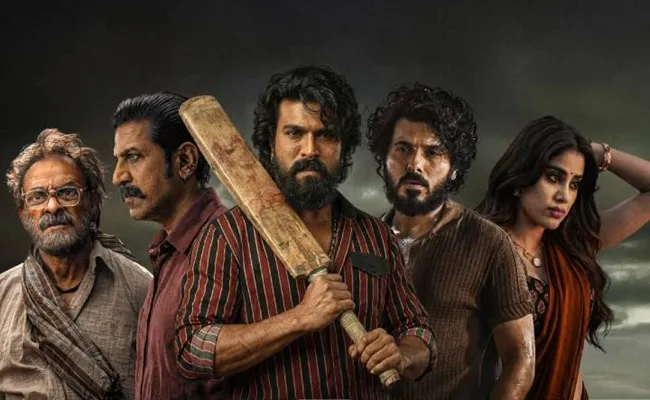
Director Buchi Babu Sana has teamed up with Ram Charan for “Peddi,” and the film has been carrying massive expectations ever since its first glimpse was released a year ago. With Ram Charan, Jagapathi Babu, and Shiva Rajkumar all describing it as one of the best films of their careers, the hype has only grown stronger.
The big question now is whether “Peddi” can live up to those lofty expectations and lofty claims.
Story
Set in a village in Vizianagaram during the 1990s, Peddi (Ram Charan) is a cricketer-for-hire who plays for any team willing to pay him.
The village he calls home has no official identity and does not even exist in government records. Peddi is also in love with Achiyamma (Janhvi Kapoor), the daughter of the local sarpanch.
Appalasuri (Jagapathi Babu) is an idealist whose lifelong dream is to secure a railway halt for their neglected village. Despite years of relentless struggle, he fails to make it happen.
What follows is Peddi’s journey as he takes up Appalasuri’s mission and goes to extraordinary lengths to fulfill that dream.
How his wrestling skills become crucial to the fight, the sacrifices he makes along the way, and his transformation from a paid-player into a true sportsman form the heart of the story. Guiding him through this journey is his mentor, Gavarnaidu (Shiva Rajkumar).
Will the village finally earn recognition, and can Peddi achieve what Appalasuri could not?
Performances
Without a doubt, Ram Charan delivers a career-defining performance. He completely immerses himself in the character, both physically and emotionally. Watching him excel as a crossover athlete across multiple sports is impressive, but it is his transformation into a wrestler that stands out the most. His final look as a runner is equally striking.
Charan undergoes a remarkable physical makeover, and his Uttarandhra dialect comes across as authentic. For the most part, the film rests on his shoulders, and he carries it with conviction.
Jagapathi Babu, who played a ruthless antagonist in Ram Charan’s “Rangasthalam”, appears in a completely contrasting role here. As a villager fighting for the development of his community, he brings considerable emotional weight to the narrative, particularly in the pre-interval portions.
Kannada superstar Shiva Rajkumar has a substantial role and leaves a strong impact. Janhvi Kapoor does not have a particularly significant part, but she plays the village belle with ease and adds charm to the proceedings. However, her character has very little presence in the second half.
Boman Irani’s role comes across as largely illogical. Although the film features a large ensemble cast, most of the supporting actors are left with little scope to make an impression.
Satya barely registers, while Rao Ramesh appears in only a handful of inconsequential scenes. Ravi Kishan, Ajay Ghosh, Tarak Ponnappa, Harish Peradi, and Srikanth Ayyangar have little to do.
Divyenndu, known for “Mirzapur”, makes his presence felt in the opening portions, but his character ultimately amounts to much ado about nothing.
Technical Aspects:
Technically, the film benefits immensely from the contributions of music director AR Rahman and cinematographer Rathnavelu.
Of the songs, two work effectively on screen, while the special song featuring Shruti Haasan lacks the desired impact. However, Rahman’s powerful background score elevates several important sequences and strengthens the emotional moments. But still his BGM cannot be rated as ‘outstanding’.
Rathnavelu captures the sports episodes with flair and energy, making the wrestling and cricket sequences visually engaging. Avinash Kolla’s production design authentically recreates the period setting.
Editing, however, is uneven. The film suffers from pacing issues, particularly in the middle portions, where the narrative tends to drag. The writing is also quite weak.
Highlights
Ram Charan’s performance and remarkable transformation
Two sports episodes
Emotionally powerful final 20 minutes
Drawbacks
Noticeable lag in both halves
Janhvi Kapoor’s underwritten episodes
Analysis
“Peddi” marks Buchi Babu’s second directorial venture after his successful debut, “Uppena”. This time, with Ram Charan leading the project, he mounts the story on a much larger canvas. Although the film falls in the sports drama genre, and Telugu cinema has seen several sports-based films in recent years, “Peddi” offers a variation by incorporating multiple sports rather than focusing on just one. More importantly, Buchi Babu uses sports as a backdrop to tell a social drama about identity, recognition, and the development of a neglected village.
To establish the emotional conflict and the core issue that takes center stage from the interval onward, the director spends nearly an hour on conventional commercial elements. Ram Charan is introduced as a cricketer-for-hire, followed by his romantic track with Janhvi Kapoor, along with a couple of songs. As a result, the first hour largely plays out like a template mass entertainer.
Since Janhvi Kapoor’s character has little relevance to the latter half of the story, Buchi Babu appears to have front-loaded her role, giving her more screen presence and glamour in the opening portions before wrapping up the romance track. Consequently, the entire subplot feels forced and often borders on being cringe-worthy.
The film finds its footing with the emotionally charged episode involving Jagapathi Babu’s character, who desperately tries to secure a railway halt for his village, a place that does not even exist in government records. The villagers, lacking official recognition, are deprived of even a basic identity. This powerful sequence sets the tone for the interval and drives the narrative into a far more engaging second half.
From Jagapathi Babu’s emotional arc to Ram Charan beginning wrestling training under Shiva Rajkumar’s mentorship, these portions are handled effectively. But the way Jagapathi Babu’s character ended didn’t evoke any emotion because the character felt more superfluous and informational than emotionally engaging.
While cricket dominates the first half, the second half initially appears to shift entirely toward wrestling. However, Buchi Babu introduces another twist by transforming Peddi into a runner. In that sense, the film presents Ram Charan as a rare crossover athlete, moving from cricket to wrestling to athletics. While this progression is unique, the constant shifts between sports and the extended village-development drama create an uneven narrative rhythm. The film experiences several highs and lows, and the inconsistent flow affects the overall viewing experience.
The entire framing device involving Boman Irani is one of the film’s weakest aspects. The story unfolds as a flashback narrated to his character, a senior official from a government sports academy. Yet it is difficult to accept that such an official would be unaware of Peddi, a national champion who brought glory to India. This lack of logic weakens the narrative. Adding to the problem, the narrator occasionally reacts and shouts as though the events are unfolding in real time rather than being recounted from the past. Such moments feel contrived and add to the film’s many clichéd and illogical stretches.
It is also difficult to fully buy into the premise that an entire village could remain absent from government records simply because it is located at the foothills of a mountain, leaving its residents without official identity documents. The film attempts to justify this by claiming that thousands of villages still lack government recognition, but the execution remains unconvincing.
Interestingly, Buchi Babu employs a narrative twist that echoes a storytelling pattern seen in “Uppena”. Without revealing spoilers, Peddi’s life-altering setback and subsequent journey toward redemption bear similarities to the emotional structure of his debut film.
Although the screenplay frequently slips into predictable territory and suffers from pacing issues, “Peddi” ultimately stays afloat because of Ram Charan’s deeply committed performance and an emotionally stirring climax. The final stretch delivers enough impact to leave viewers with a positive impression despite the film’s shortcomings.
Overall, Peddi is a social message wrapped in commercial elements. It is elevated by Ram Charan’s career-best performance, a highly emotional climax, and a stirring musical treat. Though there are a few logical flaws and pacing issues, Ram Charan’s hard work and dedication earn immense respect and make the audience overlook most of the film’s shortcomings. The final 30 minutes are deeply emotional and leave a lasting impact, adding great value to the film. Ram Charan deserves all the accolades for his truly award-worthy performance.