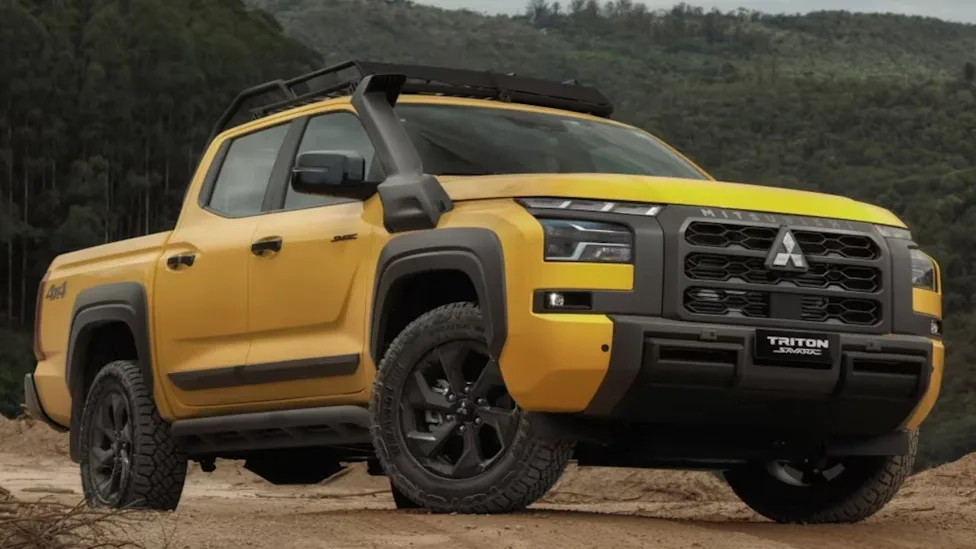
Mitsubishi is preparing to return to one of America’s toughest vehicle segments: midsize pickups.
The Japanese automaker has confirmed a joint pickup project with Nissan for North America, giving Mitsubishi a path back into a market it left after the Raider disappeared from the U.S. lineup in 2009.
The partnership makes sense. Nissan remains Mitsubishi’s alliance partner and a major shareholder, even after Mitsubishi moved in 2024 to reduce Nissan’s stake. Nissan also has the truck hardware, manufacturing base, and U.S. pickup experience Mitsubishi currently lacks.
Final details have not been fully confirmed, including the truck’s name, powertrain, timing, price, and how different it will feel from Nissan’s own midsize pickup. Current reporting points to a Nissan-developed body-on-frame platform rather than a simple return of the old Mitsubishi Raider formula.
Nissan Will Help Bring Mitsubishi Back To Pickups
Mitsubishi has confirmed the North American pickup project with Nissan, but several key details remain unsettled. Reporting points to Nissan’s Canton, Mississippi plant as the likely production site, which would give Mitsubishi a locally built truck without creating its own U.S. factory network.
That matters because U.S. pickup buyers care about more than the badge on the grille. Local production can help with tariffs, availability, dealer confidence, parts support, and the perception that the truck was built with American buyers in mind.
The truck is also expected to arrive during a major Nissan body-on-frame product cycle. Nissan has been preparing a new generation of rugged vehicles, including a next-generation Frontier and revived Xterra, and Mitsubishi’s pickup is expected to benefit from that work.
That gives Mitsubishi a better starting point than it had with the Raider. A modern midsize pickup tied to new Nissan hardware would enter the market with stronger bones, but Mitsubishi still has to make the truck feel like more than another badge swap.
The Midsize Pickup Segment Is Getting Crowded
Mitsubishi will not be returning to an easy market. The Toyota Tacoma remains the name many buyers think of first, while the Chevrolet Colorado, GMC Canyon, Ford Ranger, Jeep Gladiator, Honda Ridgeline, and Nissan Frontier all give shoppers different reasons to stay away from a new entry.
The segment has also become more specialized. Buyers can choose serious off-road trims, turbocharged engines, hybrid possibilities, premium interiors, advanced towing technology, and factory adventure packages that did not define midsize pickups the same way during the Raider’s era.
Kia has also signaled interest in a separate pickup aimed at the U.S. market, though final timing, production details, and specifications remain unsettled. That means Mitsubishi may face even more competition by the time its new truck reaches showrooms.
For Mitsubishi, the history is personal. The brand’s last U.S. pickup was the Raider, a Dodge Dakota-based truck sold for the 2006 through 2009 model years. It used traditional body-on-frame construction and offered 3.7L V6 and 4.7L V8 power, with towing capacity that reached about 6,500 pounds depending on configuration.
The Raider was not a bad idea on paper. It gave Mitsubishi dealers a truck in a segment Americans understood. The problem was that it never gave enough buyers a strong reason to choose it over the Dodge version or more established midsize rivals.
Mitsubishi Wants To Avoid Another Raider Story
The biggest challenge for Mitsubishi is not simply building a truck. It is building one with enough Mitsubishi identity to matter.
The company’s broader plan gives the pickup more context. Mitsubishi’s new mid- to long-term vision calls for 13 new models from fiscal 2026 through fiscal 2031, including hybrid, plug-in hybrid, gasoline, and battery-electric products. The plan also includes a pickup, SUVs, a minivan, and the return of the Pajero or Montero name.
That matters because the new pickup is not supposed to be a one-off experiment. It is part of a larger attempt to rebuild Mitsubishi’s visibility and product strength in important markets.
The revived Pajero or Montero also points to Mitsubishi’s renewed interest in rugged vehicles, though its U.S. future has not been fully confirmed. If Mitsubishi can reconnect the pickup with the brand’s off-road history instead of making it feel like a Nissan with a different grille, the truck has a much better chance of avoiding the Raider’s fate.
Electrification Will Be Part Of The Bigger Plan
Mitsubishi is not walking away from gasoline power, but it is not ignoring electrification either.
The company’s product plan includes five hybrid models and five plug-in hybrid models among the 13 vehicles planned from fiscal 2026 through fiscal 2031. Mitsubishi has also confirmed a Nissan-sourced battery-electric vehicle for North America, based on the next-generation Nissan Leaf, beginning in summer 2026.
The pickup itself has not been confirmed as electric. That is important in the U.S. truck market, where many buyers still want familiar capability, predictable range, and proven truck behavior before they commit to a fully electric work vehicle.
A gasoline or hybrid-assisted midsize pickup could make more sense for Mitsubishi’s comeback than a full EV. It would allow the brand to control cost, lean on Nissan’s truck development, and offer buyers something easier to understand than an expensive electric truck from a company still rebuilding its U.S. image.
Mitsubishi is also trying to shorten development time. Its planning materials show a goal of reducing vehicle development lead time from 45 months to 36 months, which would help the brand respond faster as markets, regulations, and buyer expectations change.
A Big Chance For A Brand That Needs Momentum
If Mitsubishi gets this pickup right, it could give the brand its most meaningful U.S. product story in years.
The formula is promising: Nissan truck engineering, likely U.S. production, a body-on-frame platform, and a segment where buyers are willing to pay for capability when the product feels credible. The risk is just as clear. If the truck feels too much like a rebadged Nissan, buyers may remember the Raider for the wrong reasons.
Mitsubishi does not need to beat the Tacoma, Ranger, Colorado, and Frontier at everything. It needs a clear reason to exist. That could come from pricing, warranty value, off-road tuning, hybrid strategy, styling, dealer support, or a sharper connection to Mitsubishi’s own rugged history.
The pickup will enter a crowded market full of loyal buyers and well-established rivals. Still, a locally built midsize truck with Nissan engineering underneath could give Mitsubishi something it badly needs in the United States: a reason for shoppers to look again.