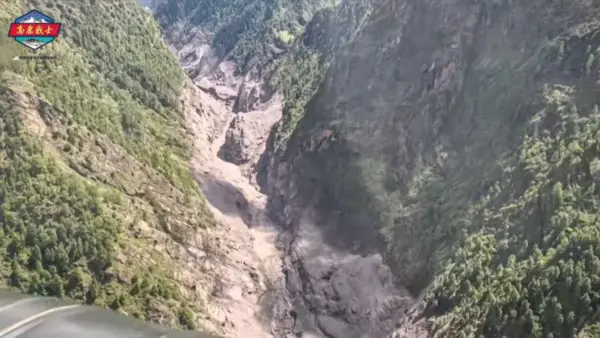
ANepali journalists’ collective has alleged that the August 26, 2026 flash flood in the country’s Rasuwa district was a ‘purposeful ecological disaster’ triggered by the construction activities carried out by the Chinese in the adjoining border region.
It alleges that Chinese Xiaokang settlements trigger avalanches annually on the China-Nepal border, resulting in flash floods.
The post was made by Nepal Correspondence, which calls itself a “platform for investigative journalism”.
“Ecological disaster caused by Chinese Xiaokang settlements in Glacial altitudes now triggers avalanches annually on China- #Nepal border resulting in flash floods,” wrote the collective in a social media thread.
“Today’s flood was triggered near Gyrong town in occupied #Tibet which has been constructed by cutting hills. The town itself has been constructed on the natural course of Trishuli river. The damage to sensitive ecosystem on glacial peaks now result in avalanches on annual basis causing flash floods in Nepal causing extensive loss to life and property.”
“The Gyrong port constructed on #Rasuwa border has also been constructed by China purposefully on the river confluence which increases the velocity of the river. towards Nepali territory. This is not only a purposeful ecological disaster but is cruel too.@PM_nepal_ must take up this matter with #China which is destroying ecosystem across the entire border causing irreparable damage to Himalayas.”
China has denied these accusations, saying that the glacier collapsed on the Nepali side and it caused significant casualities on both Nepali and Chinese sides of the Gyirong-Rasuwagadhi border region.
In a statement on Facebook, the Chinese embassy in Nepal said, “An earthquake or earthquake-like glacier collapse occurred on the Nepali side on the morning of August 26, triggering huge mudslides, which caused significant casualties and left people missing on both the Nepali and Chinese sides of the Gyirong-Rasuwagadhi border region.”
However, satellite images show that the glacier collapsed in Tibet roughly 20 kilometres northeast of the Rasuwagadhi border crossing. These allegations could not be verified, and there is no scientific peer-reviewed study on the impact of the Chinese Xiaokang settlements. Notably, a similar flash flood struck the same Bhotekoshi and Trishuli river corridor in Rasuwa on July 8, 2025. However, this year it was larger in scale and more devastating.