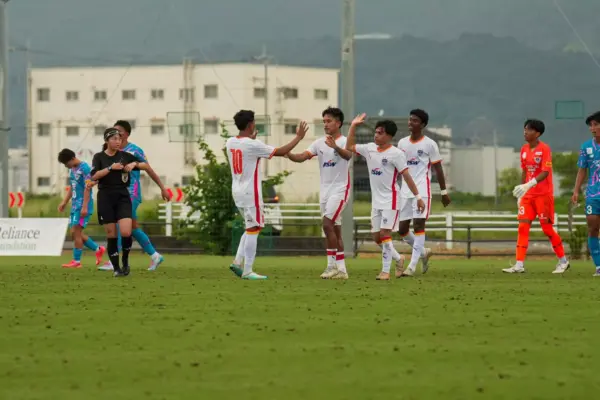
Guwahati, Aug 26: The Japanese players did not stop running.
Whether it was an Under-18 side protecting a narrow lead or chasing an equaliser, the intensity remained the same.
Three, four or five players would close down together, fight for the ball and keep going until the final whistle.
For the Indian coaches and young footballers who recently toured Japan, facilitated by Reliance Foundation, that was among the clearest lessons from an experience that went well beyond the scorelines.
Three Indian clubs, Bengaluru FC, FC Goa and Punjab FC, travelled to Japan with a mix of Under-20, Under-19, Under-18 and Under-17 players to play against Japanese youth sides. The results were encouraging, but the bigger gain was an opportunity to experience a football culture that has steadily built itself into one of Asia’s strongest.
“The players got to experience a completely different football environment and culture, and that was probably the biggest takeaway from the tour,” FC Goa coach Israil Gurung told The Assam Tribune.
“We have always heard about what Japan are doing and how Japanese football is developing. But now the boys have seen it and experienced it themselves. We don’t have to explain it to them anymore.”
For former India captain Renedy Singh, who serves as Bengaluru FC’s first-team assistant coach and head coach of the reserves, the value of the tour lay in testing Indian players against a higher benchmark.
“If you look at our previous results against Japanese opposition, there have been some heavy defeats. So, to go there and compete was a big positive,” he said.
More importantly, Bengaluru did not abandon their football against the Japanese sides.
“The result is important, but the way you play is equally important. We didn’t just defend deep for 90 minutes and rely on counter-attacks. We tried to control the game. That is a very positive step,” Renedy said.
Punjab FC were equally impressive going forward. Singamayum Shami scored four goals in three matches and saw the tour as an important test.
“It was a very good tour for young players like us. Playing against good Japanese teams was a great experience because Japan is one of the best footballing countries in Asia,” Shami said.
He was particularly impressed by the technical quality of the Japanese players.
“The Japanese players are very good technically, and I noticed that they have very strong basic skills. Whether you look at their youth players or the senior national team, the basics are very good,” he said.
Yet Shami did not believe Indian youngsters were far behind.
For Gurung, however, the most striking difference was not simply technical ability. It was the structure supporting the players.
“It doesn’t matter which club a player comes from. The technical foundation is largely the same,” said Gurung, the head coach of FC Goa Development.
“In India, we often look at the first team first. Then we look at the second team, youth teams and, finally, grassroots development. In Japan, it is almost the opposite. They build from the bottom and then move upwards.”
That approach, he believes, can make clubs more sustainable by developing their own players instead of repeatedly relying on ready-made signings.
Then came another lesson: discipline. “The level of discipline among the players really impressed me. When they go for a training session, the players themselves know what they are supposed to do,” Gurung said.
Renedy reduced his own lessons to two words: technique and intensity. “We can talk about strength and speed, but those two things have to come later. First, we need to develop technically good players who can play with intensity for 90 minutes,” he said.
He also saw a deeper cultural quality in Japanese football.
“The culture they have developed is about fighting for 90 minutes,” said Renedy who represented India in 78 matches. “There is a tremendous amount of patience and discipline in their culture. You see the same mentality in their football.”
For the Reliance Foundation, the choice of Japan was deliberate. The organisation has previously sent teams to the United Kingdom and organized matches against the Premier League as well as South African sides.