The exclusion of five Indian tennis players from the country’s Asian Games squad has sparked a debate over how athletes should be selected for major multi-sport events, with the Sports Authority of India (SAI) defending the decision and two-time Asian Games gold medallist Rohan Bopanna questioning the process.
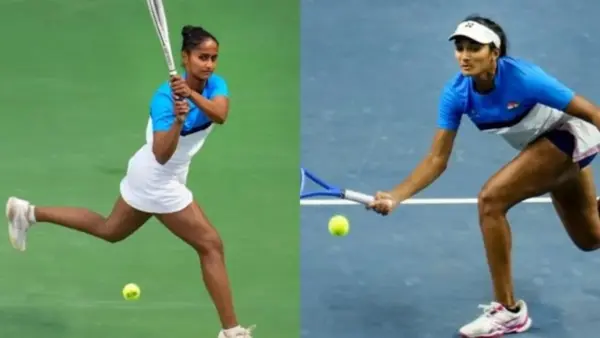
Manas Dhamne, Vaishnavi Adkar, Sahaja Yamalapalli, Vaidehee Chaudhari and Prarthana Thombare were not included in India’s seven-member tennis contingent for the 2026 Asian Games in Aichi-Nagoya. While their omission initially drew criticism, an SAI source told PTI that the five players were not removed from the final squad by the Sports Ministry because their names were never included in the shortlist submitted by the All India Tennis Association (AITA) to the Indian Olympic Association (IOA).
The dispute has since widened into a debate over the criteria being used to determine who should represent India at the continental Games.
What is the controversy over India’s Asian Games tennis squad?
The immediate issue is the omission of five players who have established themselves at different levels of international and domestic tennis.
Sahaja, currently ranked 344th in the world, is India’s highest-ranked women’s singles player, while Vaishnavi, ranked 388th, is the country’s second-highest-ranked player in the category. Dhamne, who is only 18, has already reached a Challenger-level final.
Vaidehee is a two-time national champion, while Prarthana brings Asian Games experience, having won a bronze medal at the 2014 edition.
Their exclusion therefore came as a surprise to some sections of Indian tennis, particularly because the final squad contains only one singles player.
However, a SAI source has stressed that the Sports Ministry did not arbitrarily remove the five players from the selection list.
“Their names were not received by Sports Ministry in the final list shared by the IOA. In fact, their names were not there in the shortlist sent by the All India Tennis Association (AITA) to the IOA,” the source told PTI.
That puts the focus of the selection controversy on the recommendation process itself, rather than solely on the Sports Ministry’s final decision.
What are the Asian Games selection criteria?
The Sports Ministry introduced its selection criteria in September 2025, setting specific ranking benchmarks for individual sports.
For tennis, players were required to be among the top six in Asia for singles events and inside the top eight in Asia for doubles, with rankings assessed over a 12-month evaluation period.
The government has maintained that the criteria are intended to ensure that India sends athletes with a realistic prospect of competing effectively at the Asian Games rather than using the event primarily as an opportunity for exposure.
The Ministry reiterated on Monday that it would not relax the criteria despite criticism of the tennis selections.
The policy has consequently left little room for discretionary selections outside the prescribed ranking brackets.
Why has Rohan Bopanna criticised the decision?
Bopanna, a two-time Asian Games gold medallist, has argued that the selection process should not prevent promising players from gaining experience at a major continental event.
He was particularly critical of the idea of determining an athlete’s prospects solely through a committee-based assessment.
“A committee that never stood where they stood has decided their fate on paper, before a ball is struck,” Bopanna said.
The former India player also questioned the broader philosophy behind the selection policy.
“You don’t build a sporting nation, or a sporting economy, by deciding in a boardroom who’s allowed to compete,” he said.
His comments reflect the argument that major events such as the Asian Games can play an important role in developing athletes who may not yet have the rankings to challenge the continent’s established stars.
Why does SAI believe the players should not be included?
The SAI position is that the Asian Games should not be treated as an exposure tournament.
The source argued that athletes outside the prescribed ranking range have other avenues through which they can gain international experience and improve their standings.
“Exposure trips belong on the ITF and Challenger circuits, not at the Asian Games,” the source said.
The source also suggested that making exceptions for players ranked outside the required range could undermine the consistency of the selection policy and create difficulties across other sports.
“Creating discretionary back-channel clearances for tennis players ranked 25th to 40th in Asia would destroy administrative integrity and trigger widespread litigation from other National Sports Federations,” the source said.
The argument, therefore, is not simply about the prospects of the five excluded players but about whether the government should make exceptions once objective selection criteria have been established.
What about the proposed women’s doubles pairing?
The selection debate has also raised questions over the proposed combination of Prarthana and Vaidehee.
Although the two players were potential partners for the women’s doubles event, they have never played together competitively.
The SAI source cited that lack of experience as another reason to question whether the pair would represent a competitive combination at the Asian Games.
“(It) raises legitimate questions about their preparedness and intent to build a competitive partnership ahead of the Asian Games,” the source said.
That argument contrasts with the view that giving the pair an opportunity to compete together could itself have helped establish a new Indian doubles partnership.
How difficult is the Asian tennis ranking cut-off?
The ranking threshold is particularly demanding in women’s singles, where Asia has several players firmly established among the world’s elite.
Kazakhstan’s Elena Rybakina is currently Asia’s top-ranked player and No. 2 in the world, while Japan’s Naomi Osaka is second in the continental rankings and 13th globally.
All six of Asia’s highest-ranked women’s singles players are currently inside the world’s top 100.
Against that backdrop, breaking into Asia’s top six is considerably more difficult than simply being India’s highest-ranked player. Sahaja’s position at No. 344 in the world makes her India’s leading women’s singles player, but it does not put her close to the continental benchmark set by the Ministry.
Who is in India’s Asian Games tennis squad?
India’s final tennis contingent consists of seven players, with Sumit Nagal the country’s sole representative in men’s singles.
Ramkumar Ramanathan, Saketh Myneni and Yuki Bhambri will feature in the doubles events, while Rutuja Bhosale and Ankita Raina make up the women’s contingent.
The absence of a women’s singles player is likely to remain one of the most striking aspects of India’s tennis selection.
What does the selection row mean for Indian tennis?
The disagreement ultimately exposes two competing approaches to athlete selection.
Bopanna’s argument is centred on opportunity: young or lower-ranked players can benefit from competing against stronger opposition at major events, and excluding them could deny them valuable experience at a crucial stage of their development.
The Sports Ministry and SAI, on the other hand, are emphasising performance and competitive prospects. Their position is that the Asian Games should be reserved for athletes who meet clearly defined standards, while developmental opportunities should be pursued through the ITF and Challenger circuits.
The debate also comes as Indian tennis receives significant financial support. The sport has been allocated Rs 10.05 crore under the 2026-27 Annual Competition and Training Calendar, with more than Rs 2 crore earmarked for overseas training and competition.
For now, the government has shown no inclination to make an exception for the five excluded players. The controversy has consequently become a larger question about Indian sport: whether selection for major Games should be governed strictly by measurable performance criteria, or whether federations should retain enough discretion to invest in athletes who could become future international contenders.