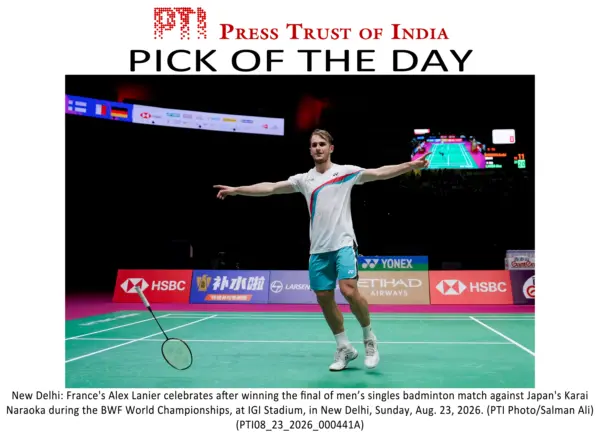
Men’s singles has entered an unusually open phase, with a deepening pool of contenders making sustained dominance increasingly difficult to imagine, according to several leading players, including new World Badminton champion Alex Lanier of France and world No. 7 Victor Lai.
The evidence is not just in the names at the top of the rankings but in the uncertainty surrounding almost every major tournament. The gap between the established elite and the chasing pack has narrowed considerably, while the physical demands of the modern men’s game have made consistency across an entire season increasingly difficult.
“It’s a tough question, but I definitely feel that this is a different period,” said Lanier when asked whether it is possible to achieve the kind of domination that the old guards such as Lee Chong Wei, Lin Dan or Viktor Axelsen once achieved.
“There are more tournaments nowadays, and there are also more good players. We can lose from the first round, and the intensity in the opening round is already very high.”
At the World Championships here, that depth has been particularly evident, with India’s Ayush Shetty, ranked world No. 22, stunning defending champion and world No. 1 Shi in the opening round or Denmark’s World No 26 Rasmus Gemke beating All England champion Lin Chun-Yi and Indonesia’s World No 3 Jonatan Christie.
Lanier, who became the first Frenchman to win the men’s singles title at the World Championships, said the depth of the field had made it much harder to string together victories week after week.
“It is becoming increasingly difficult in men’s singles to win one tournament and then win another one the following week. There are more good players, and winning is very tough,” he said.
“I cannot say that there will never be dominance again, but for me it is probably more difficult to achieve that kind of dominance now. There is still space for it, though.”
That view was echoed by another member of the younger generation, Victor Lai, who said the competitive gap had virtually disappeared beyond the very top.
“Anyone in the top 30 can beat anyone. I’ve been saying that since I first made it to the top 30. There are no easy matches, and as you saw yesterday, Gemke made it to the quarters, and his ranking is 20-something, so it just proves that anyone in top 30 can beat anyone. It’s just how you perform on the day,” said Lai, who claimed his second successive World Championships bronze.
Lai, who broke into top 20 in January and rose to World No 7, said the absence of a single defining figure had become one of the defining features of the current men’s singles landscape.
“Most people agree that there’s no dominant force in men’s singles right now. It’s a lot of different players, and anyone can win on any given day. There’s no dominant force like Lin Dan, Lee Chong Wei back in the day, so it’s really nice that we’re all competing for the top spot,” he said.
Asked whether one of the current generation could establish that kind of dominance over the next five years, he was skeptical.
“Honestly, I don’t think it’s possible for one person to be so dominant. We have so many young guys like Alex and I, and Ayush from India, Alwi from Indonesia — these are just a few, and there’s a lot of guys coming up now who maybe we haven’t heard of yet, but we will hear soon. I doubt there’s going to be one dominant force in the future.”
The change is not simply about talent. Improved physical preparation, sports science and professional support structures have helped players from outside badminton’s traditional Asian powerhouses close the gap.
“France is one of the countries that takes advantage of that — they have great strength trainers, great physios, and they’re doing a great job. Alex physically is a beast, so they’re doing something right,” Lai said.
Denmark’s Anders Antonsen, one of the more experienced voices in the field, summed up the current landscape succinctly.
“There is strong competition at the moment. There are a lot of very strong players from a lot of different nations, so interesting times for men’s singles,” he said.
But the price of that competitiveness is a men’s singles game that has become increasingly unforgiving physically.
Vittinghus, a former world top 10 player, said the modern game was considerably more demanding than it was even a decade ago.
“It gets more and more physical all the time. I think it’s good for the players that it will soon be to 15 only, instead of 21 — then we will see the same length of matches as we did maybe 10, 15 years ago, and that was already very physical in my eyes,” said the 40-year-old, who took over full-time coaching duties in June 2025.
Vittinghus believes the physical evolution of the sport is closely linked to the depth of the current field.
“It’s getting more and more physical because the players are getting more and more complete,” he said.
“Everyone has world-class defence today. It wasn’t like that at the start of my career — you would see players being more offense-minded or defence-minded. In men’s singles today, if you want to reach top 20, even top 30, you have to have basically the full package.”