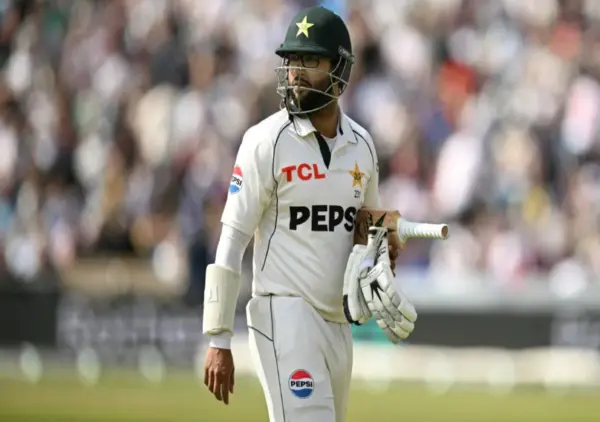
Leeds:Pakistan‘s long wait for a 50-run opening partnership in Test cricket on English soil has stretched to 27 innings, with the unwanted record continuing during the first Test against England at Headingley.
Pakistan’s second innings got off to another disastrous start on Friday when Jofra Archer dismissed Imam-ul-Haq for a duck in the second over. The early wicket meant Pakistan’s wait for an opening stand of at least 50 runs in England continued, with the last such partnership coming 16 years ago in 2010.
The record has become an increasingly notable statistic in Pakistan’s Test history in England. Despite several batting generations passing through the team since 2010, Pakistan have been unable to produce another half-century opening partnership in an away Test in England.
Last 50-run opening stand came in 2010
Pakistan’s last opening partnership of 50 or more in a Test in England came at Headingley in 2010.
Salman Butt and Imran Farhat added 56 runs for the first wicket against Australia during that match. Since then, Pakistan have gone through 27 innings without their opening pair putting together another half-century stand on English soil.
The longevity of the drought is particularly striking because Pakistan have continued to produce talented opening batters during the period.
However, consistency at the top of the order has remained a recurring issue whenever Pakistan have toured England.
The Headingley Test once again exposed that weakness.
Archer strikes early for England
Pakistan entered their second innings already facing a substantial deficit.
England had built a first-innings lead of 238 runs, leaving Pakistan with the difficult task of batting for a long period simply to make the hosts bat again.
Instead, their innings began with another early collapse.
Imam-ul-Haq, who had scored 42 in Pakistan’s first innings, attempted to evade a short delivery from Archer. The ball caught the edge of his glove and carried through to England wicketkeeper Jamie Smith.
Imam was dismissed without scoring.
The dismissal meant Pakistan were once again 0-1 at the beginning of their innings, and it immediately extended the team’s unwanted opening partnership record.
Azan Awais falls soon after
Archer then struck again to leave Pakistan in even greater trouble.
Azan Awais, who had been dismissed for a golden duck in the first innings, made nine before clipping a delivery from Archer towards the leg side.
The ball went directly to England captain Joe Root, positioned at leg slip.
The tactical placement proved effective.
Pakistan were reduced to 13/2, with Archer responsible for both early wickets.
It was another difficult start for a Pakistan side already under enormous pressure after England had dominated the first innings.
Abdullah Shafique provides brief resistance
Abdullah Shafique had been one of Pakistan’s few bright spots in the first innings.
The opener scored 61 runs in Pakistan’s total of 171, providing some resistance against England’s bowling attack.
However, he could not repeat that performance in the second innings.
Shafique made 15 before edging a full-length delivery from Ollie Robinson.
The edge travelled towards second slip, where Harry Brook completed the catch.
Pakistan were subsequently left in deeper trouble as England’s bowlers continued to exploit the conditions.
Pakistan 59/3 at lunch
At lunch on the third day, Pakistan were 59/3.
They still needed another 179 runs simply to make England bat again, illustrating the extent of the first-innings deficit.
Shan Masood was unbeaten on 28, while Saud Shakeel was not out on five.
Pakistan therefore needed a substantial partnership after lunch to prevent England from completing a comprehensive victory.
However, the opening partnership drought had already been extended.
England dominate the first Test
The opening partnership statistic is only one part of Pakistan’s wider struggle at Headingley.
England dominated the Test from the opening stages and were on course for a commanding victory by the third day.
Pakistan’s first-innings total of 171 left England with a significant advantage, while the hosts’ bowlers maintained pressure throughout the second innings.
The match also marked the beginning of Joe Root’s second stint as England’s full-time Test captain.
The Yorkshire batter was able to make an immediate impact tactically, with his positioning of Root at leg slip contributing to Awais’ dismissal.
Jofra Archer leads England’s attack
Archer emerged as one of England’s most important weapons during the Test.
His pace and ability to generate bounce made life particularly difficult for Pakistan’s batters.
By lunch on the third day, Archer had figures of 2/27 from five overs in the second innings.
His dismissal of both Pakistan openers meant the visitors were unable to establish any kind of foundation.
Archer had also contributed with the bat earlier in the day, scoring a quickfire 23 not out before returning to his main role with the ball.
A long-standing problem for Pakistan
A strong opening partnership is not essential for winning a Test match, but it can provide the platform required to absorb pressure from the opposition’s new-ball attack.
Pakistan’s inability to record a 50-run opening stand in England for 16 years indicates a persistent issue.
Opening batters face some of the most demanding conditions in Test cricket, particularly in England, where the new ball can move through the air and off the surface.
Surviving the first hour can often be crucial.
Pakistan have repeatedly struggled to do so on English soil.
The 27-innings statistic shows that the problem has extended across multiple tours and combinations at the top of the order.
The importance of a stable opening pair
Opening partnerships serve several purposes in Test cricket.
They allow batters to assess the conditions before the ball becomes older and help reduce the pressure on the middle order.
A successful opening pair can also force opposition captains to change their bowling plans and provide the rest of the batting line-up with a more settled platform.
Pakistan’s recent struggles in England have often meant that the middle order enters the contest much earlier than planned.
The Headingley Test followed a similar pattern.
The visitors lost their first wicket almost immediately in both innings, giving England’s bowlers the ideal start.
2010 remains the benchmark
The fact that Pakistan’s last half-century opening partnership in England came in 2010 makes the record even more remarkable.
Butt and Farhat’s 56-run stand at Headingley remains the last time Pakistan’s openers reached that benchmark in a Test in England.
Since then, Pakistan have had several prominent opening batters, but none have been able to produce another 50-plus stand in 27 innings on English soil.
The record therefore represents more than an isolated statistic from one match.
It reflects a recurring difficulty that Pakistan have faced during overseas Test tours.
England eye comprehensive victory
With Pakistan already 238 runs behind after the first innings, England entered the third day in a commanding position.
The early wickets only strengthened the hosts’ grip on the contest.
England needed to take seven more wickets after lunch while Pakistan needed to find a way to erase the deficit and set up a competitive fourth innings.
The balance of the match was heavily in England’s favour.
The hosts were also targeting what would be only their third win in 11 Tests, according to the report, adding further significance to the result for Root’s new captaincy era.
Root’s tactical move pays off
One of the more interesting moments of the morning came when Root positioned himself at leg slip.
Awais clipped Archer towards that area, and Root completed the catch.
It was a tactical decision that immediately produced a result.
Such field placements can be particularly effective against batters looking to counter short deliveries or guide the ball into the leg side.
Root’s move demonstrated the importance of proactive captaincy, particularly when an opposition batting line-up is already under pressure.
Pakistan’s batting challenge remains
The immediate focus for Pakistan was to survive the remainder of the third day and avoid an innings defeat.
Masood’s unbeaten 28 provided some hope, while Saud Shakeel had also survived until lunch.
But the team needed a much larger partnership to change the direction of the match.
The openers had failed once again, leaving the middle order with the responsibility of rescuing the innings.
That pattern has repeatedly hurt Pakistan in overseas Tests.
Conclusion
Pakistan’s unwanted record has continued at Headingley, with the team’s wait for a 50-run opening partnership in Test cricket in England reaching 27 innings. The last such stand came in 2010, when Salman Butt and Imran Farhat added 56 against Australia at the same venue.
The drought extended after Imam-ul-Haq was dismissed for a duck by Jofra Archer early in Pakistan’s second innings. Azan Awais soon followed, leaving Pakistan 13/2 before Abdullah Shafique was dismissed for 15.
Pakistan reached 59/3 at lunch, still 179 runs short of making England bat again after conceding a 238-run first-innings lead.
For Pakistan, the statistic highlights a persistent weakness at the top of the order in English conditions. For England, the early wickets further strengthened their control of the Headingley Test and gave Joe Root’s return to full-time Test captaincy an emphatic start.