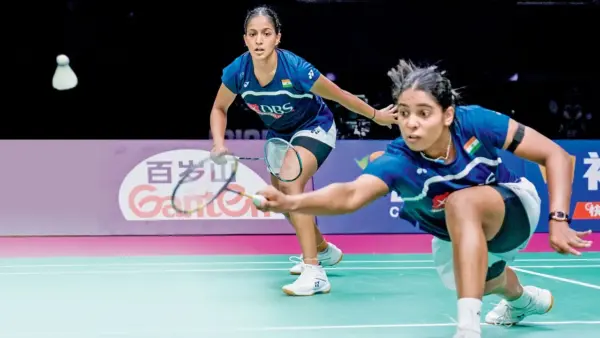
Treesa Jolly and Gayatri Gopichand secured a historic spot in the semi-finals by defeating China’s Jia Yifan and Zhang Shuxian 16-21, 21-15, 21-13. With this victory, they set up a semi-final clash against the World No. 1 pair, Liu Sheng Shu and Tan Ning.
Doubles delight and despair
This ends India’s 15-year wait for a medal in the women’s doubles event. India last won a World Championship medal in this category back in 2011, when Jwala Gutta and Ashwini Ponnappa claimed bronze in London. Meanwhile, in men’s doubles, Satwiksairaj Rankireddy and Chirag Shetty bowed out after losing to China’s third-ranked pair, Liang Wei Keng and Wang Chang.
Satwiksairaj Rankireddy (left) and Chirag Shetty compete in the men’s doubles quarter-final on Friday
Fuelled by the home crowd, endured a slow start, falling 0-6 behind in the opening game as drift issues hampered their movement and the Chinese pair proved tough to break down. Although they recovered slightly, the Indians dropped the first game. A tactical shift in the second game saw the Indian duo race to a 5-1 lead, later extending it to 10-7, capitalised by a few unforced errors from the Chinese team. Jia and Zhang managed to save two match points in the decider, but a wide shot from the Chinese pair eventually sealed the win for India.
It was an emotional victory for the pair, who immediately rushed to chief coach Pullela Gopichand for a warm hug.
Speaking after the match, said: “We were trying our best, but after the first game, we changed our tactics. It was a bit tricky in the beginning, but I think we managed it well.”
When asked about the specific strategy, she added, “We don’t want to reveal too much. I think we were just rotating better and focused on getting our legs moving. Remaining calm on court was the most important thing.”
On coach Gopichand’s advice, Jolly shared: “He told us to calm down and stay in the present moment. That really worked for us today.”
Role reversal pays off
Doubles coach Sumeeth Reddy highlighted the pair’s tactical evolution: “Over the last 30 to 40 days, their rotation has improved significantly. Gayatri and Treesa executed it well and shared the load equally. There is a noticeable difference in their net game. Conventionally, Gayatri plays at the net while Treesa takes the rear, but this tournament saw them reverse roles — and it worked.”
In men’s doubles, India’s other top medal contenders, Rankireddy and Shetty, were outplayed 21-18, 21-9 by their third-ranked Chinese opponents. Reflecting on the defeat, Shetty said: “After winning the first game, they came back harder. We played decent badminton — I wouldn’t say we played poorly — but a lot of points we expected to finish just didn’t go our way.”