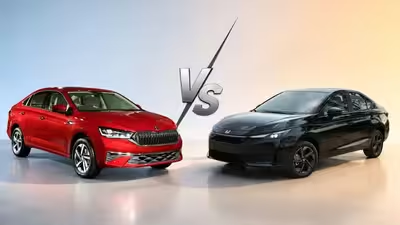
The Skoda Slavia facelift has recently been unveiled in India. The updated sedan gets an 8-speed automatic unit and several new features. This addition puts it back in focus against the Honda City. For buyers looking at a petrol sedan, the two cars now differ quite a bit in their approach. The Slavia uses turbocharged petrol engines including a 1.5-litre unit, while the City gets a naturally aspirated 1.5-litre petrol engine and a strong-hybrid version. Skoda has also added features such as a 360-degree camera and massage function for the rear seats. Honda’s answer is its City e:HEV and Honda Sensing safety technology. Here’s a closer look at what separates the two.
Slavia Or City: Which Looks Bigger?
The does not get a completely new body. Skoda has worked on the details instead with changes to the front and rear styling, lighting and wheels. It measures 4,541mm in length, 1,752mm in width and 1,507mm in height. Its 2,651mm wheelbase is worth noting because it is longer than the City’s 2,600mm wheelbase. The Slavia also has a 521-litre boot.
The Honda City is 4,583mm long. This means it is longer overall but the shorter wheelbase means the difference is not as straightforward as the exterior dimensions suggest. The City has a 506-litre boot. Here is a table showing the complete dimension comparison.
| Dimension | Skoda Slavia Facelift | Honda City |
| Length | 4,541 mm | 4,594 mm |
| Width | 1,752 mm | 1,748 mm |
| Height | 1,507 mm | 1,489 mm |
| Wheelbase | 2,651 mm | 2,600 mm |
| Boot Space | 521 litres | 506 litre |
In simple terms, the City takes up slightly more road length, while the Slavia has the longer wheelbase and a marginally larger boot.
Slavia Gets Turbo Power, City Gets Hybrid
There is a bigger difference once you look at the engines. The Slavia continues with two TSI petrol engines. The 1.0-litre turbo-petrol makes 113 hp and 178 Nm, while the 1.5-litre TSI produces 148 hp and 250 Nm. The 1.5-litre engine is paired with a seven-speed DSG.

Skoda Slavia Facelift Rear Quarter Shot
The facelift’s big transmission change is the new 8-speed automatic for the 1.0-litre TSI. This gives buyers a different automatic option in the lower-powered engine variant.
The City uses a 1.5-litre naturally aspirated petrol engine that makes 119 hp and 145 Nm. It can be paired with a six-speed manual or CVT. There is also the City e:HEV, which uses a 1.5-litre petrol-electric hybrid setup and develops 124 hp of combined output.

Honda City Rear Profile
That makes the engine choice fairly clear. The Slavia leans towards turbocharged petrol performance whereas the gives buyers the option of going hybrid.
Features: What Do They Get?
The Slavia facelift’s equipment list has grown. The new model gets a 360-degree camera and rear-seat massage function, two additions that weren’t available on the earlier version.

Skoda Slavia Facelift Interior
The City counters with Honda Sensing. This feature suite brings a range of driver-assistance functions. Depending on the version, these include collision mitigation braking, adaptive cruise control, lane-keeping assistance as well as road departure mitigation.
Both cars offer the usual modern sedan equipment, but their feature priorities are different. Skoda has concentrated on adding more convenience and cabin equipment to the facelift, while Honda’s biggest differentiator is the availability of its hybrid powertrain and ADAS technology.

Honda City Interior
For someone choosing between them, the decision isn’t simply about which car has more features. The Slavia makes more sense for buyers interested in turbo-petrol engines and the newer cabin additions, while the City has a clear advantage for those specifically looking for a strong-hybrid option and Honda’s driver-assistance technology.