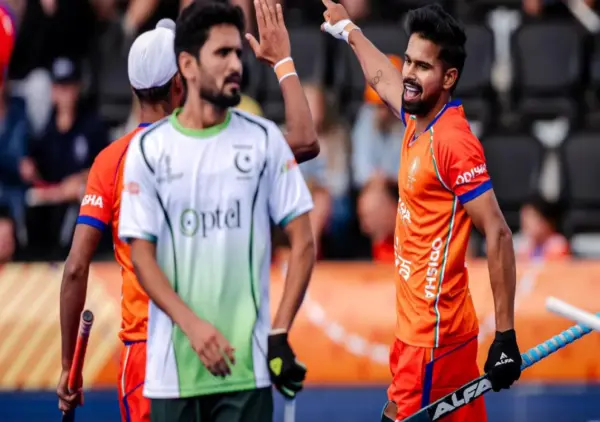
Amstelveen: The India-Pakistan rivalry produced another memorable chapter at the FIH Men’s Hockey World Cup, but the most talked-about moment came after the intense contest had ended.
India defeated Pakistan 5-3 in their final Pool D match at the Wagener Stadium in Amstelveen, Netherlands, but the result was accompanied by a notable display of sportsmanship.
The two teams skipped the customary pre-match handshake and instead exchanged quick high-fives after their national anthems. However, once the match ended, players from both sides shook hands, offering a different picture from the tense scenes that have surrounded several recent India-Pakistan sporting encounters.
The result extended India’s decade-long unbeaten run against Pakistan in men’s hockey and brought Pakistan’s campaign at the tournament to an end.
Players exchange high-fives before the match
After the national anthems were played, the Indian and Pakistani players lined up before the start of the match.
Rather than exchanging the traditional handshake, the players acknowledged each other with quick high-fives before taking their positions.
The gesture attracted considerable attention because of the broader political backdrop surrounding India-Pakistan sporting events.
In recent months, cricket encounters between the two countries have been accompanied by the absence of customary handshakes. Hockey, however, has so far maintained a different approach.
The high-fives in Amstelveen offered both sets of players a way to acknowledge their opponents while avoiding the traditional pre-match handshake.
Handshakes return after full-time
The difference between the start and end of the match was striking.
After India completed their 5-3 victory, the players did exchange handshakes.
The teams had avoided the customary gesture before the first whistle, but once the contest was over, they acknowledged each other’s efforts.
The post-match interaction was widely viewed as a positive sporting moment because it separated the rivalry on the field from the respect shown between the athletes.
For 60 minutes, India and Pakistan competed in a high-pressure World Cup fixture. Once the final whistle was blown, the players were able to recognise the effort of their opponents.
India make a flying start
On the field, India quickly established control.
Captain Harmanpreet Singh opened the scoring in the fifth minute, converting a penalty corner to put India 1-0 ahead.
The early goal gave India confidence and put Pakistan under immediate pressure.
Six minutes later, Abhishek doubled India’s advantage with a field goal.
India’s attacking movement continued to trouble Pakistan, while their penalty-corner opportunities gave them another major weapon.
Harmanpreet struck again in the 21st minute, once more finding the target from a penalty corner.
The Indian captain’s second goal made it 3-0 and placed Pakistan in a difficult position.
Abhishek extends India’s lead
India’s attacking momentum continued.
Abhishek scored his second goal in the 24th minute, giving India a commanding 4-0 lead.
His brace was particularly important because it allowed India to build a significant advantage before Pakistan could settle into the contest.
The four-goal lead appeared to have put India firmly in control, but Pakistan responded with a spirited fightback.
Pakistan refuse to give up
Despite conceding four goals, Pakistan did not allow the match to become a one-sided affair.
Hannan Shahid scored Pakistan’s first goal in the 22nd minute, giving his team some hope.
The comeback gained further momentum when Sufyan Khan converted a penalty corner in the 24th minute.
The two quick goals changed the atmosphere of the contest.
Pakistan had gone from being four goals behind to creating genuine pressure on India, forcing the Indian team to remain disciplined during the remainder of the match.
Hardik Singh gives India breathing room
India responded with another crucial goal through Hardik Singh.
He converted a penalty stroke in the 34th minute to restore India’s three-goal advantage.
The goal proved important as Pakistan continued to search for another route back into the contest.
India were unable to completely shut Pakistan out, however.
Hannan Shahid scored his second goal in the 46th minute, reducing the deficit to 5-3 and giving Pakistan a final opportunity to mount an unlikely comeback.
India held firm during the closing stages and prevented Pakistan from scoring again.
Harmanpreet and Abhishek lead India
The victory was built around the performances of Harmanpreet and Abhishek.
Harmanpreet scored twice from penalty corners, demonstrating once again the importance of India’s set-piece game.
The captain’s ability to convert penalty corners provided India with a major advantage against Pakistan.
Abhishek’s two field goals were equally significant.
His movement and finishing helped India establish the commanding lead that ultimately proved decisive.
Hardik Singh’s penalty stroke completed India’s scoring.
For Pakistan, Hannan Shahid scored twice, while Sufyan Khan added one goal.
Pakistan’s campaign comes to an end
The defeat ended Pakistan’s campaign at the World Cup.
The team had returned to the tournament after an eight-year absence and had entered the India match hoping to produce a major upset.
Instead, India once again came out on top.
Pakistan’s second-half response nevertheless demonstrated considerable fighting spirit.
The team continued to attack after falling four goals behind and managed to score three times against India.
However, the early deficit proved too large to overcome.
India’s decade-long unbeaten run continues
The victory also extended India’s unbeaten run against Pakistan in men’s hockey to a decade.
The rivalry remains one of the most closely followed contests in international hockey, with matches between the two teams attracting significant attention regardless of tournament standings.
For India, the latest victory provided another important result against their traditional rivals.
For Pakistan, it was another disappointing chapter in a rivalry in which they have struggled to defeat India in recent years.
Hockey and cricket take different approaches
The scenes in Amstelveen also highlighted the different approaches taken by hockey and cricket in India-Pakistan sporting encounters.
Following Operation Sindoor, India and Pakistan’s cricket teams have refrained from shaking hands during their recent meetings.
Hockey has not adopted the same pattern.
The two sides had also exchanged handshakes after their meeting at the Sultan of Johor Cup last year, indicating that sporting interactions in hockey have continued to follow a different path.
The Amstelveen match reinforced that distinction.
The players did not shake hands before the match, but they did so afterwards.
A rivalry that still commands attention
India-Pakistan matches carry an emotional weight that extends beyond sport.
The political relationship between the two nations frequently becomes part of the conversation surrounding their sporting contests.
That can sometimes overshadow the athletes and their performances.
The hockey encounter in Amstelveen offered a different narrative.
The match remained fiercely competitive, with both sides determined to win, but the players were also able to acknowledge each other after the contest.
The high-fives before the match and handshakes afterwards provided a sporting contrast to the wider tensions surrounding the rivalry.
India will need to improve defensively
While the result was highly encouraging for India, conceding three goals will provide the team with something to address.
India’s four-goal advantage demonstrated their attacking strength, but Pakistan’s response showed that the Indian defence can come under pressure when opponents are given opportunities.
At the World Cup level, such lapses can prove costly against stronger sides.
India will therefore need to maintain their attacking efficiency while improving defensive concentration as they progress through the tournament.
A memorable World Cup encounter
The 5-3 scoreline ensured that the contest remained competitive despite India’s dominant start.
Pakistan’s comeback prevented the match from becoming a routine victory for India, while the Indian team demonstrated enough composure to withstand the late pressure.
The packed Wagener Stadium provided an appropriate setting for one of the tournament’s most anticipated fixtures.
For Pakistan, the result ended their World Cup campaign. For India, it provided a valuable win and continued their dominance over their traditional rivals.
Conclusion
India’s 5-3 victory over Pakistan at the FIH Men’s Hockey World Cup was significant both on and off the pitch.
Harmanpreet Singh scored twice from penalty corners, Abhishek added two field goals and Hardik Singh converted a penalty stroke as India extended their decade-long unbeaten run against Pakistan.
Pakistan fought back through two goals from Hannan Shahid and one from Sufyan Khan, but India’s early advantage proved decisive.
The biggest talking point beyond the scoreline, however, was the interaction between the players. The teams skipped the traditional handshake before the match and exchanged high-fives instead. After full-time, the players shook hands.
That simple gesture offered a reminder that sporting rivalry and mutual respect can coexist. While India-Pakistan contests will inevitably carry enormous attention, the scenes in Amstelveen allowed the athletes to put the focus back where it belongs – on competition, performance and sportsmanship.