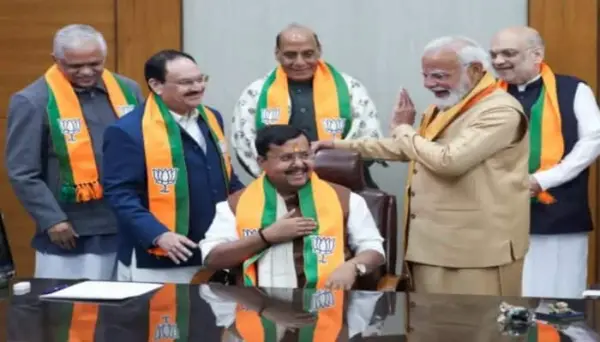
New Delhi: With the Uttar Pradesh Assembly election around six months away, the newly constituted national team of the Bharatiya Janata Party (BJP) has put its choices from the state under the spotlight.
The line-up brings together leaders from different regions and social groups. It also offers clues about the partys strategy ahead of the 2027 contest.
The stakes are unusually high. Uttar Pradesh sends 80 MPs to the Lok Sabha, nearly 15% of the 543-member House, and the assembly verdict is also expected to influence national politics ahead of the 2029 general elections.
Among the prominent names from Uttar Pradesh in BJP President Nitin Nabins team are former Union Minister Smriti Irani, former Basti MP Harish Dwivedi, former Dhaurahra MP Rekha Verma, Rajya Sabha MPs Sangeeta Yadav and Amar Pal Maurya, Bulandshahr MP Dr Bhola Singh, former Aligarh Muslim University Vice-Chancellor Tariq Mansoor and BJP Minority Morcha President Kunwar Basit Ali.
Maharashtra leader Vinod Tawde has also been given charge of the state, while Pratapgarhs Dr Swadesh Singh has been appointed a national secretary.
The appointments include women, OBC, Dalit, Brahmin and Muslim faces, along with leaders from different parts of the state. BJP spokesperson Rakesh Tripathi rejected the idea that the national team had been put together as a response to any Opposition formula.
The BJPs national team is not formed to counter the narrative of any regional party. Uttar Pradesh is politically very important. The state has the highest number of Lok Sabha seats, so its role is naturally significant. The state has received representation in the national team in keeping with that importance, he said.
He acknowledged that the timing could energise the party ahead of the assembly poll. The election has no direct connection with this. But it certainly creates enthusiasm among BJP workers. We expect to benefit from this energy in the election, he said.
Why Dwivedis elevation stands out
Senior journalist Anand Rai sees more than individual appointments in the new line-up. He says the BJP has attempted to balance region, caste and gender while giving representation to the six organisational zones into which the state is divided Kashi, Gorakhpur, Awadh, Kanpur-Bundelkhand, Braj and West Uttar Pradesh.
Among the appointments, he places particular importance on Harish Dwivedi, a two-time MP who lost the 2024 Lok Sabha election but has now been made a national general secretary.
Harish is an organisation man. His political journey began with the Akhil Bharatiya Vidyarthi Parishad, followed by the BJP Yuva Morcha and then the national organisation. Despite losing the 2024 election, the party has given him an important responsibility. One reason could be his Brahmin background and the attempt to promote a relatively young face, Rai said.
Dwivedi said his elevation was based on organisational work rather than electoral calculations. The BJP is a cadre-based party, and whenever the party gives someone a responsibility, it is based on the workers ability and capacity. The organisation has continuously supported me. I am presently the in-charge of Assam and was also given responsibility for the local body elections in Rajasthan. The party keeps assigning responsibilities based on the work, he said.
His appointment comes as Samajwadi Party chief Akhilesh Yadav continues to push his PDA formula, which originally referred to backward and marginalised groups and has more recently included Brahmins in his political messaging.
Rai sees the BJPs new team in that context. The success the Samajwadi Party achieved through PDA in 2024 boosted the Oppositions morale. The Congress and the Samajwadi Party appear ready to contest the 2027 election together. The BJPs new team can therefore also be seen as an attempt to strengthen its social and regional balance in response to the PDA, he said.
BJPs outreach to Pasmanda Muslims
The inclusion of Tariq Mansoor and Kunwar Basit Ali also highlights the BJPs outreach to Pasmanda Muslims. Mansoor has been retained as a national vice-president. Ali has received a national-level organisational role.
Rai says the BJP hopes its welfare schemes can help it build support among Pasmanda Muslims who have benefited from government programmes.
The BJP hopes to establish a place among Pasmanda Muslims who are beneficiaries of its welfare schemes. This effort is visible at the national level. However, at the state level, the chief minister continues to emphasise Hindutva politics. So it is difficult to expect much impact from this organisational move, he said.
Iranis return to the national team
Her appointment also has its importance because of her political history in Uttar Pradesh. She defeated Rahul Gandhi in Amethi in 2019 and became one of the BJPs most prominent women leaders, before losing the seat in 2024.
Senior journalist Sharat Pradhan believes her return to the national organisation could also have implications for the Uttar Pradesh elections. Yogi is very dominant, and Smriti Irani is even more dominant. I don’t think coordination between them will be easy, he said.
He says it is still unclear whether her role will be limited to the organisation or extend into state politics.
Her appointment also comes as speculation continues over the relationship between the BJPs central leadership and the Uttar Pradesh government.
Pradhan does not dismiss Iranis political influence, but says only representation may not translate into votes. Simply showing that this person is Dalit or that person is backward will not work. What matters is how popular that person actually is within their own community, he said.
He describes some of the appointments as cosmetic rather than electorally decisive, while Rai believes the BJP has made the choices after careful consideration.