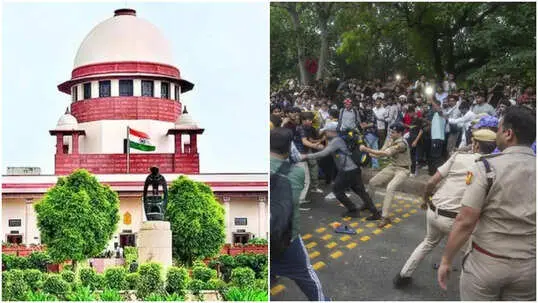
New Delhi: The Supreme Court on Tuesday said it will constitute a high-powered committee to examine the allegations of police excesses and other issues related to the students’ protest at Delhi’s last month.
The apex court will announce the composition of the panel tomorrow (August 19).
A bench headed by Chief Justice of India Surya Kant indicated that the committee is likely to comprise a former Supreme Court judge, a former Chief Justice of a High Court, and an officer who retired at the level of Director General.
“As we said we will be constituting a . Some measures of urgent interim nature,” Chief Justice of India (CJI) Surya Kant stated.
On the CJI’s statement, Solicitor General Tushar Mehta argued that complaints were filed by both parties – police and protestrers – and even questioned the decision to constitute the high-power committee.
“There are complaints on both sides. If there is dereliction of duty on the side of the police, we will deal with it in consultation with the HPC. What is the need of a interim order at this juncture ,” Mehta stated.
“Once we are setting up the HPC let us leave it to them,” the CJI replied to SG Mehta.
A bench headed by CJI Kant indicated that the committee is likely to comprise a former Supreme Court judge, a former Chief Justice of a High Court and an officer who retired at the level of Director General.
“We are constituting a committee comprising a former Supreme Court judge, a former Chief Justice of a High Court and another officer who retired at the level of Director General. We will upload the order tomorrow,” the CJI stated.
On allegations of mass surveillance using the facial recognition :system, Mehta said that it does not profile every individual and only captures those with prior criminal record. only individuals with serious criminal backgrounds. The SG further submitted that these individuals with criminal backgrounds would be probed by a special investigation team (SIT) formed by the police commissioner.
CJI On FIRs Filed
The CJI said the court could invoke its special powers under Article 142 of the Constitution to quash FIRs against innocent protesters. “We will invoke special powers to quash FIRs against innocent protesters using Article 142,” the CJI said.
The Apex Court, however, made it clear that cases involving protesters with criminal antecedents would be examined separately.
Solicitor General Mehta said FIRs against student protesters could be quashed by the Supreme Court but maintained that a different approach may be required for individuals with criminal antecedents.
The CJI directed both sides to submit complete details of the FIRs, saying the court would first separate cases involving students who had no criminal background from those involving serious criminal allegations.
“Both sides give a list of FIR. Let us identify the area where there is no controversy. But where there are criminal antecedents also, we will decide what to do,” CJI Surya Kant observed.
The Chief Justice stressed that the right to protest must be distinguished from criminal conduct, referring to the fundamental right to freedom of speech and expression under Article 19.
“We must remember Article 19, freedom of speech and expression, rightful protest. Their case can be completely distinguishable from criminal elements,” the CJI said.
Senior advocate Gopal Sankaranarayanan representing one of the petitioners, stated, “A strong message has to be sent to the policemen who committed excesses. The affidavit filed by the Delhi police is totally silent on administrative action taken against errant policemen.”
Last month, a massive protest was held at Delhi’s Jantar Mantar by the Cockroach Janata Party (CJP) over the alleged irregularities in the NEET UG paper leak. Thousands of students also participated in the protest. On July 20, clashes erupted between the protesters and the Delhi Police during the CJP’s ‘Sansad Chalo’ protest march. Protesters alleged police brutality. However, the force denied such allegations. The CJP called off the pro-resp after the resignation of the then education minister, Dharmendra Pradhan.