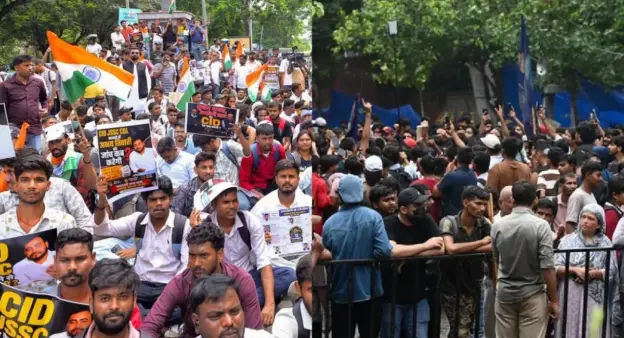
Astudent protest over alleged irregularities in JPSC and JSSC examinations has been gaining momentum in Jharkhand’s capital Ranchi, with Jaipal Singh Munda Stadium now being referred to as “Ranchi’s Jantar Mantar”.
The protest comes in the backdrop of the NEET-UG paper leak movement at Delhi’s Jantar Mantar, which drew national attention. While both protests are driven by concerns over transparency and fairness in examinations, the nature of their demands, participants, leadership and objectives differ significantly.
Here are 10 key differences between the two movements:
1. The Core Issue: Admission vs Government Jobs
The Delhi protest centred around alleged paper leaks and irregularities in the national-level medical entrance examination NEET-UG. Students demanded accountability over the examination process conducted for medical admissions.
In Ranchi, students are protesting against alleged irregularities in state-level recruitment examinations conducted by JPSC and JSSC, including allegations of cutoff errors, OMR manipulation, rigging and seat-selling.
While the Delhi movement focused on access to higher education, the Ranchi protest revolves around recruitment and government jobs.
2. Demands: Resignation vs System Reform
At Delhi’s Jantar Mantar, one of the major demands was the resignation of Education Minister Dharmendra Pradhan along with reforms in institutions like the National Testing Agency (NTA).
Ranchi protesters are demanding cancellation of the 14th JPSC examination, a CBI probe or investigation by an external judicial panel, and long-term reforms to ensure transparency in the recruitment system.
3. Age Group Of Protesters
The NEET protest in Delhi largely involved Gen-Z students, mostly between 14 and 29 years old, as NEET is generally taken after Class 12.
The Ranchi protest includes a larger number of candidates in the 25-35 age group, with some nearing 40. Many have spent years preparing for competitive examinations and are fighting against uncertainty over employment and age-limit concerns.
4. Language And Style Of Protest
The Delhi protest witnessed instances of aggressive slogans, controversial posters and heated exchanges at some locations.
The Ranchi movement has largely remained peaceful, with students carrying placards and raising slogans focused on examination reforms while avoiding personal attacks and offensive language.
Students protesting alleged irregularities in Jharkhand’s recruitment examinations on Sunday burned effigies of Chief Minister Hemant Soren, Congress leader Rahul Gandhi, and RJD leader Tejashwi Yadav, accusing them of remaining silent after previously using student issues for political gain.
5. Leadership And Organisation
The Delhi protest had a more unified structure, with organisations like CJP and figures such as Sonam Wangchuk helping maintain a collective voice.
In Ranchi, the movement has developed through multiple groups, including one led by Devendranath Mahato and another under the JPSC-JSSC Reform Forum. Different groups have raised similar but not identical demands, creating a less centralised movement.
6. National Issue vs State-Level Movement
The NEET protest became a nationwide issue and directly put pressure on the central government.
The Ranchi protest is primarily focused on the Jharkhand government, JPSC and JSSC, making it a state-level movement. Its national visibility has also been comparatively limited.
7. Social Media Presence And Protest Style
The Delhi movement gained traction through viral memes, reels, satirical posters and online campaigns.
The Ranchi protest has followed a more traditional approach, with placards, flags and issue-based slogans. The focus has remained on grievances rather than creating a social media spectacle.
8. Self-Imposed Code Of Conduct
Ranchi protesters have introduced their own code of conduct, asking participants to focus only on examination issues, avoid abusive language, refrain from political slogans and prevent the protest from becoming a platform for any party.
Such structured restrictions were less visible during the Delhi movement, where some controversial slogans and statements emerged.
9. Political Involvement
During the Delhi protest, political support and participation were more visible, with leaders from the opposition backing the movement through public speeches.
In Ranchi, students have repeatedly maintained that their protest is not linked to any political party and is aimed at demanding reforms in the recruitment process. However, some local political support has emerged.
10. The Larger Goal: Education vs Livelihood
The NEET movement was primarily about admission opportunities and fairness in higher education.
The Ranchi protest is directly linked to employment, unemployment and years of preparation invested by candidates. For many aspirants, the issue is not only about an examination but also about their future careers and livelihoods.
Senior journalist Shambhunath Choudhary said both movements reflect growing youth frustration over the examination system. However, Ranchi’s protest has developed its own identity due to its focus on employment, discipline and state-level recruitment issues.