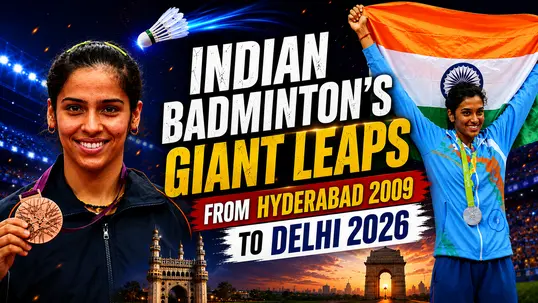
August 17, 2026, marks a special day for Indian badminton as it marks the start of the 2026 BWF World Championships, which are taking place at the Indira Gandhi Stadium in New Delhi.
India is hosting the mega event for only the second time in history after the 2009 edition, which took place in Hyderabad at the Gachibowli Stadium.
However, the India that hosted the event in 2009 and that is hosting the competition 17 years later are two different nations. At the time of hosting the mega event for the first time, India had a heritage in badminton, but the country was a no-hoper as far as medal potentials were concerned. Now, they come to a country that is fast emerging as a superpower in the sport and one where medals are an expectation and not even a hope.
Indian Badminton’s Dramatic Transformation Pre And Post 2009
When India hosted the tournament in 2009, they only had one medal to their name in the first 16 editions of the competition since the inaugural edition in 1977, which was Prakash Padukone’s bronze medal in 1983. However, this time around, they have won 15 medals, including a gold by PV Sindhu in 2019. In fact, India is currently on a streak of winning at least one World Championship medal since 2011 with some even producing multiple medals since.
In fact, at that time no Indian shuttler in history had ever stood on the podium in the Olympic Games. However, since then, there has been one Indian medalist in three of the four editions. While Saina Nehwal broke the drought in 2012, Sindhu has become the first Indian shuttler with multiple medals as well as the first female athlete in the country to stand on the podium twice in Olympic Games history.
Similarly, at the Commonwealth Games, Indian badminton has taken giant strides. The country’s transformation began in 2010 when New Delhi hosted the event. Since 1966, when badminton was first part of the games, to 2006, over 11 editions, India secured just 10 medals. Since then, in four editions, 21 Indian medalists have emerged in the quadrennial event.
Meanwhile, at the Asian Games, the country had seven medals from 1974 to 2006 in badminton. From 2010 to 2023, they have six medals, including a first-ever gold medal.
Overall across the four major competitions, India had only 17 medals before 2009. Since the Hyderabad edition, they have secured 42 medals. Across the World Championships, Olympic Games, Asian Games, and CWG, there were only two instances of an Indian shuttler winning a gold medal, while there have been 10 since.
India’s Badminton Medals In All Four Major Events Pre And Post 2009 BWF World Championships
| Tournament | Pre 2009 | Post 2009 | Total |
| Olympics | 0 | 3 (1 Silver, 2 Bronze) | 3 |
| BWF World Championships | 1 (1 Bronze) | 14 (1 Gold, 4 Silver, and 9 Bronze) | 15 |
| Commonwealth Games | 10 (2 Gold, 2 Silver, 6 Bronze) | 21 (8 Gold, 6 Silver, 7 Bronze) | 31 |
| Olympic Games | 7 (0 Gold, 0 Silver, 7 Bronze) | 6 (1 Gold, 2 Silver, 3 Bronze) | 13 |
A Factory Of Talent
The major difference comes through the fact that a constant pipeline of talents is emerging as India’s success in the sport is not a one-off anymore, like stories of Prakash Padukone and Pullela Gopichand winning the All England Championships or Syed Modi’s triumph at the CWG.
Currently, India has a factory of talent, which is visibly in the fact that 21-year-old Ayush Shetty qualified in the men’s singles over former medalists Kidambi Srikanth, HS Prannoy, who are in the reserves.
Similarly, in the women’s singles,, while PV Sindu dominated the headlines, it is 18-year-old Unnati Hooda who will be a player of keen interest. The teenager became only the third Indian to enter the top 20 of the rankings earlier this year after Sindhu and Saina.
Meanwhile, till the start of 2026, only Indian female shuttlers had won a BWF World-level title; the tally has gone up to 5 this year with 21-year-old Devika Sihag, 17-year-old Tanvi Sharma, and 26-year-old Ashmita Chaliha.
One can now say for sure that India is here to stay as a badminton superpower, and only better days lie ahead. Any success now is not a one-off but a result of a proper system built (with veterans like Gopichand and Padukone playing a key role), which will continue to produce talent.