
An Indian auto component manufacturer headquartered in Noida, Uttar Pradesh , aims to increase the contribution of its passenger vehicle business to 25% of revenue by 2030, from the current 19%, as it expands its product portfolio and strengthens its presence in the segment, Ajay Agarwal, Group CFO and President – Finance & Strategy, told CNBC-TV18.
He said growth will be driven by products such as instrument clusters, wiring harnesses, sunroofs and new electric vehicle (EV)-related offerings.
He added that the company also plans to increase the contribution of its EV business from 14% to 20-25% through new product launches and partnerships.
Despite commodity cost pressures, Minda Corporation has retained its 11-12% earnings before interest, taxes, depreciation, and amortisation (EBITDA) margin guidance and expects to continue delivering double-digit growth, citing cost pass-through arrangements with customers.
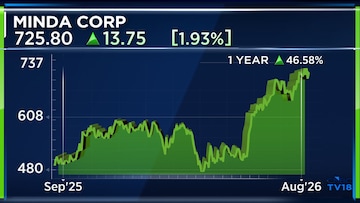
Minda Corporation shares were trading at ₹720.35 on the NSE at 3:24 pm. The company has a market capitalisation of ₹17,352.38 crore, and its shares have gained more than 46% over the past year.
This is an edited transcript of the interview.
Q: You always maintain growth of 50% above the industry average in your company, along with margins of 11% to 12% in FY27. Just wanted to understand if you could give us a sense of, after the first quarter’s performance, how do you foresee all your other segments performing—mechatronics, aftermarket, information and connected systems? At what rate do you expect these businesses to grow in the remaining three quarters?
A: We are truly delighted to see our April-June 2026 quarter performance, on the back of what we delivered in financial year 2025-26 (FY26). Speaking about the rest of the quarters and the rest of the year ahead, we believe that there is a strong momentum being built across the platform and the product portfolio we have, whether it is information connected systems, mechatronics, aftermarket, as well as the new product launches that we have slated towards the end of this fiscal year. So, we have no reason to believe that we will not outpace the industry average and deliver double-digit growth even this year.
Q: In terms of one of the margin headwinds being the rise in commodity costs. How much of that did you already absorb in the first quarter? As a result, your margin is currently at the lower end of your guided range, 11.5%. Will you be able to sustain this? Do you see further headwinds? How do you expect to close the year?
A: We suffered a margin impact due to commodity inflation to the tune of 50 bps. Also, if you look at the whole of last year, we delivered an average margin of 11.6%. Last quarter, the margin was about 11.7%. Given that for most of the commodities we have a pass-through arrangement with most of our customers, I don’t see any challenge in terms of maintaining the margin in absolute terms.
However, we may not be able to earn additional margin on commodity inflation as such. It could be a challenge in terms of passing on the cost on a quarter-on-quarter basis, but we believe that during the current fiscal year, we will be able to pass on the cost to the customer and recover it as well. So, on account of commodity inflation, we don’t believe that our margin in absolute terms should suffer.
Q: So, no impact on the margins. Guidance remains in the 11% to 12% range as well. Your view on the passenger vehicle share as well as the electric vehicle share. Passenger vehicles, obviously, have increased to around 19%-20% right now. How much higher can it go from here onwards? And what does that mean for your kit value, which is between ₹9,000 and ₹13,000? For electric vehicles, at a group level the share is about 14%. Where do you intend for that to go as well?
A: Speaking about the passenger vehicle segment first, due to the consolidation of Minda VAST, our group revenue from passenger vehicles moved from 15% to 19%. On a longer-term basis, we have guided the market that by 2030, our intention is to take the passenger vehicle business from the current 19% to 25%.
And how will it happen? We have the cluster and instrument cluster business. We have the wiring harness business, with an absolute focus on growing our passenger vehicle market share in the wiring harness business. And last but not the least, the sunroof business, which we started this fiscal year. There are also several EV-related products that we intend to launch along with our current portfolio. All of this will help us increase this revenue share from the current 19% to 25%.
Speaking about the electric vehicle contribution, today, at a group level around 14% of our revenue, including Flash Electronics, comes from electric vehicles. And the way we are seeing the market, electric vehicle adoption is taking place across India. We believe that we will play a significant role in expanding our presence in the EV market as well.
Our intent is to take this share of business from electric vehicles from the current 14% to about 20%-25%. We have already announced a joint venture with Turntide. It’s a UK-based company where we will hold a 49% stake. It will create significant value for our business as far as EV penetration is concerned.
We are also simultaneously evaluating various other joint ventures and technology licensing agreements (TLAs) to ensure that the share of business from EVs grows from the current 14% to more than 20%.