expects the June quarter to mark the low point for sales and cash generation in FY27, with production normalisation and a richer product mix driving the immediate recovery before four upcoming models become key growth engines beyond the current financial year, CFO Richard Molyneux said.
Jaguar Type 01 is expected to deliver “virtually entirely incremental growth”, while Range Rover GT will take the luxury carmaker into a new segment. Range Rover Electric and Range Rover Sport Electric complete the four-product offensive.
“Q1 is our weakest quarter, both typically in terms of sales and also particularly in terms of cash, so we expect all subsequent quarters to be an improvement on that,” Molyneux told analysts during Tata Motors Passenger Vehicles’ post-results conference call.
North America, India next
Towards the back end of the decade, North America is expected to provide another growth leg. JLR has signed a non-binding agreement with Stellantis to explore Defender products with greater relevance for the US market.
Molyneux said the four-model offensive would drive short- to medium-term growth before the North America strategy and potential Defender expansion “take us to the next level”.
India will also assume greater importance following the India-UK free trade agreement, although benefits will take time to materialise.
“India is one of the big growth markets for JLR,” Molyneux said, adding that expanding its presence “as rapidly as we can” forms part of the company’s plan.
Tough starting point
The recovery starts from a difficult base. JLR’s Q1 revenue fell 9.6 per cent to £5.97 billion from £6.60 billion, while adjusted EBIT margin contracted to 2.8 per cent from 4 per cent. Profit before tax and exceptional items plunged 68.9 per cent to £109 million from £351 million.
Variable marketing expenses, incentives used to support retail sales, jumped to 7.1 per cent from 4.1 per cent, creating a £165-million year-on-year drag on profitability. Foreign exchange and commodities were another £123-million headwind.
Free cash flow was negative £998 million against negative £758 million a year earlier.
Temporary supply disruptions compounded the pressure. A fire at a chassis-component supplier knocked out production of Range Rover and Range Rover Sport for several days, and Molyneux said JLR could not recover all the lost volumes during Q1.
A richer product mix provided some protection. Range Rover, Range Rover Sport and Defender accounted for around 81 per cent of sales, with Molyneux saying mix offset roughly half the adverse volume impact.
Despite the year-on-year deterioration, Molyneux said Q1 profit remained consistent with JLR’s full-year guidance.
Four-model growth engine
The four upcoming vehicles, however, will not materially transform FY27 wholesales. “They won’t have massive impact on FY27 wholesales,” Molyneux said, but added that the products “will be the key drivers of our growth going forward”.
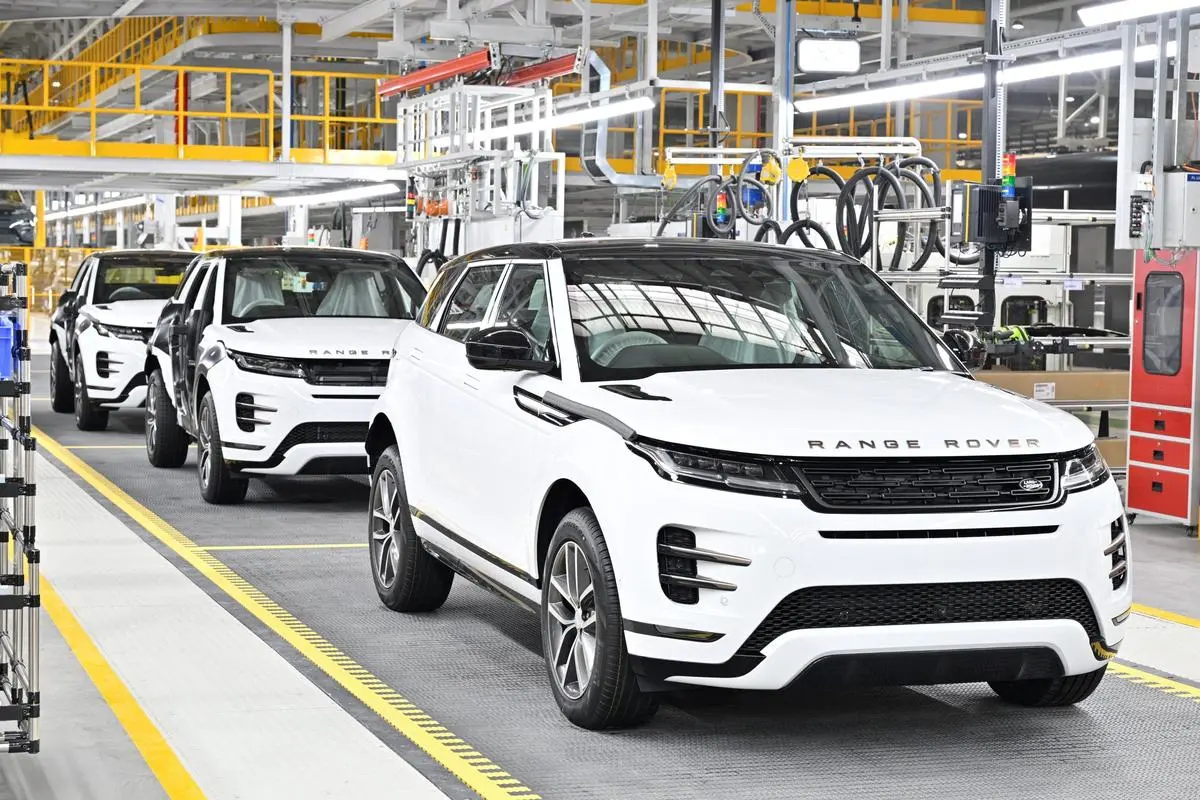
Prototype vehicles are already moving down production lines and manufacturing facilities are in place.
That leaves JLR’s FY27 recovery dependent initially on normalising production, maintaining a richer mix, controlling incentives and extracting cost savings. JLR is targeting £1.7 billion of operating-efficiency savings over two years through its Enterprise Missions programme.
Beyond the four announced launches, Molyneux indicated another two products were “in the wings”, pointing to a broader product pipeline. For FY27, the immediate task is to recover production lost to supply disruptions, contain incentives and costs and restore cash generation before the new-model cycle begins doing the heavier lifting.