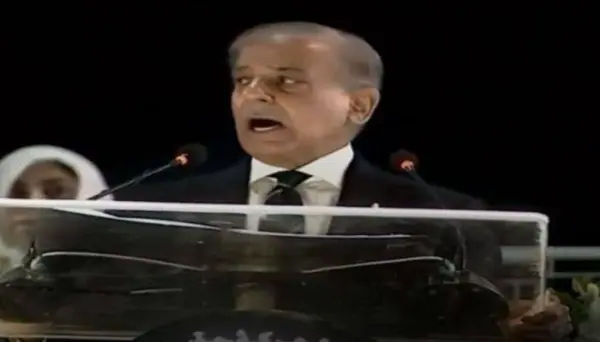
Islamabad: Pakistan Prime Minister Shehbaz Sharif warned India on the eve of Independence Day, saying Pakistan would hit back harder if its security, sovereignty or water rights were threatened.
He also said Pakistans response would be tougher than its May 2025 action against India.
He made the remarks on Thursday (August 13) night at the inauguration of the Yadgar-i-Fatah monument in Islamabad, a new memorial built to honour Pakistani soldiers and commemorate “Marka-i-Haq” (Battle for Truth).
President Asif Ali Zardari, Chief of Defence Forces and Army Chief Field Marshal Asim Munir, Air Chief Marshal Zaheer Ahmad Babar Sidhu and Naval Chief Admiral Naveed Ashraf attended the ceremony.
The event came on the eve of Pakistan’s 80th Independence Day and was built around the military’s account of the May 2025 war with India. The monument features images and displays related to that fighting, including scenes presented by Pakistan as part of its victory narrative.
What exactly did Shehbaz say about India?
He began his address by congratulating Pakistanis on Independence Day and paying tribute to those who sacrificed their lives during the country’s creation. He then turned to the military confrontation with India.
“Yadgar-i-Fatah (victory memorial) symbolises our resolve and determination and the domination of our armed forces over the enemy,” he said.
He also credited Pakistan’s military leadership for what he described as a victory in the May conflict.
“Under his leadership, we defeated the enemy,” he said while praising Field Marshal Munir. He described the monument as a tribute to soldiers who died defending the country and said the victory was a matter of pride for Pakistan.
He then issued warnings to India.
Pakistan wants peace, he said, but wanting peace should not be taken as weakness. “With dignity and determination, we are resolute for peace,” he said, adding that Pakistan has been recognised as a “guarantor of peace” in the region.
He followed that statement with a warning aimed directly at any country challenging Pakistan. “If anyone challenges Pakistans sovereignty and defence, they will receive an even stronger reply than in May 2025,” he said.
The reference was to the military confrontation between India and Pakistan that followed the April 22, 2025, terrorist attack in Pahalgam. India launched Operation Sindoor on May 7, targeting terrorist infrastructure in Pakistan and Pakistan-occupied Jammu and Kashmir. Fighting continued for several days before the two countries agreed to halt military action on May 10.
Reuters reported at the time that the ceasefire came after four days of fighting and followed intense diplomatic pressure
Indus Waters Treaty becomes another warning
Sharif also brought water in his address, directly referring to India’s decision to put the Indus Waters Treaty in abeyance.
“Every drop of water is our red line. If India does not keep on the right track, we will give it a direct response,” he said.
India announced that the 1960 treaty would be held in abeyance after the Pahalgam attack. The Ministry of External Affairs (MEA) has described the treaty as being “in abeyance” and said the decision was part of the Cabinet Committee on Security’s response to the developments following the attack.
The treaty governs the use of the Indus river system and sets out rights and obligations for both countries. Its provisions cover the waters of the Indus, Jhelum, Chenab, Ravi, Beas and Sutlej systems, along with mechanisms for dealing with differences and disputes.
Sharif’s reference to water therefore carried a direct policy message. His government is treating India’s position on the treaty as a national security issue and has repeatedly warned that Pakistan would respond if it believes its water interests are being threatened.
Pakistan’s Independence Day message
After issuing threats, he talked about peace. He said Pakistan wanted a world “free from all sorts of conflict” and called for disputes to be resolved through justice and the UN Charter.
“We want to resolve all the issues with justice and in accordance with the UN Charter,” he said.
He talked about Pakistan’s role in the Middle East and its support for Palestinians, while calling for peace in Afghanistan and describing the use of Afghan territory for cross-border terrorism as “unacceptable”.
The ceremony carried a strong military theme. A light and sound show projected images of Pakistan’s history and military operations onto the monument, including visuals from the May 2025 conflict. Pakistan Air Force fighter jets later conducted a flypast over the site. The monument has five archways representing the five pillars of Islam and what the authorities describe as five pillars of Pakistan, while its design also refers to the Army, the Air Force, the Navy, the cyber defence and the space warfare.
President Zardari also used the ceremony to speak about India’s role in the war. He said Pakistan’s armed forces had given India a “befitting answer”. We are not a small country for you to play with,” he declared.
Sharif’s address thus carried two messages on India a call for peace and a warning that Pakistan would respond militarily if it saw a threat to its sovereignty, defence or water interests. His reference to May 2025 and his “every drop of water” warning put the two issues at the heart of his message on the eve of Pakistan’s 80th Independence Day.