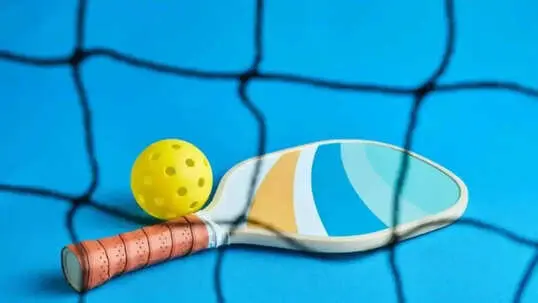
55 years ago, a table tennis paddle became an unlikely instrument of US-China diplomacy. Now, pickleball paddle is being handed a chance to do something identical.
24 American students from Iowa arrived in China this week for an eight-day cultural and sporting exchange that will take them from Beijing to Qingdao and Hebi. Their target is simple on the surface: play pickleball with Chinese students, explore the country and experience some of its most popular sports. But the symbolism runs deeper.
Organised by China’s Ministry of Education, the visit comes as pickleball continues to gain a strong foothold in China. A hybrid of tennis, badminton and table tennis, the sport has caught on with Chinese players, with its easy-to-play and social nature further fuelling its rapid growth.
One of the delegation’s most notable stops will be Hebi, a city in central Henan Province that has embraced the sport so enthusiastically that it is now known as China’s “Pickleball City.” Hebi will host the national championships for the third consecutive year in September. The city has also hosted American youngsters before, serving as one of the destinations for the 2026 US Youth Pickleball Cultural Exchange Trip in February.
Yet the significance of the trip stretches well beyond the pickleball court.
Revisiting the history
The template was established in 1971, when an American table tennis team visited China in a breakthrough moment that helped reopen people-to-people contact between the two countries. The episode became known as Ping-Pong Diplomacy. Its 55th anniversary was marked this past April, when young people from the US and China came together to commemorate the historic exchange.
Today’s pickleball initiative is considerably smaller, but it fits into a much larger effort to strengthen youth engagement between the two nations. In November 2023, China launched a programme aimed at bringing 50,000 young Americans to the country over five years for educational and cultural exchanges. According to China’s Ministry of Foreign Affairs, that target has already been reached, with two and a half years still remaining in the original timeline.
A Chinese education ministry official described the latest initiative as part of the evolution from Ping-Pong Diplomacy to pickleball exchanges, arguing that sport remains a rare space where people from both countries can meet beyond political differences.
The ambition is not to rewrite US-China relations with a pickleball paddle. It is more modest – and perhaps more meaningful: give young people a court, a common game and enough time to discover one another.