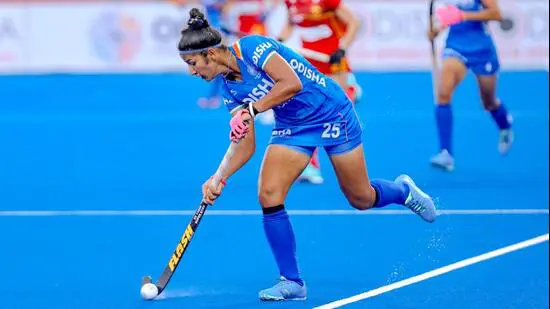
New Delhi: For the Indian women’s hockey team, the journey back to the elite has been defined by resilience, tactical evolution, and commitment to unity.
After facing a difficult two-year spell – marked by the exit from Pro League and a series of losses – the Salima Tete-led squad has staged a turnaround. Under the guidance of Dutch chief coach Sjoerd Marijne, who rejoined the fold in January, the team earned World Cup qualification – it missed the bus for Paris Olympics – and secured a return to the Pro League by winning the Nations Cup.
Forward Navneet Kaur has played a pivotal role in this revival. Not only was the 30-year-old India’s top scorer at the World Cup Qualifiers in Hyderabad with four goals, she was also named Player of the Tournament. She also scored four goals in the Nations Cup in Auckland.
“When the team falls down, everyone starts doubting why is this happening? Why are we losing every match? So, that also makes a difference on team unity,” Navneet told HT, reflecting on the psychological toll of their past slump.
Upon his return, Marijne prioritised repairing the team’s foundation before tackling tactical overhauls. “The coach also said that team unity is a must. We have to work as a team. We sit together. We talk to each other. We watch the clips of other teams as a team. Team unity has improved a lot,” said Navneet, who has played 211 internationals.
This cohesion quickly translated into results on the turf. For Navneet, while the victories validate their efforts, the process of improvement is continuous.
“So far, we have done well (this season). We have performed well in both the World Cup Qualifiers as well as the Nations Cup. But no matter how much you do, it is not enough. You always need more from your game. So, I want to perform well in the upcoming major tournaments as well,” said Navneet, who hails from Shahabad in Haryana.
A crucial element of India’s recent strategy has been resolving scoring difficulties that hampered them in previous seasons. The forward line has focused heavily on circle entries, penalty corner (PC) creation, and precise execution in the attacking third.
“First, we try to score in the circle. Second, we try to create as many PCs as possible. In the end, it doesn’t matter if we score via field goals or PC,” added Navneet.
To sharpen their finishing, the squad has introduced targeted unit training. “We also train separately as strikers and midfielders so that we can have a good connection. We are still working on our connections, who should lead at what time and where to pass,” said Navneet.
With the World Cup and Asian Games approaching, the team wants to go step-by-step. Rather than divide focus between the two major events, the immediate attention is locked on the World Cup where they will face global powerhouses as well as continental rivals China in the pool stage. India are in Pool D with England, South Africa and China.
“As a player, we won’t be able to focus on both. It’s clear to our team that we must focus on the World Cup first. Both the tournaments are important. We can’t choose just one,” said the striker.
Facing top-tier opponents requires closing the structural gap between India and the world’s best. For Navneet, bridging that comes down to individual accountability, enhanced physical conditioning, and integrating younger talent into a cohesive tactical system.
“As a player, we have to improve individually. When that happens, the team also improves. We are working on improving our fitness. If we are fit, we can run as much as we want. We can cover our mistakes,” she said.
As India prepare to take the field against the world’s best, the objective extends beyond the individual, it is about establishing a lasting standard as a team. “In the end, we have to build a winning habit. We have to build a winning system,” concluded Navneet.