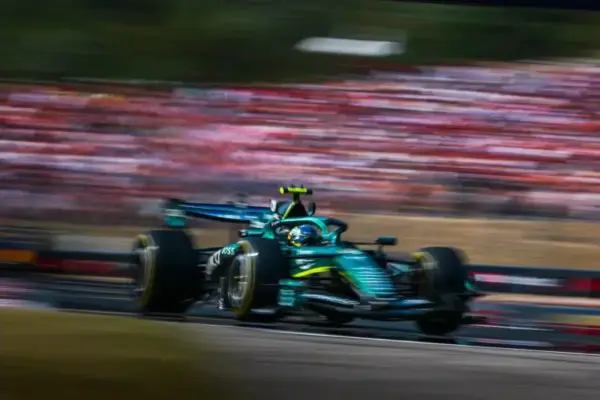
Aston Martin-Honda’s 2026 Formula 1 campaign has emerged as the season’s most glaring disappointment, with the British outfit scraping just a solitary point after 11 races despite sky-high expectations.
Once touted as a potential race-winning force following the regulation overhaul, Aston Martin’s struggles have confounded experts and fans alike, casting a shadow over the combined efforts of design guru Adrian Newey, Honda’s power unit, and two-time world champion Fernando Alonso.
The team’s lacklustre performance has been dissected by several insiders. Motorsport analyst Edd Straw bluntly described Aston Martin-Honda’s tally as “below even the lowest of realistic expectations,” highlighting the frustration of seeing such promising components failing to deliver. While upgrades introduced from Hungary onwards have shown faint promise, Aston Martin finds itself perilously close to being overtaken by Williams, a team similarly mired in difficulties this season.
Veteran engineer Gary Anderson places Aston Martin alongside Williams and Haas as “disappointments,” though he cautions that Cadillac, a new entrant, deserves more time before judgment. Anderson emphasises Aston Martin’s early-season woes, stating that despite a “glimmer of light” with Hungary’s B-spec car, the team still has “a lot more work to do” before consistently challenging for Q3 positions. Notably, Aston Martin’s fleeting advantage in Hungary was partly due to rivals Williams and Haas regressing.
From a media perspective, Valentin Khorounzhiy pointed to broader frustrations within Formula 1’s 2026 season, such as the sport’s hesitancy to incorporate more battery data in broadcasts and the opaque performance comparisons between teammates. He singled out Williams for a “catastrophic” season, lamenting the wasted potential of Carlos Sainz amid the team’s ongoing struggles. Alpine also garnered criticism for failing to maximise the Mercedes power unit advantage, settling into a “perennial midpacker” status.
Jack Benyon offered a nuanced take on George Russell’s performance, suggesting that while the Mercedes driver is not the “disappointment,” the new regulations have exposed limitations in his adaptability. Benyon recalled Russell’s impressive resilience in Formula 2 but lamented that the current F1 machinery is the “least malleable” he has encountered, hindering his championship aspirations.
Power unit innovations have also come under fire. Mathew Somerfield labelled the new hybrid engines a “subpar product” that has stifled racing quality, despite increased manufacturer involvement. He attributed Aston Martin’s woes to a “hard development pivot” mid-cycle and Honda’s scaling challenges. Williams’ difficulties were linked to missed pre-season deadlines, an overweight chassis, and a late development U-turn on car design.
Oliver Card echoed the astonishment surrounding Aston Martin’s plight, describing the team’s predicament as “devastating” given its technical pedigree and resources. Despite the bleak start, Card noted “green shoots of recovery” as the season unfolds, with hopes resting on Honda’s improved engine to spark one of the sport’s most remarkable comebacks. Currently sitting 10th out of 11 teams, Aston Martin cannot drop further, but the road ahead remains arduous.
Team principal Jon Noble reflected on the precipitous fall from grace, recalling the initial optimism when the AMR26 debuted in Barcelona. He criticised Formula 1’s leadership for dismissing technical concerns raised by fans, accusing officials of ignoring the sophisticated audience’s appetite for detailed engineering dialogue. Noble lamented the insistence that “everything has been perfect this year,” a stance he found “dismissive” of the sport’s most engaged followers.
Collectively, the verdict from experts and insiders paints a stark picture: Aston Martin-Honda’s season has been a failure of execution, development, and expectation management. Williams and Haas share the ignominy of underperformance, while power unit and regulatory issues cast a pall over the entire grid. Yet, amid the disappointment, faint signals of recovery suggest the narrative is far from over.