Ferrari’s relentless technical assault has set the tone for the 2026 Formula 1 season, unleashing a wave of innovation that has forced rivals into a reactive scramble.
As the championship reaches its mid-point, the Italian powerhouse’s pioneering aerodynamic breakthroughs have not only boosted their SF-26’s performance but reshaped the development landscape for the sport’s elite teams.
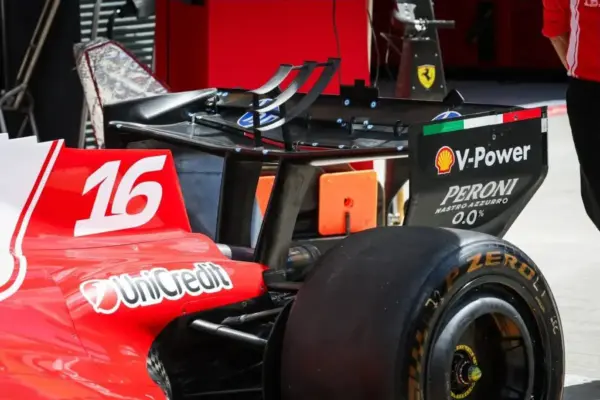
From the outset, Ferrari’s SF-26 showcased the revolutionary Flip Tail Mode (FTM), a cunning aerodynamic device that manipulates exhaust gases by partially obscuring the power unit’s outlet with a curved winglet. This clever redirection channels hot gases beneath the rear wing, generating a substantial surge in rear downforce. Unlike typical mid-season upgrades, the FTM was embedded in the car’s DNA from the very first race, underscoring Ferrari’s forward-thinking design philosophy.
Adding to their aerodynamic arsenal, Ferrari unveiled the so-called ‘Macarena’ rear wing during the second pre-season test, debuting it competitively in Miami alongside an evolved floor section. This wing has proven devastatingly effective on tracks featuring long straights paired with fast corners, allowing Ferrari to maintain high downforce levels in technical sections without sacrificing top-end speed. Attempts by Red Bull and McLaren to replicate the Macarena’s impact have highlighted the complexity and sophistication of Ferrari’s engineering triumph.
Conversely, McLaren, the reigning champions, have pursued a contrasting path defined by steady, methodical upgrades. Their Miami launch package and subsequent Canadian front wing revision laid the groundwork, but the game-changer arrived at the Hungarian Grand Prix with a radical floor redesign. The overhaul targeted McLaren’s perennial aerodynamic weakness: insufficient floor-generated downforce, exacerbated by the MCL40’s short wheelbase. This rework focused on enhancing overall aerodynamic load and optimizing its distribution for improved handling balance. Notably, McLaren’s version of the Macarena wing remains a work in progress, underscoring the engineering challenges Ferrari has already mastered.
Red Bull’s RB22, meanwhile, has undergone a profound aerodynamic transformation that marks a shift in design philosophy. The Barcelona upgrade introduced a sweeping redesign of the lower sidepods, steering Red Bull closer to McLaren’s rear-ramp concept while drawing inspiration from Ferrari’s sidepod and floor treatments ahead of the rear wheels. Complementing this was the addition of a mini-flap above the rear-wing actuator fairing, a logical evolution of earlier Monaco adjustments aimed at rectifying rear downforce deficits. Further evolution arrived in Austria with critical improvements to radiator inlet openings and internal ducting, enhancing cooling efficiency without compromising the engine’s compact packaging.
Mercedes’ W17 has seen continuous refinements, but its most significant leap came in Canada with a comprehensive floor redesign. This upgrade encompassed reshaped front bargeboard fins to better manage airflow, targeted enhancements to the floor section ahead of the front wheels, and an evolved diffuser featuring large cut-outs in the outer vertical fences to boost extraction in the rear expansion zone. These tweaks reflect Mercedes’ attempt to reclaim aerodynamic efficiency amid fierce competition.
This mid-season technical review reveals a high-stakes development war where Ferrari’s aggressive innovation leads, McLaren’s patient refinement continues, Red Bull recalibrates its philosophy, and Mercedes fights to regain lost ground. The relentless pursuit of aerodynamic advantage defines the 2026 campaign’s narrative, with each team pushing the boundaries of engineering in the quest for supremacy.