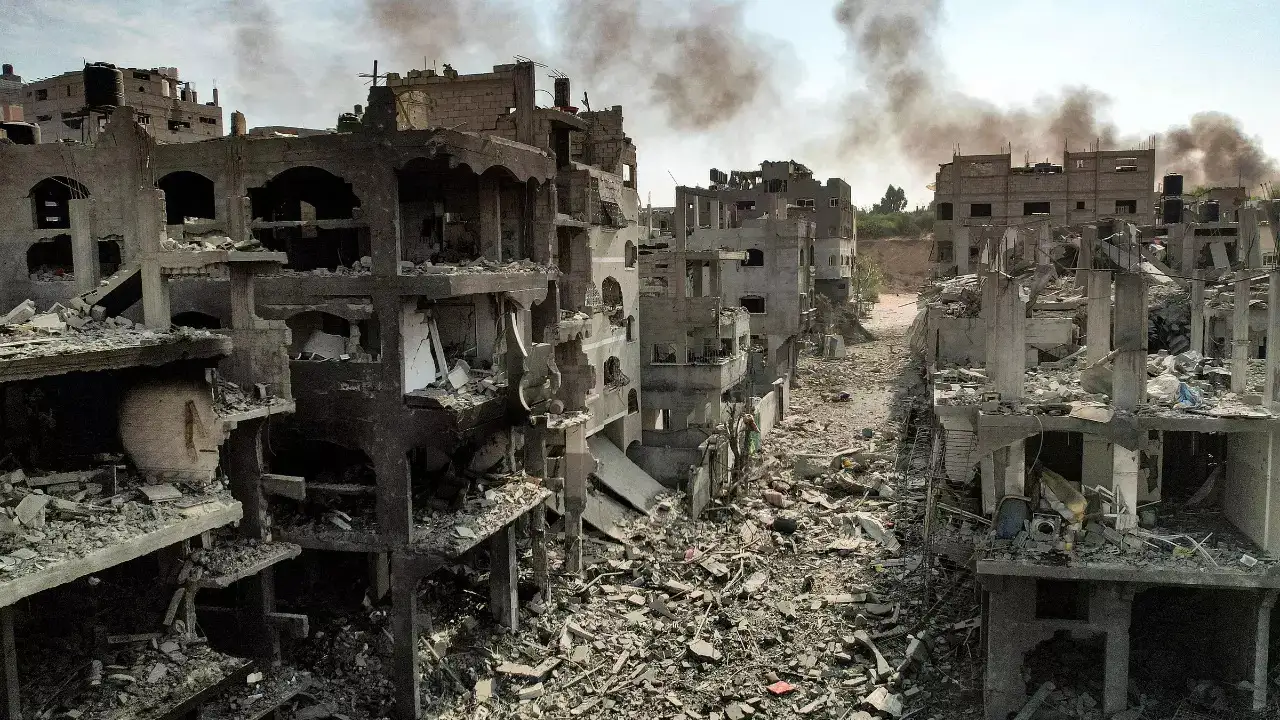
Israeli soldiers have provided rare accounts of military operations in Gaza, alleging that deadly incidents have continued despite a ceasefire that came into effect in October. Their testimonies, shared with The Associated Press (AP), raise questions about how the truce is being implemented on the ground and the rules governing engagement near a dividing line separating Israeli-controlled and Palestinian areas.
One reservist recalled witnessing fellow soldiers celebrate after a vehicle carrying Palestinians was struck near the so-called “yellow line” in Gaza, killing those inside. The soldier, who served in Gaza after the ceasefire began, said troops were instructed to fire on anyone crossing the boundary.
“It was a jungle,” the soldier told AP. “After the ceasefire, the order was: If someone crosses the line, you shoot them.”
Three Israeli soldiers who served in Gaza between October and January described confusion over the ceasefire’s terms and the military’s rules of engagement. According to their accounts, some commanders publicly supported the truce while privately expressing support for continuing military operations.
The soldiers, who spoke anonymously due to fears of professional and social repercussions, said they decided to speak out because they were troubled by what they witnessed.
The ceasefire required Israeli forces to withdraw to a buffer zone marked by the yellow line, leaving Israel in control of just over half of Gaza. However, negotiations over a broader withdrawal have stalled, and Israel has since expanded its control over additional territory.
A key issue, according to the soldiers, is that the yellow line is not always clearly marked. In some areas, it is indicated by barriers or painted markers, while in others it remains difficult to identify. This ambiguity, they said, has contributed to deadly incidents involving civilians.
According to Gaza’s Health Ministry, more than 900 people have been killed in the territory since the ceasefire took effect, including dozens reportedly killed near or across the yellow line. The ministry does not distinguish between civilians and militants in its casualty figures.
The Israeli military maintains that the area near the line is a sensitive security zone and says civilians are warned not to approach it. The military said its forces do not target civilians solely for nearing the boundary and that rules of engagement require warnings before force is used, except in situations involving immediate threats.
However, soldiers interviewed by AP and the Israeli veterans’ organisation Breaking the Silence said identifying who is crossing the line is often difficult. One soldier said troops sometimes relied on incomplete information or visual estimates when requesting approval for strikes.
Breaking the Silence, which has collected testimonies from Israeli soldiers throughout the war, said engagement rules in many sectors effectively amount to a “shoot-to-kill” policy for anyone crossing the boundary. The group’s executive director, Nadav Weiman, argued that military policies have created conditions in which civilians can be killed for crossing poorly defined or invisible lines.
Another soldier who served in Gaza after the ceasefire described a culture in which maintaining control of territory took precedence over concerns about civilian lives. He said commanders often stressed the importance of defending positions and expected Palestinians to know where the yellow line was located, even when markers were absent.
The soldiers also said there was a widespread belief among troops that Israel intended to maintain a long-term military presence in Gaza rather than carry out a full withdrawal envisioned under the ceasefire framework.
An internal report circulated among humanitarian organisations and reviewed by AP suggested Israeli military operations have become increasingly proactive in recent months. Data from the Armed Conflict Location and Event Data Project (ACLED), a US-based monitoring group, found that April was Gaza’s deadliest month of the year and recorded an increase in fatalities near the yellow line compared with earlier months.
Israeli Prime Minister Benjamin Netanyahu recently stated that Israel currently controls about 60% of Gaza and intends to expand that figure to 70%.
For the soldiers who spoke out, the reality on the ground differs sharply from the idea of a ceasefire.
“We need to stop using this term,” one soldier said. “It’s not serving people that want to stop the war.”