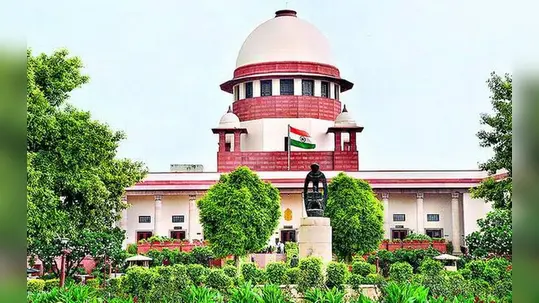
The Supreme Court on Monday refused to grant bail to a Chinese national arrested from Noida for cheating and forging Indian identity documents.
A bench of Justices JB Pardiwala and K Vinod Chandran, while dismissing the bail petition of Liu Fengfei, directed that trial in the case be expedited and completed preferably in six months.
Counsel appearing for Fengfei said that he was facing an extraordinary medical emergency in the family as his mother was suffering from serious illness and was admitted in the hospital.
He said that Fengfei intends to visit his ailing mother at Nanyang City, Henan Province in China.
Additional Solicitor General Archana Pathak Dave, appearing for the Centre and the Uttar Pradesh government, submitted that the trial was already underway and 36 witnesses needed to be examined in the case.
The bench noted the submissions and said it was difficult for the court to allow him on bail on account of medical emergency as trial in the case was underway.
On June 5, the top court noted that Fengfei intends to attend to his ailing mother on purely humanitarian grounds and sought response of the Uttar Pradesh government.
It also noted that there was no extradition treaty between India and China and impleaded the Centre through the Ministry of External Affairs as an additional party in the present petition.
The top court had said the impleadment of Union of India was solely to explore the possibility of finding out a way to enable Fengfei to be by the side of his mother for some time.
On February 24, the Allahabad High Court refused to grant him bail in the matter while noting that India has no extradition treaty with China and if such a foreign national escapes from the territory of India, the surety or security submitted by the applicant would become irrelevant.
It had said if the fugitive foreigner effectively goes beyond the reach of coercive jurisdiction of Indian courts, the criminal justice process would come to a dead end. “The issue of securing the presence of foreign nationals, who are fugitives from Indian Courts, is more complex, cumbersome, time consuming, and unpredictable,” it had said.
The high court had further said since the Union of India and Republic of China do not have any extradition treaty arrangement and the extradition is a long drawn process, therefore, permitting the applicant to travel abroad is at a high risk and it could be possible that the applicant would not return to face criminal trial proceedings.