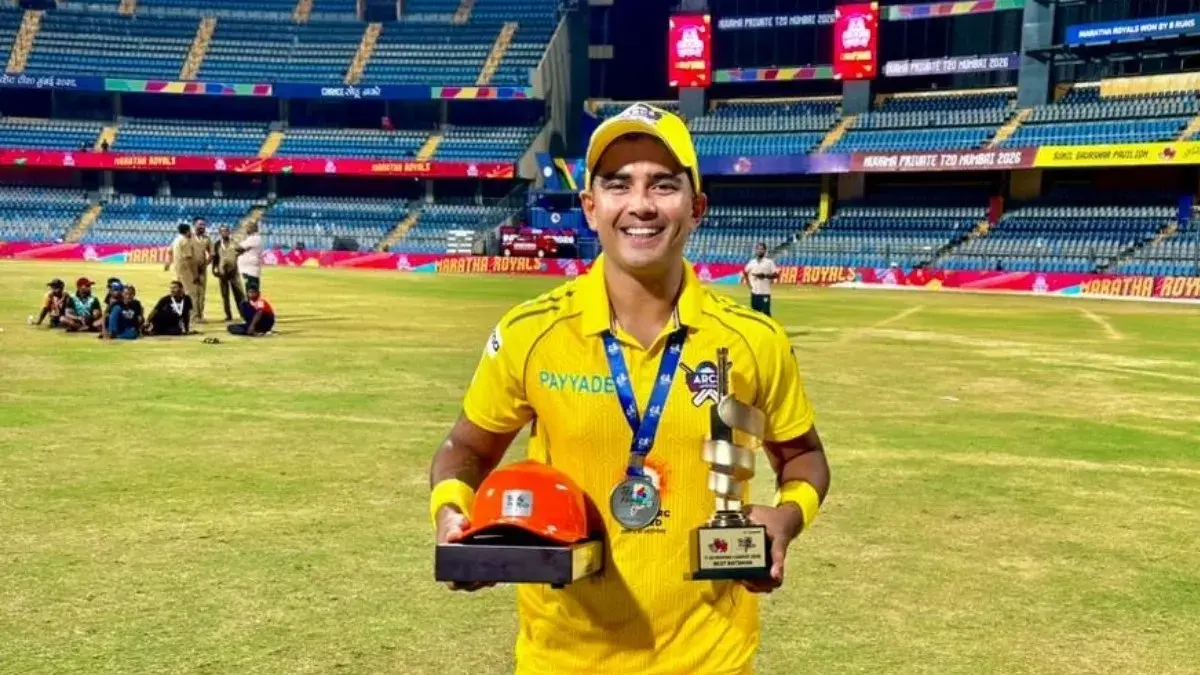
The T20 Mumbai League may have ended with ARCS Andheri falling short in the final, but Divyaansh Saxena walked away with something far more significant – recognition as the tournament’s leading run-scorer and the Orange Cap.
In an exclusive conversation with MyKhel, the ARCS Andheri batter reflected on his Orange Cap-winning season, the grind that shaped him, his India Under-19 World Cup memories, his bond with Yashasvi Jaiswal, his rare ambidextrous bowling ability and the challenges of breaking into a fiercely competitive Mumbai Ranji side.
There are few cricketing journeys quite as demanding as the one through Mumbai’s domestic system. For generations, young cricketers in the city have learnt that talent alone is not enough. The journey involves early mornings, crowded local trains, heavy kitbags and countless hours in the nets before the rewards begin to arrive.
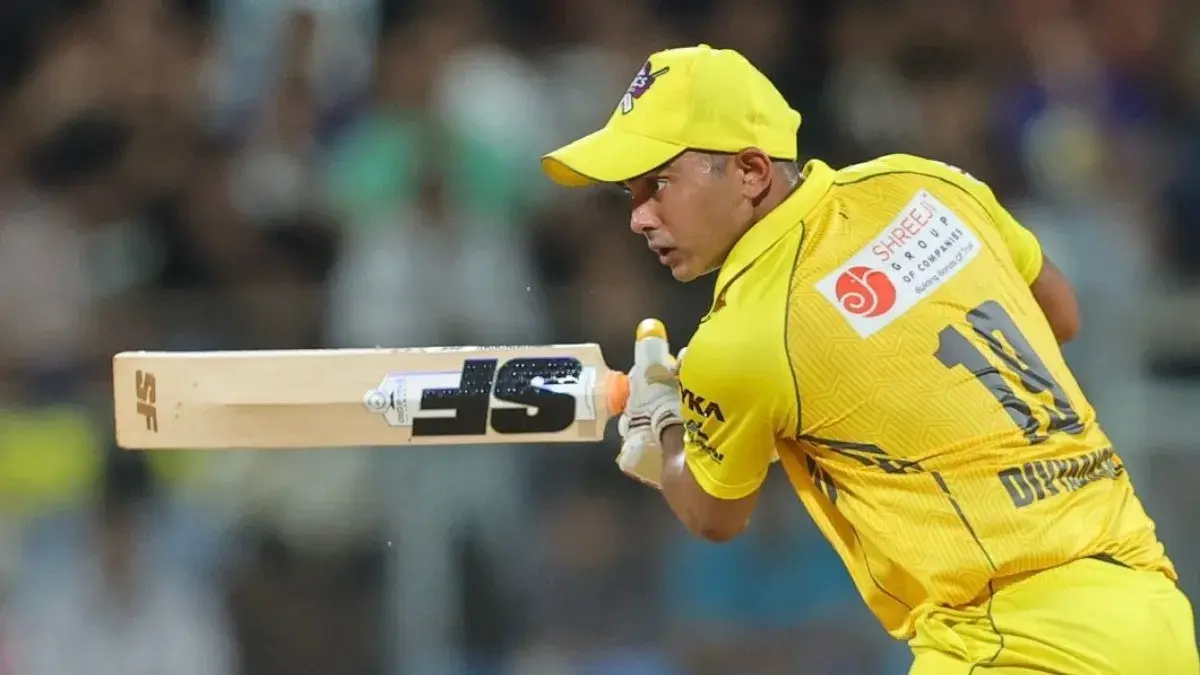
Divyaansh Saxena knows that grind first-hand. The ARCS Andheri batter has just completed a standout campaign in the T20 Mumbai League, finishing as the tournament’s highest run-scorer, winning the Orange Cap and helping his team reach the final. Yet behind the numbers is a season Saxena believes was built on a year of reflection and hard work.
“Last year, I didn’t have a very impressive season, but this year I was looking forward to it. I practiced a lot and worked hard, so I think I got the rewards for it,” he stated.
The environment around him also played a role. Sharing the ARCS Andheri dressing room with experienced campaigners such as Shiv Dube, Musheer Khan, Arjun Tendulkar and Prasad Pawar allowed Saxena to learn from players who have already experienced different levels of domestic and professional cricket. For a young batter trying to establish himself, that exposure can be as valuable as time spent in the nets.
The local train grind that built his character
Saxena’s association with cricket began when he was six, after his cricket-loving father introduced him to the sport. His talent soon became evident, and after being spotted by coach Ashok Kamat, he joined the Dilip Vengsarkar Cricket Academy in Churchgate.
That decision would also introduce him to one of the less glamorous sides of Mumbai cricket. With school in Chembur and training in Churchgate, Saxena had to travel considerable distances with his cricket kit. By the age of 10 or 11, he was making those journeys alone, navigating Mumbai’s local trains during peak hours while balancing school and cricket.
Those journeys became an important part of his development, teaching him independence and mental toughness at an early age.
“At the age of 10 or 11, I was traveling up and down by the local train all alone. That made me a really strong person,” Saxena recalled.
The sacrifices began producing results soon enough. On his Mumbai Under-14 debut against Gujarat, he scored a double century, setting the tone for a progression through the city’s age-group system that eventually took him to the India Under-19 setup.
The India Under-19 World Cup and Yashasvi Jaiswal
Saxena’s consistent run-scoring across age-group cricket earned him a place in India’s Under-19 squad for the 2020 World Cup. Among his teammates was Yashasvi Jaiswal, with whom he shared a coaching connection through Jwala Singh.
While Jaiswal has since established himself as an international star, Saxena continues to maintain a close bond with him and follows his career with genuine interest. For Saxena, Jaiswal’s rise is a reminder of the value of discipline and an uncompromising approach to improvement.
“Whenever he does well, I put out a message for sure,” Saxena says about Jaiswal. “He’s a special player who works really hard on his game and is very focused. I learn a lot from his work ethic.”
The Under-19 World Cup itself remains one of the most emotional chapters of Saxena’s career. For a young cricketer, the moment of receiving an India kit bearing the BCCI logo carries a significance that is difficult to replicate. Walking out at a World Cup and hearing the national anthem only magnifies that feeling.
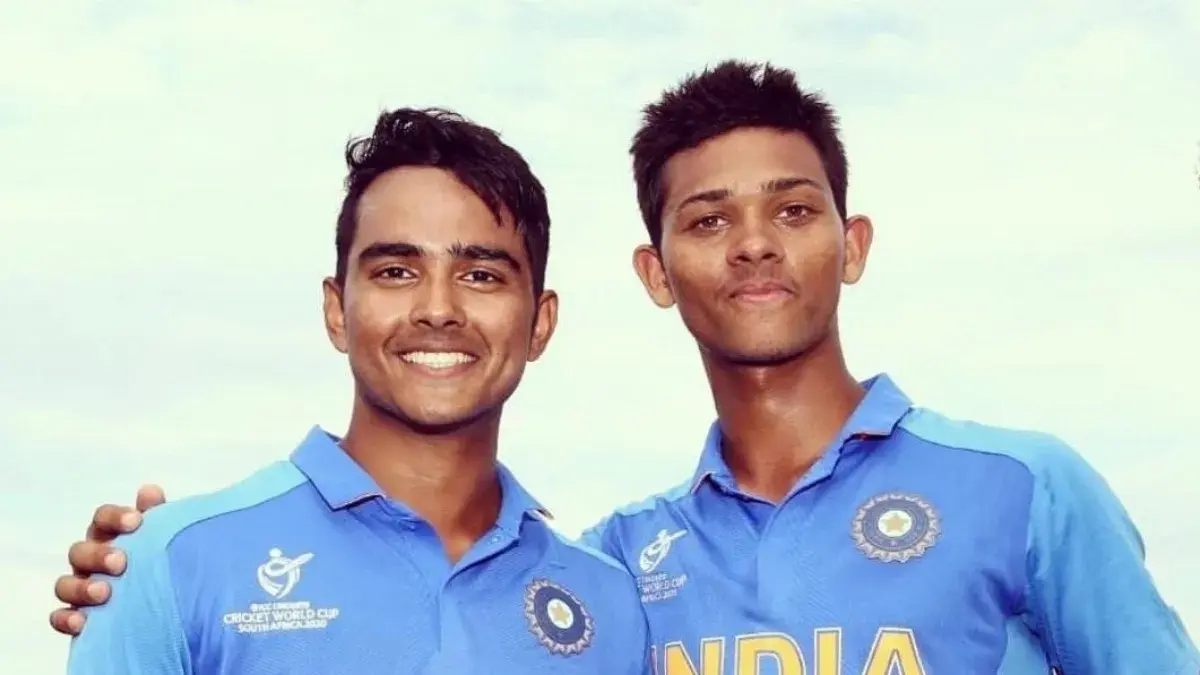
“When you first get that kit in your room with the India BCCI logo… it makes you emotional at that young age. When the national anthem plays in the stadium at the World Cup, it gives you goosebumps. It’s something I will never forget.”
The ambidextrous cricketer Divyaansh Saxena
There is another intriguing dimension to Saxena’s game. He is capable of bowling with both arms, a skill that developed from an experiment during his childhood.
Naturally a right-handed thrower and bowler, Saxena was encouraged by coach Ashok Asvalkar to try left-arm spin. He embraced the challenge so seriously that he eventually became comfortable bowling with either arm. What began as an experiment has since become a genuine weapon that he has used in competitive cricket.
“Now, it has come in handy; I’ve bowled in the Ranji Trophy, List A matches, and the Mumbai T20 League with both arms. It’s a rare skill, and I really want to improve it,” he revealed.
For Saxena, the ability is not simply a curiosity. He sees it as another aspect of his game that can make him more adaptable and useful to a team, particularly as modern cricket increasingly rewards players who can offer multiple options.
Learning to thrive in Mumbai’s competition
Saxena has traditionally been regarded as a red-ball batter, someone comfortable spending long periods at the crease and constructing substantial innings. His T20 Mumbai League campaign, however, demonstrated his ability to adapt that foundation to the demands of the shortest format.
The transformation has been particularly important given the competition he faces in Mumbai. Breaking into the regular Ranji Trophy side is an enormous challenge when the state boasts a deep pool of established players and several cricketers with international experience.
Saxena has already tasted Ranji cricket, scoring 35 and 62 on debut, but regular opportunities have been limited. Rather than viewing Mumbai’s depth as a disadvantage, he believes it provides the pressure required to keep improving.
“If I were playing for a smaller state, I might not push myself as hard. But playing for Mumbai, you have to be at your absolute best,” he explains.
Shreyas Iyer and the importance of mindset
Saxena’s development has also been shaped by interactions with senior players. Shreyas Iyer, in particular, left a strong impression during their time together at the Buchi Babu tournament in Tamil Nadu.
For Saxena, observing Iyer was about more than batting technique. He was impressed by the senior player’s understanding of the game, his work ethic and his competitive mentality.
“He has a great cricketing brain. he has a very dominant, ‘mamba mentality’. He is very hard-working. I’ve learned a lot from him,” Saxena added.
The Role Model in SKY
In world cricket, someone who has massively inluenced Divyaansh’s journey is former India captain Suryakumar Yadav.
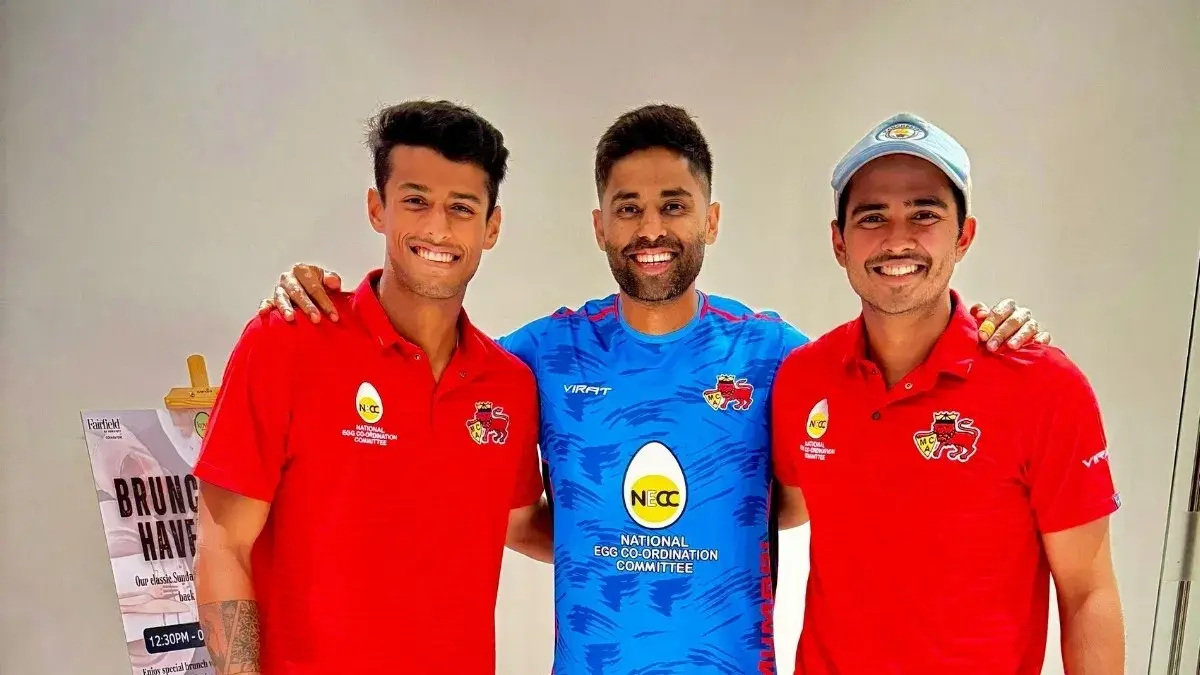
“My role models are probably a little different from what most people would have. Suryakumar Yadav would be my first. I’ve seen his grind very closely because he was my neighbour for many years. I’ve seen his struggles, everything he has been through, and how hard he worked. He got his India cap very, very late.
I relate to his journey because most of my Under-19 batchmates are now playing for India or in the IPL and have been very successful. I feel like I have a lot of catching up to do. I’ve been working hard but haven’t had many opportunities, and now it’s time for me to catch up as well. That’s something Suryabhai had to do too. Many of his batchmates played for India much earlier, while he got his opportunity very late. So he is definitely one of my biggest role models,” says Saxena.
Beyond the Orange Cap
Away from cricket, Saxena is a keen traveller and a passionate football follower, with Manchester City his preferred club. His cricketing influences, meanwhile, include Suryakumar Yadav and MS Dhoni, two players he admires for their calmness and humility as much as their performances.
For Saxena, the Orange Cap represents recognition for a successful campaign, but it is not the endpoint. His journey has already taken him from Mumbai’s local trains and age-group cricket to an India Under-19 World Cup, Ranji Trophy cricket and now a standout T20 season.