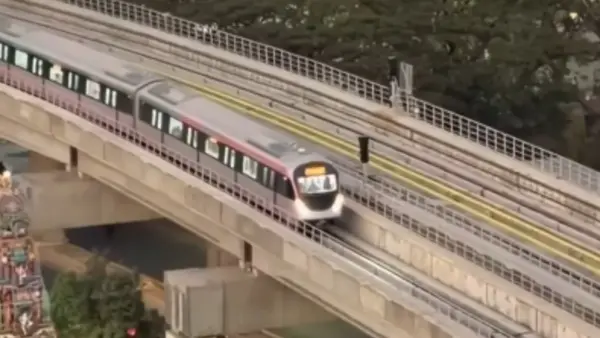
Bengaluru’s traffic could soon have more public transport options as the city’s lifeline, Namma Metro, moves closer to opening its Pink and Blue lines.
The Railway Board has given in-principle approval for the signalling system required to operate both corridors.
The approval covers the 21.25-km Pink Line, also known as Reach-6, and the Blue Line corridors being built under Phase 2A and Phase 2B.
The Pink Line is currently the one commuters are likely to see first.
BMRCL is working towards opening a 7.5-km elevated stretch between Kalena Agrahara and Tavarekere in August 2026. Greater Bengaluru Development Minister Krishna Byre Gowda has also set August as the target for commissioning this section.
But the date is not final yet. The line must first complete the required safety inspections and obtain statutory clearances.
The full Pink Line will stretch 21.25 km and include a major underground section towards Nagawara. The entire corridor is targeted for completion by March 2027.
For people living and travelling around Bannerghatta Road and nearby areas, the line could mean a faster alternative to road travel, particularly during Bengaluru’s peak-hour traffic.
Blue Line May Offer Bengaluru Commuters A Way Around ORR Traffic
For many Bengaluru commuters, the biggest promise of the Blue Line is not just the airport connection. It is the possibility of avoiding long road journeys through some of the city’s busiest corridors.
The line will eventually link key technology hubs in east Bengaluru with Kempegowda International Airport through north Bengaluru. However, the benefits will come in stages as different sections of the project are completed.
BMRCL is planning to conduct trial runs on the KR Pura-Marathahalli stretch in October 2026. The section is also expected to be extended towards HSR Layout.
The next major stretch, between Hebbal and the airport, is targeted for commissioning in June 2027. The KR Pura-Hebbal section is expected to be ready by December 2027.
That means commuters along the Outer Ring Road and nearby technology hubs may have to wait for the full network before seeing a major change in their daily travel.
The airport stretch, meanwhile, could be particularly useful for passengers who currently rely on road transport and have to factor in Bengaluru’s unpredictable traffic while planning their journey.
The Railway Board’s in-principle approval is an important step, but it is not the final clearance for passenger services.
The approval relates to the signalling system, including CBTC, or Communications-Based Train Control. The system helps regulate train movements by allowing continuous communication between trains and signalling infrastructure.
BMRCL is working with the Railway Board and the Research Designs and Standards Organisation (RDSO) to complete the required signalling formalities.
The corridors will still need to undergo testing and safety inspections before the Commissioner of Metro Rail Safety (CMRS) grants clearance for passenger operations.
While the Blue Line is likely to take longer to become fully operational, Bengaluru could get its first new metro stretch sooner through the Pink Line.
BMRCL is working towards opening the 7.5-km elevated section between Kalena Agrahara and Tavarekere in August 2026, subject to safety inspections and statutory approvals.
For Bannerghatta Road commuters, that stretch could provide an immediate public transport option even as work continues on the remaining Pink and Blue Line sections.
The larger network will take more time. If the current schedules hold, Bengaluru will see the two corridors open in phases, gradually expanding the city’s metro connectivity and giving commuters more options beyond the road.