
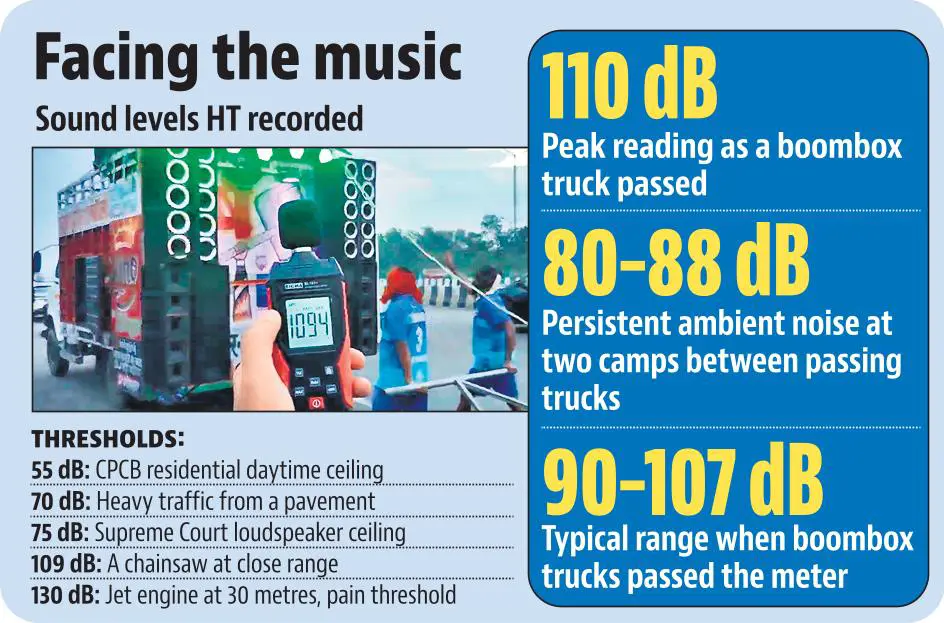
An HT sound meter registered peaks of 110 decibels at two Kanwar Yatra rest camps in east Delhi as loudspeaker-mounted convoy trucks rolled past.
That is roughly as loud as a chainsaw at close range, and more than 30 decibels above every legal ceiling that applies to noise in a residential area.
Even between the passing trucks, ambient noise at both camps – HT took the measurements at multiple occasions on Friday and Saturday – held between 80 and 88 decibels – 25 to 33 decibels above the 55-decibel daytime residential limit set by the Central Pollution Control Board. Because the decibel scale is logarithmic, the 85-decibel readings HT recorded carry roughly a thousand times the sound intensity of that ceiling.
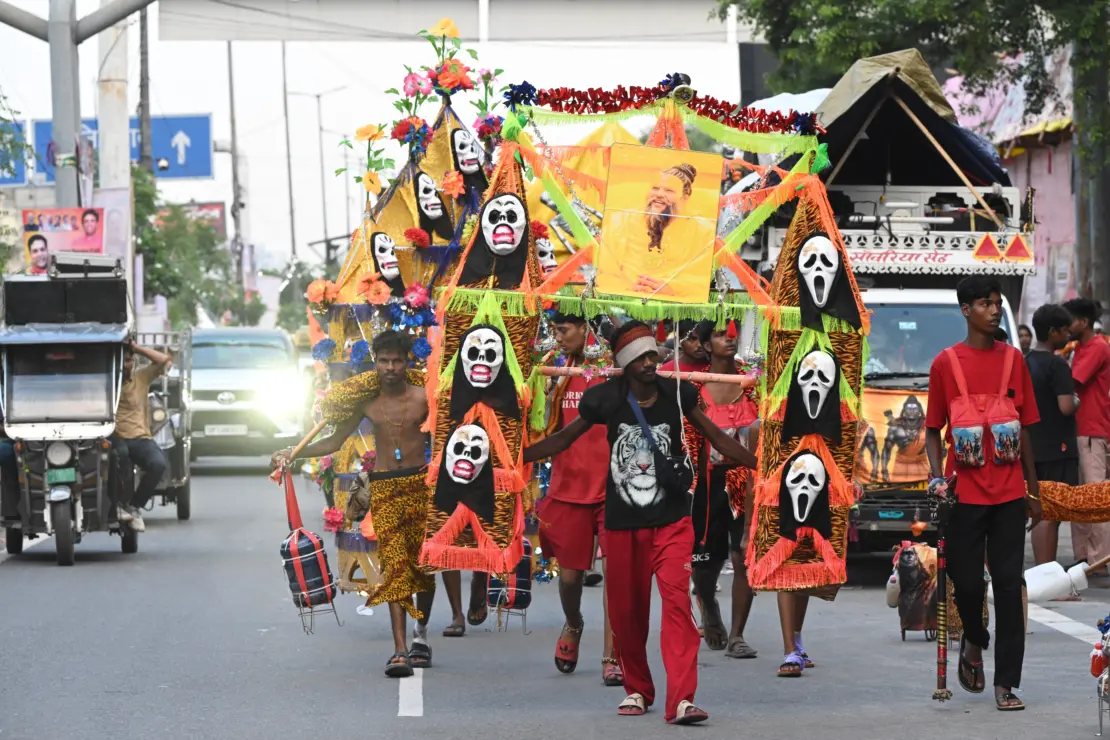
The trucks have been grinding into the capital for over a week, and Saturday’s surge – the first of the yatra’s three peak days, which will send thousands more through the city until Tuesday – swelled the flow further.
What HT investigation found
HT ran the meter at two of those camps in east Delhi: one beside the Dilshaad Garden metro station on Grand Trunk Road, through which kanwariyas enter the capital from Uttar Pradesh, and one on Delhi-Haridwar Road near the Mandawali-West Vinod Nagar metro. Both fronted onto residential blocks. At Dilshaad Garden on Friday evening, six to seven convoy trucks rolled past within the half-hour between 5.30 pm and 6 pm, each pushing the meter into the 90-to-107 decibel range, with the evening’s peak of 109.3 decibels registering at 5.51 pm as one boombox truck ground past.
The second camp saw one such truck during HT’s Friday visit; it took the meter to 109.4 decibels.
Similar readings were recorded late on Saturday, well after the nationwide 10pm curfew for loud speakers, when peaks hit 89.5db at 11.35pm near Kalkaji, while the average persisted around 75db.
The routes crisscross Delhi. Delhi Traffic Police has designated eight Kanwar corridors along the city’s busiest arterials, including Ring Road, Mathura Road, Wazirabad Road, Grand Trunk Road, Rohtak Road and Najafgarh Road, with 308 rest camps set up along them. Eastern Delhi carries the heaviest concentration at 120 camps. From Sunday morning, the GT Road stretch between Apsara Border and Yamuna Bridge will be closed to general traffic until Tuesday evening. Residential blocks along every route face the same convoys.
CPCB limits on loudspeakers
Three legal ceilings apply. CPCB rules cap ambient noise in residential areas at 55 decibels between 6 am and 10 pm, and at 45 decibels through the night. Loudspeakers face a further, hard limit of 75 decibels at the boundary of the public place where they are used. In 2005, the Supreme Court affirmed those CPCB thresholds, prohibited the use of loudspeakers and sound amplifiers between 10 pm and 6 am except in public emergencies, and locked the 75-decibel loudspeaker ceiling in place.
The underlying Noise Pollution (Regulation and Control) Rules, 2000 permit state governments to push the night cut-off to midnight on up to 15 religious or cultural days a year, but even that carve-out is bound by the 75-decibel maximum, and does not authorise 109-decibel peaks.
The Motor Vehicles Act separately prohibits both the boomboxes themselves and the vehicle modifications that mount them.
Delhi Police officers on yatra duty say that framework unravelled at the state borders. “Despite discussions, thousands of such vehicles playing loud music entered Shahdara through the borders, which means that the states’ police made no efforts in controlling them,” a senior officer involved in the security arrangement said.
Verbal agreements with counterparts in Haryana, Rajasthan, Uttar Pradesh and Uttarakhand – worked out to keep the modified convoys out of the capital – had not held. Once the trucks were inside Delhi, the officer said, the police could do little beyond asking drivers to lower the volume or physically cutting the cables, and even that had to be handled cautiously to avoid confrontation with pilgrims who could turn aggressive.
No FIRs have been filed by the police. Police spokespersons did not respond to requests for a comment.
Immeasurable effects
The readings themselves understate what residents actually endure. Standard sound meters use A-weighting, or dB(A), which is calibrated to the frequencies the human ear finds most sensitive – the mid-range where speech lives – and discounts the low-frequency energy that dominates the boombox trucks. Most of what the speaker walls produce sits below 200 hertz, in the sub-bass range that A-weighting suppresses.
HT’s dB(A) reading of 109 is a conservative floor; the same sound measured on a flatter, C-weighted scale would run substantially higher. Low-frequency waves carry long wavelengths and high energy, pass through walls, and shake structures at their resonant frequencies – which is why residents describe walls vibrating and window panes rattling in their frames.
The World Health Organization’s Guidelines for Community Noise flag this specifically, warning that A-weighting is inadequate for the non-auditory effects of low-frequency noise and that such noise disturbs rest and sleep well below the levels standard meters register.
Residents along the yatra routes will be exposed to that noise, in the busiest stretches, for three consecutive days. Rajesh Bhardwaj, consultant ENT specialist at MedFirst ENT Centre, said prolonged exposure at the intensities HT recorded could produce auditory fatigue, tinnitus and, if sustained, permanent damage to the sensory cells of the inner ear. “Chronic exposure to excessive environmental noise has been associated with broader cardiovascular and psychological health effects,” he said.
Children were particularly vulnerable, he added, because sustained noise interfered with sleep, concentration and learning, and the elderly with existing hearing loss faced compounded difficulty communicating. “Religious celebrations should absolutely be respected, but they should not come at the cost of public health,” Bhardwaj said.
At the Dilshaad Garden camp, police were on site, but were directing pilgrim movement – not stopping the boombox trucks that rolled past unchallenged. A transport department official said the convoy setups were themselves illegal under the Motor Vehicles Act and that most operated with no permission of any kind. Delhi Police has deployed around 15,000 personnel across the city for the yatra’s law-and-order arrangements.