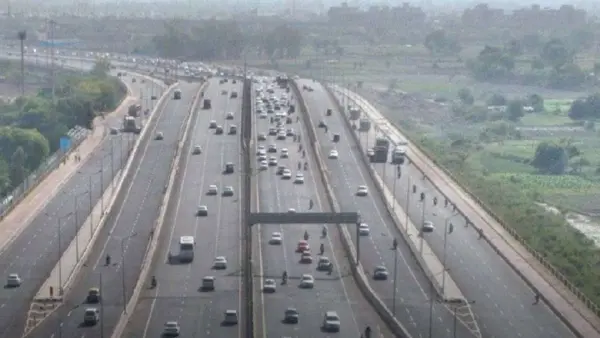
Delhi’s traffic jams could possibly be cleared not by accelerating but by decelerating. A pilot study on the Delhi-Meerut Expressway will soon test the efficacy of variable speed limits on an 8.7 km stretch from Sarai Kale Khan to the border with Uttar Pradesh to ease breaks and congestion near Akshardham.
The pilot study is likely to start from around August 15 and will utilise electronic signboards to indicate varying speed limits based on vehicular density.
The research will be conducted under the Ministry of Road Transport and Highways and will be led by Prof Satish Chandra IIT Roorkee and Dr Chalumuri Ravi Sekhar, director, CSIR-Central Road Research Institute.
How will variable speed limits work on Delhi-Meerut Expressway?
Unlike conventional speed-limit boards, the new boards will have the capability to indicate varying speeds depending on the requirement of the time. Variable speed limit boards will have sensors and CCTV cameras to automatically reduce the speed limit as per traffic density, poor visibility, and traffic bunching on the road. The indicated speed can be hiked once the traffic eases out.
On the Delhi-Meerut Expressway, the carriageway’s speed limit is 70 kmph for cars and 50 kmph for commercial vehicles (CVs). This remains static irrespective of traffic conditions on the road. The proposed solution recommends a more nuanced approach to varying traffic densities.
A proposed time-wise framework suggests a 65 kmph speed limit for cars and 50 kmph for CVs between midnight and 7 am. The analysis recommends a 55 kmph speed limit for cars and 45 kmph for CVs between 7 am and 5 pm. From 5 pm to midnight, the suggested speed limit is 60 kmph for cars and 40 kmph for CVs.
Why was Akshardham identified for pilot testing?
Akshardham is one of the most traffic-infested zones on this expressway. As cars and trucks carrying office-goers from Meerut, Modinagar, and Ghaziabad head towards Delhi, they face congestion on the road, restricting free-flowing traffic. The situation is exacerbated further in the evening as several people attempt to return to their residences in the National Capital Region (NCR). A steep slowdown in the traffic speed is witnessed, with people breaking and accelerating repeatedly as they inch forward.
Prior to the pilot study, a traffic density analysis was conducted at the Akshardham plaza on the Delhi-Meerut Expressway. The researchers evaluated 72 hours of recorded footage on Mondays-Tuesdays and one weekend in July this year. The analysis captured the traffic at the road stretch where the speed limit was changed from 100 kmph to 70 kmph.
The analysis revealed that more than 80% of traffic comprised of private cars while 4-12% was constituted by commercial vehicles. The traffic witnessed an increase throughout the day, decreased slightly in the afternoon, and spiked further in the evening to witness peak congestion on the Delhi-Meerut Expressway. According to the researchers, the congestion was most acute between 5 pm and midnight.
Additionally, using an international standard model, the researchers captured the average speed at which motorists were willing to travel on the expressway. It was revealed that the average speed of a car during peak congestion ranged between 75-88 kmph. This will help formulate the proposed variable speed limit model to be used in the pilot study on Delhi-Meerut Expressway.
Will enforcement of variable speed limit help the pilot study?
The pilot study will primarily depend on motorists’ adherence to the dynamically changing speed limits. Electronic variable speed boards will be installed on both sides of the road near the Akshardham interchange. Furthermore, prior permission has been sought from Delhi Traffic Police to enforce the norms by issuing challans to errant motorists.
“The police force has been requested to follow up on enforcement activity. It will be imperative to analyse the response to dynamic speed limits by actually enforcing the limits,” said Dr Ravi Sekhar. Unless enforcement is done, the effectiveness of this solution cannot be evaluated objectively.
After the pilot, assessments of the before and after scenario will be done to measure the impact. “We will measure traffic speed, congestion, standard deviation of speed, and adherence to speed limits to traffic on the road,” said Prof Chandra. The analysis will be done at 30, 90, and 120 days after installation to understand the impact of the solution.
Variable speed limit boards have been in use in the US, UK, and Germany. These are primarily used on motorways and expressways where there are abrupt changes in traffic density, causing traffic jams and accidents. India is yet to witness variable speed boards and has primarily relied on fixed speed limits and road expansion to deal with traffic congestion.
Should the Delhi-Meerut Expressway experiment yield positive results, the findings will be shared with relevant authorities for similar pilot studies on other expressways. For rapidly growing cities, variable speed limit boards will be a cheaper and quicker alternative to road expansion for controlling congestion.
This pilot study will be crucial in analysing how drivers respond to dynamic speed limits. While the former will see a variable speed board, the latter will see controlled traffic movement, with hopes of reducing congestion and enabling free-flowing traffic as cars head towards Delhi.