Twelve months ago, Carlos Alcaraz left Cincinnati with another trophy and the feeling that men’s tennis was beginning to bend around him.
He had defeated Jannik Sinner in a curtailed final, added another Masters 1000 title to a remarkable season and strengthened the impression that his rise was becoming dominant.
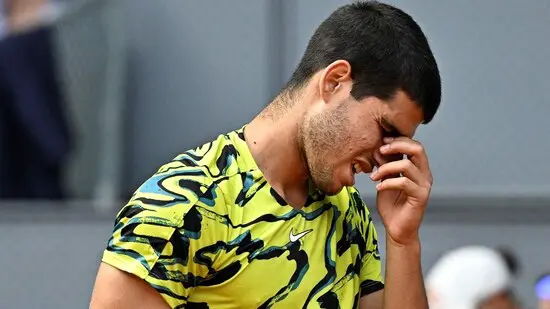
This year, Alcaraz will not defend that title. A lingering right-wrist injury has forced him out of Cincinnati and extended an absence that has lasted since April. The contrast is difficult to ignore: one year after charging through the sport’s biggest stages, the 23-year-old is trying simply to make his body ready for competition again.
The withdrawal is not an isolated interruption. Alcaraz has not played since feeling discomfort during his opening match in Barcelona, after which tests revealed an injury he admitted was “slightly more serious” than initially expected. Madrid disappeared first. Rome and Roland Garros followed, then Queen’s and Wimbledon. Cincinnati was supposed to mark his return. Instead, it has become the latest tournament lost to rehabilitation.
For a player whose career has unfolded at extraordinary speed, the enforced stillness feels especially significant.
From command to an enforced pause
Alcaraz’s 2025 campaign represented the fullest expression yet of his talent. He won eight titles, including Roland Garros and the US Open, finished runner-up at Wimbledon and reclaimed the year-end world No.1 ranking. He also won Cincinnati, completing a season in which his game travelled across surfaces without losing its force.
His rivalry with Sinner had become the axis around which the men’s tour revolved. Alcaraz’s variety, improvisation and explosive movement met Sinner’s relentless precision and controlled aggression, producing a contest that seemed capable of defining the decade.
Then 2026 began with Alcaraz moving even further ahead of history. He defeated Novak Djokovic in the Australian Open final, won his seventh Grand Slam title and became the youngest man to complete the career Grand Slam. At 22, he had already assembled the collection that eludes many great players across an entire career.
This was supposed to be the year in which Alcaraz converted extraordinary achievement into sustained authority.Instead, his season stopped in Barcelona.
His 22-3 record still shows how well he played before the injury, but it also underlines how abruptly his momentum disappeared. He missed Roland Garros and Wimbledon, surrendered valuable ranking ground and watched the season continue without him.
Sinner, meanwhile, strengthened his position at the top of the rankings and successfully defended his Wimbledon title. The rivalry has not ended, but it has temporarily become one-sided for the simplest reason possible: only one of its two central figures has been available to compete.
This is the hidden cost of injury at the highest level. Trophies and ranking points are the obvious losses. Rhythm is harder to calculate. So is confidence in the injured area, the trust required to swing freely under pressure and the resilience needed to survive best-of-five matches after months away.
Alcaraz’s game makes those demands particularly severe. His tennis is constructed around violent acceleration, sudden changes of direction, extreme court coverage and the ability to turn defensive positions into attacking ones within seconds. A wrist problem therefore affects more than pain tolerance. It can influence timing and the freedom with which he attacks the ball.
There is no medical basis to declare that his style caused the injury, and it would be irresponsible to portray the setback as evidence of permanent fragility. Alcaraz has returned from physical problems before. An abdominal tear ended his 2022 season, a leg injury ruled him out of the 2023 Australian Open, and a forearm problem disrupted his 2024 clay-court preparation. Yet he recovered from that last setback to win Roland Garros.
That history offers reassurance and warning. Alcaraz has repeatedly shown that injuries do not prevent him from reclaiming his highest level. But they have arrived often enough to make physical management a central part of his future.
The immediate concern is the US Open. Alcaraz remains entered as the defending champion, but Cincinnati’s withdrawal leaves him with little time and potentially no meaningful match practice before New York. Even if the wrist heals, entering a Grand Slam after more than four months without competition would create questions about endurance, timing and recovery between rounds.
Yet the larger issue extends beyond one title defence. Alcaraz has already proved that his tennis is capable of rewriting historical timelines. The challenge now is ensuring his body allows him enough years to fulfil that promise.
Greatness is not measured only by how quickly a player reaches the summit. It is also measured by how long he can remain there. Alcaraz has spent his career showing that almost nothing in tennis can slow him down. Injuries have finally done it. His next victory may not be a trophy. It may simply be returning without fear, trusting the wrist again and learning that a career built at breathtaking speed must sometimes be protected through patience.