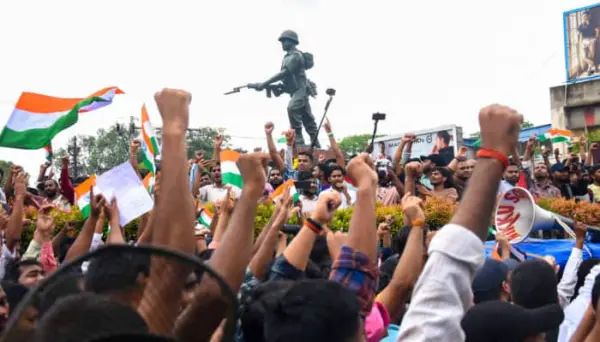
Students across India have defined the past two months with street protests seeking accountability from the government. From the posh streets of Lutyens Delhi to the forested state of Jharkhand, Indias youth have stepped out to assert their right to education and greater transparency in examinations, seeking accountability over paper leaks and alleged exam irregularities.
Yet, the two most visible movements, one associated with a platform that emerged from satire and mockery, and the other organised by local aspirants in Jharkhand, have unfolded with markedly different methods and tones on the ground.
Beyond the CJP noise
The internet records nearly every moment of these events, and algorithms shape how netizens interpret them. Beneath the rapid flow of clips and commentary, however, lies a ground reality shaped by the actual incidents, statements and choices made at the protest sites themselves.
While the Cockroach Janata Party (CJP) was successful in getting its demands met, the movement was majorly marred by incidents of vandalism, violence, police brutality, foul language, abuse and mockery.
On the other hand, in Ranchi, at Jaipal Singh Munda Stadium, aspirants from all 24 districts of Jharkhand have maintained an indefinite sit-in since late July 2026. Their demands centre on alleged paper leaks and irregularities in examinations conducted by the Jharkhand Public Service Commission (JPSC) and the Jharkhand Staff Selection Commission (JSSC).
They seek cancellation of the 14th JPSC Combined Civil Services Preliminary Test, an independent Central Bureau of Investigation (CBI) or Enforcement Directorate (ED) investigation into recruitment processes spanning recent years, structural reforms in the two bodies, and a transparent system free of political interference.
Similar demands, different methods of execution
Similar to the Jantar Mantar protest, student leaders have undertaken an indefinite hunger strike. Slogans focus on student unity, calls for a CBI probe, and accountability from the state government.
Protesters have held torchlight marches and continued studying even while camping at the site.
What has drawn sustained online attention to the Jharkhand protest is the deliberate manner in which these students have framed their agitation.
Videos from the ground show participants speaking directly to reporters, emphasising that the protest must remain peaceful and free of political colour. This stands in contrast to the Jantar Mantar protest, which turned into mockery and insult for the mainstream media, with several reporters and media personnel allegedly assaulted by a mob.
In one viral video, a young man appeals for the movement to stay clear of politics and asks groups linked to the Cockroach Janata Party (CJP) and its founder, Abhijeet Dipke, not to arrive, arguing that external involvement could alter the character of an effort built over days of local organisation, although Zee News did not independently verify these viral claims.
Another recording captures a firm declaration that Azadi slogans will not be raised because this is not Jantar Mantar. Further footage shows measured interactions with media teams, with students gesturing and speaking about the need to keep the focus on examination integrity rather than spectacle.
These images have been set against the CJP-led agitation at Delhis Jantar Mantar.
How Jharkhand student protesters are winning over the internet
The differences in execution and self-presentation, however, account for much of the distinct online reception. Jharkhand organisers have repeatedly insisted on keeping the agitation non-political and free of external branding, rejecting the importation of slogans or leadership styles associated with the Delhi camp.
Interactions captured on video show students engaging with the media without the larger theatrical elements that marked some coverage of the Jantar Mantar gatherings.
The Ranchi protest has remained local in leadership, drawing primarily from Jharkhand aspirants rather than a pan-India mobilisation under a single named platform.
While CJP publicly extended support to the Jharkhand students, the ground response visible in circulating footage has been one of polite but firm distance.
The visual language and rejection of certain forms of external participation have travelled quickly across platforms.
The Ranchi protest clips have found a receptive audience among viewers who respond to the visible effort to keep the message narrow, the methods restrained, and ownership with the students themselves, unlike the Jantar Mantar protest.
While the sit-in continues and authorities respond with probes and statements, viral videos from the Jharkhand protest have shaped how the agitation is perceived online, with organisers seeking to keep external elements away to prevent the movement from being derailed.