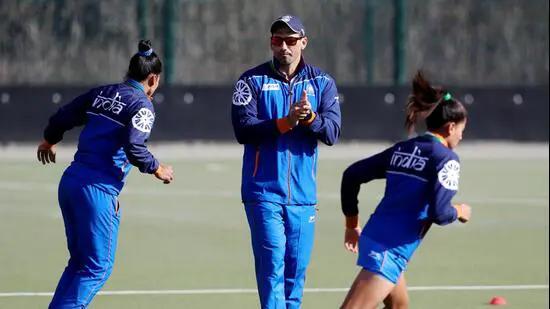
NEW DELHI: The hockey season is heating up. The Indian men fine-tuned their skills at the FIH Pro League in Europe last month, building up to the World Cup.
The Salima Tete-led women won the Nations Cup in New Zealand.
The bigger tests lie ahead, the World Cup in August and the Japan Asian Games in September-October. With just a fortnight separating the two mega events, the team managements are trying to build teams with robust athletes to help them excel at both the competitions without any dip in performance. This is where the role of sports science comes in.
For decades, Indian hockey was celebrated for its breathtaking stickwork, flair, and intuitive genius. But in the relentless ecosystem of modern hockey – defined by 15-minute quarters, rolling substitutions and hyper-aggressive pressing – flair alone is no longer enough.
To survive and dominate, India’s national teams have re-engineered how they build athletes. Through an exhaustive, technology-driven integration of sports science, both the men’s and women’s programmes have shifted from reactive recovery to predictive, precision-engineered athletic performance.
The introduction of advanced data analytics into Indian hockey started with human connection. When Wayne Lombard, head of athletic performance for the women’s hockey team returned to the role in January, he knew that data without belief is useless.
“My first job wasn’t actually about VO2 max numbers or force plate data, it was about people,” Lombard recalls. “It was about sitting down with the players and the coaching staff and earning their buy-in. Helping them understand that the physical side of the game is every bit as important as the technical and tactical side.”
This cultural shift required moving away from a traditional “one-size-fits-all” coaching mentality. The modern setup introduced individualisation. Alan Tan, scientific advisor of the Indian men’s team, notes that while players’ intellectual interest in the data varies, the collective buy-in is absolute.
“There are players who have a healthy curiosity, such as Hardik (Singh), who would like to go further in depth after a brief of our objective has been given,” Tan explains. “Other players are okay just being told what they need to accomplish.”
The target is identical: eliminating what Lombard calls “energy leaks” – the subtle physiological asymmetries or conditioning deficits that hold an athlete back from their true ceiling.
The measuring process
For years, the multi-stage fitness test – the Yo-Yo test – was the absolute yardstick of athletic endurance in Indian sports. While it provided an excellent historical baseline, the hockey programmes have transitioned to more precise testing protocols to calculate maximal aerobic speed (MAS).
The women’s team has adopted the 30:15 intermittent fitness test, where athletes run for 30 seconds, rest for 15, and progress across a 40m grid with speeds increasing by 0.5kph each stage.
The difference comes down to prescriptive accuracy. Because hockey requires sustained high-velocity efforts over longer shuttles than football or cricket, the 30:15 test allows Lombard to programme individual running intensities with pinpoint accuracy.
The results speak for themselves – when the women’s team ran their first 30:15 test, they averaged a score around 18-18.5. Within months of structured, MAS-driven programme, that squad average climbed to a formidable 19-19.7.
The men’s team utilises a dual approach, pairing the Yo-Yo IRT2 with a gruelling 16xbaseline shuttle test across a fixed 1.463m distance. “The Yo-Yo is an intermittent test that reflects the stop-start nature of our game,” says Tan. “The baseline test gives us each player’s MAS which can easily be converted into a VO2 Max.”
The tech stack
Hockey is brutally punishing on soft tissues, knees and lower backs. To combat this, India uses an elite diagnostic tech suite designed to catch structural flaws before they manifest as tears or strains on the pitch.
Force plates measure ground reaction forces with precision, capturing how much force an athlete generates over milliseconds. Tan uses this data to dissect peak force, the Rate of Force Development (RFD) and the specific loading mechanics an athlete uses when planting or changing direction.
To test muscle groups in highly specific hockey positions – such as the deep crouch of a defender or the rotational torque of a drag-flicker – the teams rely on fixed frame and handheld VALD systems. These isolate muscle groups (like the groin and hamstring) to look for structural deficits.
This data feeds directly into a comprehensive injury risk profiling system. If an athlete reveals a $15 strength asymmetry between their left and right hamstring during a weekly frame squeeze, they are immediately flagged. The intervention becomes preventative, altering their weight-room volume before an acute injury can sideline them.
Micromanaging with GPS
During a training session or match, the most critical weapon in the sports scientist’s arsenal is the small GPS tracker tucked into the back of a player’s vest. This unit registers every acceleration, deceleration, total distance covered, and high-intensity running (HIR) metre.
The weekly schedule is divided into specific “red sessions” (high-intensity zones). The sports science team sets hard thresholds for the day. For instance, strikers and midfielders might be tasked with hitting 1,000 high-speed metres in a session.
If a player falls short due to the tactical flow of a scrimmage, they don’t simply head to the locker room. Instead, the GPS data triggers immediate, post-session running “top-ups” to ensure their physical load matches the periodisation model.
External load is only half the equation. Tan balances these GPS metrics against internal and subjective stressors. “Load comes in various forms,” Tan says. “It can be categorised into internal (heart rate, blood lactate), external (force, distance, velocity), subjective (rate of perceived exertion), and objective (weight, power output). It is important to understand how these loads interact… Other unaccounted-for loads could include media, meetings, travel, and non-physical loads like emotion or stress.”
This meticulous collection of numbers serves pragmatic purpose: to empower coaches and medical staff to make better decisions. Annual medical screenings, comprehensive blood panels, and daily hydration testing ensure that nutritional deficiencies – like dropping iron stores or climbing inflammatory markers – are corrected weeks before a physical dip occurs on TV.
Whether it is deploying edge-case sports science research like pickle juice to halt neural cramping during late-game moments in tournament play, or scaling up an injured player’s workload at a steady, data-backed rate to build long-term structural resilience, India’s hockey teams are no longer operating on guesswork.
By embracing management legend Peter Drucker’s core philosophy – “You can’t manage what you can’t measure” – the Indian men’s and women’s hockey programmes have transformed data into a collective competitive advantage. They have shifted from merely hoping to compete to a power built to contend.