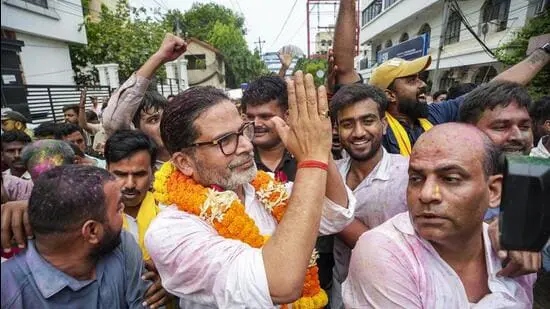
By-polls are hardly significant in empirically analysing larger electoral politics in India. But when a political rookie wrests a seat from a ruling party which the latter has not lost in three decades, and was held by its national president, some sort of analysis is called for.
Here are some key takeaways from the Prashant Kishor’s (PK) comprehensive victory in the Bankipur assembly constituency (AC) by-poll in Bihar.
The numbers are unambiguous. PK has polled almost 50% vote share in the election. The BJP, which has polled 35% of the vote share in these elections, has recorded its worst ever performance by a distance in this AC since it came in existence in 2009. The RJD, the main opposition party in the state, has been confined to just about 10% of the vote share. A simple comparison of vote shares from the 2025 assembly election results tells us that PK has gained voters from both the BJP and the RJD, given BJP’s and RJD’s vote shares of 62.6% and 29.5% respectively.
Bankipur is as unrepresentative of the Bihar’s electorate as it can get. It is perhaps the most urban and also the richest AC in all of state with a large share of upper caste voters. This means that it will be premature to extrapolate PK’s one-off victory in this AC for his party Jan Suraaj, which polled a paltry 3.4% of the share in the 2025 assembly elections. These facts however do not make PK’s Bankipur victory insignificant for the state’s larger polity. Here is why.
Bihar’s politics, with Nitish Kumar being kicked upstairs to the Rajya Sabha earlier this year, has crossed a political rubicon. Nitish was symptomatic of a larger coalition of extremes between the state’s upper caste and non-Yadav OBC population against the RJD’s Muslim-Yadav formula. Its political appeal was rooted as much in Nitish’s so-called good governance (of mostly low hanging fruits) as it did in creating a bogey of the return of the RJD in the state. The latter, given RJD’s back-to-back big losses in elections, has been losing its traction. The RJD, in today’s Bihar, is seen more a political party under siege than a political force which can put a siege on the state as was often attributed to its founding patriarch Lalu Yadav. This fact is increasingly becoming obvious to even the party’s core voters, especially the Muslims. The BJP, by deciding to nominate Samrat Choudhary as the chief minister, seems to have made a pivot towards incorporating a part of aggressive OBC politics legacy in the state than outrightly challenging it with upper caste support. The latter is what it brought to the original coalition of extremes with Nitish. While perfectly pragmatic, the strategy is unlikely to keep the party’s upper caste base in good humour like it was in supporting Nitish Kumar, who was seen as the vanguard of the ‘remove Lalu Yadav project’ in the state. The recent controversy in the state following the extra judicial killing of a Brahmin man underscores this sentiment. What makes things difficult for the BJP is that a generation of upper caste leaders of the party, who were instrumental in establishing it as a force to reckon with have passed away. The BJP has expanded its political footprint in Bihar but has seen a simultaneous weakening of its core in the state is the biggest message of the latest results.
PK is not the kind of political operator who would be content to become an MLA or an MP. He has had much larger share of political limelight and access in his previous life as a political consultant. His decision to not contest himself during the assembly elections and contest the current by-poll is in keeping with his political shrewdness. The only question which needs to be asked is what will he try and make of this victory in the state’s larger politics?
Here is my take on what will possibly be PK’s strategy. He is pragmatic enough to know that on its own his party cannot break political ground in Bihar. This makes it imperative for him to find a political partner in the state. The BJP and the RJD are automatically ruled out because neither would be willing to even share a part of their political status as the leader of the government and the opposition in the state with a third party. The JD(U), is currently in what can only be described as a trance of atrophy in its post-Nitish era. PK’s best bet for an alliance partner in the state is likely to be the Congress, which has enough of a legacy and recall value but very little strength on the ground to not mind a dominating partner who can bring some bling to its political appeal. Anybody who has been following the RJD-Congress engagement in the state knows that it has been a frigid relationship for a long time now. The social capital for this possible political alliance could come from two core blocks: upper caste Hindus and Muslims. They form the core of their respective political camp’s supports, namely, the BJP and the RJD, but are increasingly believing that the quid pro quo for their support has been diminishing. PK’s language of governance rather than confrontational caste or religious politics might give both these communities the perfect alibi to embrace promiscuity. The BJP will do all it can to prevent this attrition from its ranks. The RJD’s ability to do the same is less likely.