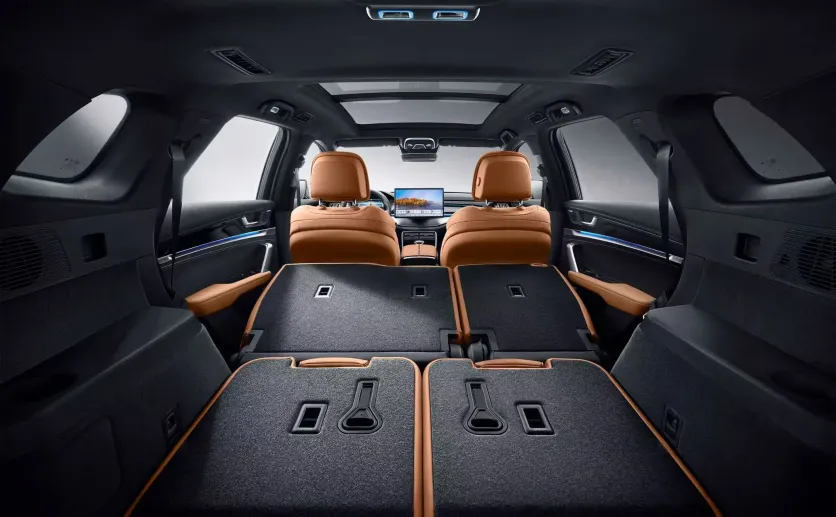
BYD has officially revealed the interior of the Sealion 08 — its most premium SUV to date — with the company’s Ocean Network general manager sharing images online on Thursday, a move that functions simultaneously as a design debut and a launch countdown signal. The six-seat cabin addresses buyers at a price point that has historically belonged only to European marques. Before any purchase decision, buyers need to understand one fixed legal condition: requires BYD to cooperate with Chinese intelligence authorities on demand, and the Sealion 08’s roof-mounted LiDAR sensor, 360° camera array, and rear-cabin personalization systems make this SUV a more capable data-collection platform than any vehicle BYD has previously sold globally.
Interior That Targets the BMW X7
The reveal marks the first time BYD has officially shown the full production cabin of the Sealion 08, completing the public picture of a vehicle that was first unveiled externally at the Beijing Auto Show in April and has been .
The interior design language is what BYD calls , applied to a three-row layout that accommodates six passengers in a five- or six-seat configuration. The cabin features a floating screen in the dashboard paired with a large LCD instrument cluster, a three-spoke D-shaped steering wheel with a column-mounted gear shifter, and a center tunnel housing a wireless charging pad, physical buttons, and a concealed storage compartment. Door panels use seashell-shaped handles in a nod to the lineup’s marine theme, and runs throughout the cabin.
Premium materials appear throughout. The headliner is suede-covered, the seats are leather-trimmed, and the seatbelts are finished in beige to match the interior palette. A is standard.
Second Row Is Where BYD Makes Its Clearest Statement
The rear cabin is where the Sealion 08 most directly targets the BMW X7 and Mercedes-Benz GLS. The second row offers two independent captain chairs with power leg rests; the right passenger seat adds a Both seats integrate cup holders in the armrests, and a folding table is positioned in front of the right rear passenger. A large ceiling-mounted screen is fitted for rear-seat occupants, along with independent climate control and both Type-A and Type-C charging ports. Heating and ventilation functions are standard for both second-row seats.
Third-row seating accommodates two additional passengers, completing the six-seat layout — though a five-seat version will also be offered.
Dimensions Rival German Flagships
The Sealion 08 measures , 1,999 mm (78.7 in) in width, and 1,800 mm (70.9 in) in height, riding on a 3,030 mm (119.3 in) wheelbase. Curb weight ranges from approximately 2,420 to 2,710 kg (5,335 to 5,975 lbs) depending on powertrain configuration.
Those dimensions place it alongside the BMW X7 (5,151 mm in its current generation) and the Mercedes-Benz GLS (5,206 mm) — two vehicles that start well above $90,000 in American trim. CarNewsChina has estimated Sealion 08 pricing at approximately (approximately $44,367 USD at current rates) for higher configurations, which would place it at roughly one-third the price of its European rivals if that estimate holds. Official pricing has not been confirmed.
800V Flash Charging and Up to 900 km of Range
Under the floor, the Sealion 08 shares its fundamental architecture with the Seal 08 sedan that TechTimes covered in July: an 800V high-voltage platform using BYD’s second-generation Blade Battery in lithium iron phosphate chemistry. The BEV version is available with two battery options — 92.093 kWh and 115.072 kWh — delivering CLTC-rated range of 710 km (441 miles) to 900 km (559 miles) depending on configuration. A rear-wheel-drive BEV produces 320 kW (429 hp); the long-range RWD variant rates at 370 kW (496 hp); and the dual-motor AWD version produces a combined peak of with a top speed of 250 km/h (155 mph).
Those range figures are CLTC ratings — China’s test cycle, which uses lower average speeds and more optimistic energy-recovery assumptions than the international WLTP standard or the EPA cycle used in the United States. Based on the Seal 08’s independently estimated WLTP discount of approximately 20–25%, a Sealion 08 rated at 900 km CLTC would deliver roughly 675–720 km (419–447 miles) under WLTP conditions, and approximately 530–580 km (329–360 miles) in real-world mixed driving. The Sealion 08 is a heavier vehicle than the Seal 08 sedan — curb weight runs up to 2,710 kg (5,975 lbs) in top trim — which will reduce real-world range further relative to the sedan’s estimates.
Flash Charging capability is the same as the Seal 08: can replenish approximately 400 km (249 miles) of CLTC range in five minutes, completing a 10%-to-97% charge in approximately nine minutes. That capability is a function of the Short Blade battery format’s 8C peak charge rate — which is physically only possible on an 800V platform. At a conventional 400V architecture, delivering the same power would require nearly 3,750 amps of current, beyond what any production charging cable can safely carry. Outside BYD’s proprietary charging network — currently , with a target of 20,000 by year-end — the Sealion 08 charges at the rate of a conventional EV.
A plug-in hybrid variant is also available, pairing a 1.5-liter engine producing 115 kW (154 hp) with a 200 kW (268 hp) electric motor and delivering up to 400 km (249 miles) of CLTC electric-only range. The (124 mph).
God’s Eye B and Why LiDAR Changes the Data Equation
The Sealion 08 is equipped with DiPilot 5.0, BYD’s driver-assistance suite, in a configuration designated God’s Eye B. The system uses a roof-mounted LiDAR sensor — a hardware choice that distinguishes BYD’s premium models from rivals relying on camera-only setups — and supports city navigation on autopilot, highway navigation on autopilot, and automatic emergency braking. Chassis hardware includes rear-wheel steering and BYD’s DiSus-A dual-chamber full air suspension with road-preview capability.
The LiDAR sensor is worth understanding in the context of what this vehicle collects. A conventional connected vehicle’s privacy risk is primarily transactional: GPS location, driving behavior, smartphone data mirrored through the infotainment system. A vehicle with a roof-mounted LiDAR generates something qualitatively different: a continuous of the vehicle’s external environment, captured at approximately 10 to 20 complete scans per second. That data includes the physical surroundings of every road the vehicle travels — building layouts, pedestrian positions, other vehicles’ positions and license plates — not just the vehicle’s own GPS coordinates.
Under , Article 7, BYD is legally required to support, assist, and cooperate with Chinese national intelligence work on demand. This obligation applies to BYD as a Chinese company regardless of where its vehicles operate, where their data is physically stored, or what BYD’s privacy policy states. China’s Data Security Law (2021) and Cybersecurity Law (2017, amended January 2026) add data localization requirements and government-access provisions for data classified as “important” under those statutes. These are fixed legal conditions, not contested allegations.
What Connects the Cabin to the Data Question
BYD’s European head stated publicly that European customer data is processed within Europe via Google Cloud, and BYD passed China’s voluntary automotive data security assessment in December 2025. Neither assurance overrides the National Intelligence Law’s statutory obligation. In October 2025, demonstrated that the infotainment unit of a 2023 BYD ATTO 3 stored personal data — including contact lists with relationship metadata, healthcare provider information, and cellular identity codes — in unencrypted form, and confirmed ongoing transmission to Chinese servers via a pre-installed GSM modem. That finding produced CVE-2025-7020.
The Sealion 08’s rear-cabin systems add data categories not present in a simpler connected car. Zero-gravity seat position preferences, heating and ventilation patterns, ceiling screen content and usage, armrest charging activity — each of these can be tied to individual passengers and stored as behavioral or biometric-adjacent data. Combined with the LiDAR environmental scan, the GPS location history, and the mirrored smartphone data from up to six passengers across three rows, the Sealion 08 is a substantially richer data-collection platform than the Seal or Sealion 7 models that preceded it.
Buyers in markets where BYD currently sells vehicles can take partial mitigation steps: avoiding smartphone synchronization to the infotainment system reduces contact and app data exposure, and the EU Data Act (effective September 2025) grants connected-vehicle users the right to request access to data collected about them. Neither measure changes the legal framework under which BYD operates as a Chinese company.
What the Sealion 08 Cannot Yet Do
The City Navigation on Autopilot function enabled by God’s Eye B is available in China from launch. Outside China, the feature requires separate regulatory approval and mapping validation in each operating jurisdiction — timelines BYD has not announced for any international market. The same restriction applies to any advanced driver-assistance feature dependent on local HD map coverage.
The Sealion 08 has not been confirmed for sale in any market outside China as of this writing. The bans the sale or import of connected passenger vehicles from Chinese-controlled companies effective model year 2027, a rule that applies to BYD. European buyers face a combined tariff of approximately 27% on BEV Chinese imports; BYD’s Szeged, Hungary manufacturing plant is targeted to begin vehicle assembly in the fourth quarter of 2026, which could reduce that exposure over time but has not yet produced any vehicles.
No independent Western government evaluation of the Sealion 08’s real-world performance had been published as of this writing. BYD’s published specifications are self-reported and use Chinese testing standards.
Since BYD established the Ocean Series in November 2021, vehicles in the lineup have collectively surpassed six million units in global sales, with models including the Song Plus, Seagull, Dolphin, and Seal each individually crossing the one million sales mark. The Sealion 08 is positioned as the crown of that family. The interior reveal today is functionally the final step before pricing is set. When pricing is announced, buyers will have the full picture of what this vehicle offers — and what it obliges them to accept.
Exchange rate as of July 31, 2026; conversions are approximate.
Frequently Asked Questions
What is the BYD Sealion 08’s real-world range outside China?
BYD’s quoted range figures — 710 km (441 miles) to 900 km (559 miles) depending on battery size — use China’s CLTC test cycle, which is less demanding than international standards. Based on the independently estimated WLTP discount of 20–25% applied to the related Seal 08 sedan, a Sealion 08 rated at 900 km CLTC would likely deliver approximately 675–720 km (419–447 miles) under WLTP conditions. In real-world mixed driving, expect roughly 530–580 km (329–360 miles). The Sealion 08 is heavier than the Seal 08 sedan — by up to 290 kg (640 lbs) at the top trim level — which will further reduce range below the sedan’s adjusted estimates.
Does China’s National Intelligence Law apply to Sealion 08 buyers outside China?
Yes. China’s National Intelligence Law (2017), Article 7, requires BYD — as a Chinese company — to support and cooperate with Chinese intelligence authorities on demand. This legal obligation applies regardless of where the vehicle is driven, where data is stored, or what BYD’s privacy policy says. The Sealion 08’s roof-mounted LiDAR generates continuous environmental point-cloud data in addition to the GPS location, driving behavior, and mirrored smartphone data that standard connected vehicles collect. No server location choice or privacy certification changes BYD’s statutory obligation under that law. Buyers can limit some exposure by avoiding smartphone sync, but no technical measure fully resolves the structural legal condition.
Is the BYD Sealion 08 available to buy outside China?
Not at this writing. The Sealion 08 has only been confirmed for sale in China, where pricing has not yet been officially announced. BYD has not released export plans, regulatory filings, or availability timelines for any international market. US law specifically prohibits the sale or import of connected Chinese-made vehicles effective model year 2027. European buyers face approximately 27% in combined tariffs on BEV Chinese imports, and BYD’s first European factory (Szeged, Hungary) has not yet begun producing vehicles.
How does BYD price a LiDAR-equipped six-seat SUV below BMW X7 territory?
BYD manufactures — including battery cells, power management semiconductors, and vehicle software — eliminating the supplier margin that Western automakers pay to third-party battery, chip, and software vendors. The Blade Battery 2.0’s research and development costs are amortized across a lineup that sold over four million vehicles in 2025. That cost structure allows BYD to deploy its most advanced battery platform and a roof-mounted LiDAR sensor in a product priced at a fraction of European equivalents. The tradeoff is a connected-vehicle architecture subject to Chinese data law, limited international charging infrastructure for Flash Charging, and no confirmed sales outside China.