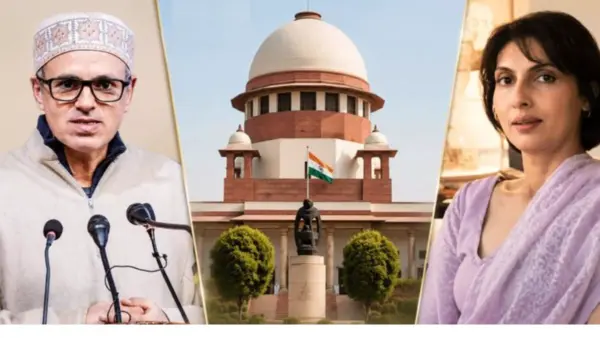
The Supreme Court on Friday granted Jammu and Kashmir Chief Minister Omar Abdullah and his estranged wife, Payal Abdullah, a divorce after being informed that they had resolved the dispute amicably and “embraced freedom”.
A bench chaired by Justices PS Narasimha and Alok Aradhe disposed of the appeal filed by Abdullah after senior advocate Kapil Sibal. The apex court stated that all disputes between the two parties had been amicably resolved through mediation, according to Bar and Bench.
Sibal clarified to the apex court that both parties had jointly invoked Article 142 of the Constitution to seek dissolution of their marriage by mutual consent. “Both of them have embraced freedom. It’s all settled. Lordships may grant divorce. All other matters will be withdrawn,” he said in his submission. “That’s good. We will dispose of it on those terms,” the Bench responded.
The Divorce
Omar Abdullah and Payal Abdullah married each other in September 1994 but were separated for a long time. The couple has two sons – Zahir and Zamir. They had been living separately since 2009 before the National Conference (NC) leader officially announced his separation from Payal in 2011.
The Supreme Court, on April 25, had directed Omar Abdullah and Payal Abdullah to make an attempt to resolve their matrimonial disputes. In December 2023, the Delhi High Court had dismissed his petition for divorce, upholding the 2016 family court order that refused to grant a decree of divorce to Omar.
‘Desertion and cruelty’
Abdullah, at the initial stage, sought divorce on the grounds of desertion and cruelty.
The High Court had stated that the allegations of cruelty were “vague and unacceptable”, adding that Omar had failed to present evidence of any behaviour by Payal that could be deemed as “cruelty”, HT reported.
“We find no infirmity in the view taken by the family court that the allegations of cruelty were vague and unacceptable, that the appellant failed to prove any act which could be termed as an act of cruelty, be it physical or mental, towards him,” the Court had said.