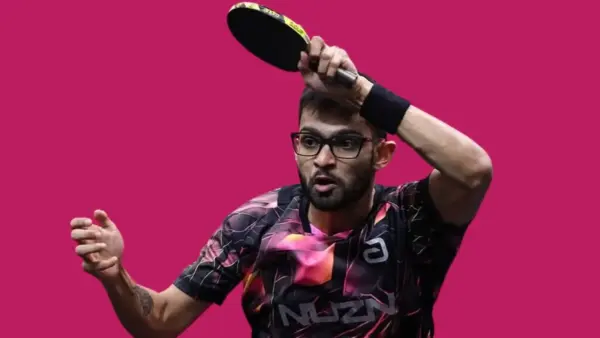
The Thyagaraj Stadium in New Delhi witnessed a masterclass in competitive temperaments this week, as the top-seeded Indian men’s and women’s teams both secured team gold against Malaysia at the 22nd Commonwealth Table Tennis Championships.
While the women executed a clinical, expected sweep, the men’s path to retaining their title was a five-match emotional rollercoaster fueled by a thirst for redemption.
Here is a closer look at the tactics, turning points, and sheer willpower that defined a historic double-gold finish.
A Five-Match Thriller: Emergence of New Champion of the Hour
Going into the men’s final, India’s brain trust made a bold tactical gamble by resting veteran Harmeet Desai. The strategy set the stage for an intense battle against a Malaysian side that had previously shocked India in the league phase. This time, it was Manush Shah who emerged as the undeniable hero of the hour.
While World No. 41, Injured Paddler Manav set the tone of the opening round with a descent win against Javen Choong with set score 3-1 ( 12-10, 11-7, 5-11, 11-5 ), early in the tie, Shah proved his mettle by pulling off a stunning comeback against left-hander Wong Qi Shen. Staring down a 4-7 deficit in the deciding game, Shah rattled off seven consecutive points to win the crucial rubber. The drama only escalated when Sathiyan lost his individual against Tey Hong ( 7-11, 8-11, 10-12 ) and pressure shifted to the team’s ace paddler, Thakkar who surrendered a 2-0 lead to lose 2-3 against Wong in the fourth set even after trying hard, drawing the match score at 2-2.
With the championship hanging in the balance, Shah stepped up for the deciding fifth rubber against Javen Choong, Channeling the confidence from his earlier victory, Shah dominated Choong in straight games with set score (11-7, 11-4, 11-4), single-handedly winning two matches to ensure India retained their defending champion title and lastly emerged as the star paddler of the Indian team turned the evening memorable.
Post the crucial yet the much emotional 3-2 victory against Malaysia as to defend the team India title, World No. 40 spoke with Vishal Sharma regard overall experience in finals and his tactics to win.Manush Shah:
“The match against Malaysia was an interesting one. We had lost to them 1-3 in the group stage. Their first player was very strong, and Harmeet, Manav, and I had all lost our respective matches. We were well prepared for the final and decided to have Manav open the tie because he had played a fantastic match against Javen Choong in the group stage. He gave us the perfect start,” Manush Shah said.
“My match was tough. I have had a good record against left-handed players recently, and playing against Wong was a strategic decision by our team. In the deciding game, I was trailing by three points and didn’t have the best start. But I fought back to make it 7-7, stayed sharp in the closing stages, and was happy to contribute an important point for the team.”
“When the score was 2-2, I had to step up again for the deciding rubber. Choong is a good friend of mine and we’ve had some memorable matches since our junior days. It was another tough contest, but I stayed sharp. With the support of the home crowd and my teammates, I managed to pull through. Winning the gold medal in front of the Indian fans is a special feeling,” the Indian paddler added.
The Women’s Tactical Sweep
In stark contrast, the second-seeded Indian women’s team showcased authoritative composure, securing a 3-0 sweep over the Malaysians. However, a flawless scorecard often masks the strategic battles fought at the table.
Swastika Ghosh set the tone early. Despite a brief lapse in concentration that cost her a game after a 2-1 lead, she quickly regrouped to outlast the Malaysian penholder Ai Xin Tee 3-1 which gave great confidence in team compatriots to defend the title.
The real test of endurance came for World No. 67 Sreeja Akula. Facing the left-hander Karen Lyne Anak Dick, Akula saw her 2-1 advantage vanish as the Malaysian forced a decider. Relying on her signature tricky variations, deceptive spin, and swift footwork, Akula quickly wrapped up the fifth game to double India’s lead. Also, gave a huge confidence and big advantage to team India for clean sweep win and retain the defending champions title.
There comes the third rubber in the picture as Yashaswini Ghorpade applied the finishing touch to help the Indian team successfully defend their title. Facing Alice Chang, Ghorpade was handed the notoriously tacky and frustrating task of breaking down a resilient defender. After splitting the first two sets 1-1, the match evolved into a grueling tactical war.
In a fiercely contested third set, where both players struggled to seize a decisive advantage, Ghorpade showcased immense maturity. She remained remarkably calm, patiently relying on short, precise backhand placements at the net to draw Chang out of her comfort zone. The moment an opening appeared, Ghorpade would strike with non-returnable forehand topspins.
The third set went deep into extra points as both players battled for control. Gripping a narrow 16-15 lead, Ghorpade took a quick, strategic break to compose herself. She returned to the table and immediately sealed the marathon set 17-15 with a blistering, aggressive forehand topspin. Having broken her opponent’s momentum, Ghorpade steamrolled through the fourth set with a commanding lead, officially outlasting Team Malaysia and securing the 3-0 team sweep.
After the emotional and crucial 3-1 win defending the teams title for India, World No. 64, Ghorpade caught up in a quick interview with freelance journalist, Vishal Sharma discussed about her strategy and tactics which helped her let seal the title and her overall experience, also shared a bit around Asian Games coming up next big target.
“I think, in the first set I was up 7-4 and then I started to hesitate for the flats and started rushing all the rallies, also was reckoning about the win and defending team title so, lost the focus and momentum. But, from the second set, I really got great support from the bench as they told me to be calm and patient and I firmly believes that has helped me play further well. The second and third set were crucial to play and win and, I am really happy to win the match 3-1,” World No. 64, Yashaswini Ghorpade said post crucial win against Malaysia.
“Yes I was looking for the opportunity to finish off the defending rallies with forehand flats that was my strategy to play against her in each ties, after loosing first one I kept the momentum being calm, especially in the third set I remain composed as the rally went long I was finding a way to seal the set and happy could execute at 17-15 before the expedite rule would have applied otherwise it would have been tough, since I never experienced and that could perhaps stressed me,” she stated.
“All my team compatriots played really well, gave their best to let India defend their title, it’s just that we had already somehow planned and strategized that I’ll play against the Malaysian defender to sweep them 3-0 and it worked in our favour only,” she further added.
“I think, I will keep the same schedule and routine for everything from court preparation to the physical fitness, including my gaming style and technique, from sometime I am playing quiet well so, yes wont change. Also, now that we have good bonding and understanding in our team, I think it’s good for us to compete at Asians as a team.”
“I get inspired from seniors like Manika Batra and Sreeja Akula, so looking forward to the Asian Games coming up, and will fight hard for the medal there and this event is like good prep and warm up before the big show. And ya, whenever I am free, I follow badminton for sure, especially H S Prannoy, Satwik-Chirag, they are really inspiring too,” said the second highest world ranked Indian paddler, Yashaswini Ghorpade.
The 2026 Commonwealth Table Tennis Championships offered a record-breaking total prize purse of $110,000. From this pool, $20,000 was dedicated to the team competitions, awarding $10,000 to the champions, $5,000 to runners-up, and $2,500 to the semi-finalists.
An Electric Atmosphere and a Golden Era
India’s gold-medal campaign in New Delhi highlighted the nation’s versatility on the table moreover was a masterclass in adaptability. While the women’s squad marched through the tournament with ruthless efficiency to secure a clean sweep, the men’s path to the gold was far more grueling. Pushed to the absolute limit in a 3-2 thriller against Malaysia, the men faced a much harder road. Pushed to the brink in a grueling 3-2 thriller against Malaysia, the men’s team showed incredible grit, surviving a tense, back-and-forth battle to successfully defend their championship title.
Throughout the finals, the energy inside the Thyagaraj Stadium was palpable. Fans threw their unwavering support behind the home teams, cheering loudly for every crucial point and tactical victory. When the final match concluded, officially securing the title defense for both the men’s and women’s teams, the entire arena erupted. A thunderous standing ovation followed, with the sound of echoing claps and cheers filling the stadium to celebrate a truly historic moment.
While the team events have concluded on a golden note, the excitement in New Delhi is far from over. Fans and the public are encouraged to stay tuned, as the championship now shifts gears into the individual, doubles, and mixed categories, promising even more thrilling, high-stakes matches in the days ahead.