
Automobile giant Maruti Suzuki India is set to announce its June quarter results on July 31, 2026. India’s largest carmaker is likely to report mixed quarterly earnings with double-digit growth in revenue but profitability could remain muted.
According to experts, Maruti Suzuki’s consolidated revenue could increase by 32 to 35% YoY in the range of ₹51,400 to ₹51,900 crore, while its net profit could decline by 6 to 12% YoY to ₹3,300 to ₹3,550 crore. Profitability could be impacted due to higher raw material costs during the quarter, while the EBITDA margin is likely to contract by 120 to 140 bps on a yearly basis due to high input costs.
Maruti Suzuki reported consolidated revenue of ₹38,605 crore in Q1FY26 and ₹52,462 crore in the previous quarter. Meanwhile, its net profit stood at ₹3,792 crore in the same quarter of the previous fiscal year and ₹3,659 crore in Q4FY26.
Investors will keep an eye on the management commentary on demand trends, upcoming new product launches. Ongoing pressure from input costs, export volumes and near-term outlook will also be closely monitored.
Ahead of the Q1 result announcement, Maruti Suzuki shares closed 1.6% higher at ₹14,180. So far this year, Maruti Suzuki shares are trading flat.
Technical analysis
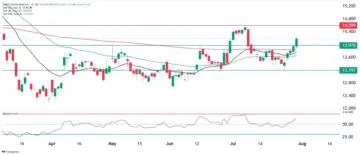
Maruti Suzuki has turned positive after breaking above the ₹13,976 resistance level. The stock is trading above its 20-day, 50-day and 200-day EMAs, indicating an improvement in both short-term and broader momentum. RSI near 61 also supports the bullish bias without showing overbought conditions. Sustaining above ₹13,976 could extend the recovery towards the previous swing resistance at ₹14,599.
On the downside, ₹13,976 will now act as the immediate support. Below this, the moving-average cluster around ₹13,750-13,840 becomes important. As long as the stock holds above this zone, the structure remains positive.
Options outlook
As of 30 July, Maruti Suzuki’s February at-the-money (ATM) strike for 25 August expiry stood at 14,100, with both call and put options priced at ₹956. This suggests an expected price move of about ±5.6%.
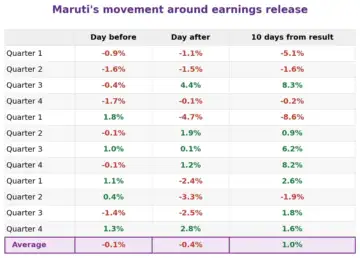
Before getting into options strategies, it helps to first review how the stock has behaved around earnings announcements over the past three years.
Options strategies for Maruti Suzuki
With the options market pricing in a potential move of about ±5.6% for the 25 August expiry, traders can look at both volatility-driven and directional setups.
For a volatility-focused approach, a long straddle involves buying an at-the-money (ATM) call and put with the same strike and expiry. This position benefits from sharp moves in either direction.
On the other hand, a short straddle means selling both an ATM call and put. This works when you expect the stock to stay relatively stable. If the move remains within the implied ±5.6% range.
For a directional view, spreads offer a more defined risk setup. A bull put spread involves selling a higher strike put and buying a lower strike put, aiming to profit if the stock stays above a certain level or moves higher. A bear call spread, in contrast, involves selling a lower strike call and buying a higher strike call, suited for a mildly bearish outlook.