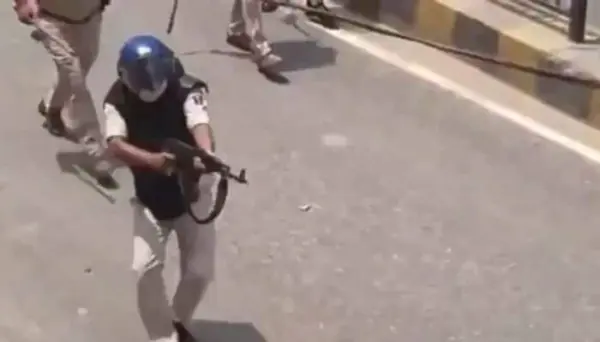
New Delhi: The AK-47, one of the worlds most recognisable assault rifles, has become a topic of debate in India after a Bihar Police personnel was seen firing the weapon during a protest in Siwan.
A video showing a police officer firing the weapon during the July 25 student protest went viral on social media. The agitation was organised over NEET paper leak and demands for the resignation of former Union Education Minister Dharmendra Pradhan. The incident led to action against the police personnel, with the Bihar Police suspending SI Abhishek Patel, who was part of the Special Investigation Team (SIT).
Civil police forces do not normally use AK-47 rifles for handling protests. The weapon is mostly kept for military operations, counter-insurgency duties and special security tasks.
Siwan District Magistrate Vivek Ranjan Maitrey said the officer did not have permission to use the weapon in that situation. He said the cop should not have carried such a weapon in a public area and should not have fired in the air.
He did not have orders. He should not have even carried out aerial firing. He should not have taken such a weapon into the public. He was trapped and was going somewhere else but got stuck there, said the district magistrate.
The incident drew criticism from Opposition leaders, who questioned the use of the rifle during a protest.
Why AK-47 is considered a special weapon
The AK-47 was made by Soviet engineer Mikhail Kalashnikov in 1947. Over the years, it became one of the worlds most common firearms because of its simple design, low maintenance requirements and ability to work in difficult conditions.
More than 100 million Kalashnikov rifles are estimated to have been sold across the world. The weapon has been used by armies, security forces, insurgent groups and criminal networks across several countries.
Former IPS officer Rajesh Pandey, who has handled several security operations, said the rifle is popular because of its reliability and firing capacity.
He recalled his experience during a United Nations peacekeeping mission in Kosovo, where he received training on several modern weapons. According to him, the AK-47 stood out because it was easy to operate and had a powerful range.
It can be used in different firing modes. In single-shot mode, it fires one bullet at a time, allowing better control. In automatic mode, it can fire multiple rounds continuously.
Former IPS officer Arun Kumar explained that automatic firing is meant for situations such as war, terrorist attacks or operations against heavily armed criminals. It is not meant for handling normal law and order situations.
In law and order situations, the repeat mode is never used. Our training is that one bullet is for one enemy. Civilians are not enemies, so such weapons are not used against them, he said.
When did AK-47 came in India?
The use of AK-47 rifles in India expanded after the Soviet Unions military intervention in Afghanistan in the late 1970s. As the weapon became common in the region, Indian security agencies also began adopting it for specialised operations.
The rifle was first provided to the Army, paramilitary forces, border units and police forces operating in insurgency-affected areas.
In the late 1980s, the Punjab Police and police forces in the Northeast received AK-47 rifles to deal with militancy. Later, the Jammu and Kashmir Police and forces fighting Maoists violence were also equipped with the weapon.
Pandey said the rifle was also used by special units created to tackle major security threats. The Special Task Force formed to capture sandalwood smuggler Veerappan in South India was equipped with AK-47 rifles. Similar weapons were provided to the Uttar Pradesh Police during operations against armed groups in sensitive areas.
AK-47s controversial cases in India
One of the most discussed AK-47-related cases in India involved actor Sanjay Dutt. After the 1993 Mumbai serial blasts, the police recovered an AK-56 rifle from his residence during an investigation into illegal possession of weapons.
He was arrested in April 1993 and was later convicted under the Arms Act in 2006. He was acquitted of charges under the Terrorist and Disruptive Activities Act (TADA).
Another major incident involving the rifle was the 1995 Purulia arms drop case. A Russian aircraft dropped wooden boxes containing hundreds of AK-47 rifles and other weapons over Purulia in West Bengal. The case later revealed that some of these weapons reached criminal networks in parts of Bihar and Uttar Pradesh.
Can police use AK-47 during protests?
Security experts say the use of firearms during crowd control is governed by strict rules. The police are trained to use minimum force, with firing considered the last option after other methods fail.
The standard procedure involves issuing warnings, using water cannons, tear gas and baton charges before considering firearm use.
Pandey said the Siwan incident was not appropriate because the protesters were not carrying weapons and there was no situation that required such a response.
The AK-47 continues to be an important weapon for security forces dealing with armed threats, but experts say its use in routine public order situations is limited because of its firepower and purpose.