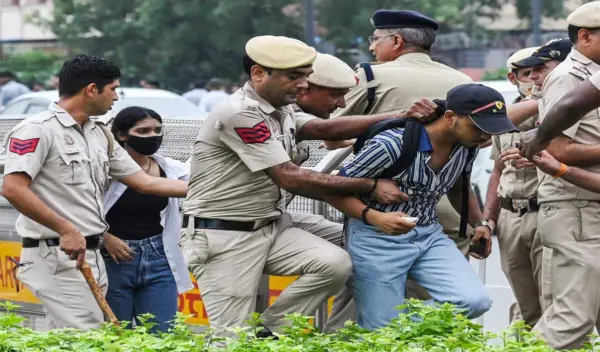
The Delhi Police is set to initiate the process of revoking passports for individuals identified as participants in recent riots, alongside pursuing legal actions under existing laws.
This move indicates a stringent approach towards those accused of engaging in violent protests.
Violence During CJP’s March
This decision follows violent incidents that occurred during the ‘Chalo Parliament’ march organized by the Cockroach People’s Party (CJP) on Monday, where protesters attempted to breach security barricades surrounding the Parliament. In response, security forces deployed tear gas, conducted baton charges, and utilized riot control vehicles. Several protesters and police personnel sustained minor injuries, while the party claimed that its founder, Abhijit Dipke, was taken into custody.
CJP Calls for Nationwide Protests
In the aftermath of the violence, the CJP announced plans for peaceful nationwide protests on July 24, urging demonstrations in every district against the alleged police brutality faced by students during the NEET movement. The party has called on student unions and organizations to coordinate locally, publicly voice student demands, and express solidarity with those affected by police actions. Until this week, protests at Jantar Mantar had been relatively small, with students and activists gathering daily to oppose alleged irregularities in the NEET exam and to demand the resignation of Union Education Minister Dharmendra Pradhan. However, the situation escalated following the clashes with police on Monday.
Large Crowds Gather
On Monday, a significant crowd began to gather at the protest site, with many participants joining for the first time; the roads leading to Jantar Mantar were filled with people. CJP organizers expressed uncertainty about estimating the crowd size, while numerous protesters mentioned that they were inspired to join the movement after viewing videos of police actions. Meanwhile, political tensions surrounding the student protests intensified, with Union Minister Jitendra Singh accusing Rahul Gandhi of backtracking on his statements, even as the government agreed to discuss the alleged NEET irregularities in Parliament.
Ongoing Protests by Congress Leaders
These statements came as Congress leaders continued their sit-in outside Prime Minister Narendra Modi’s residence, demanding discussions in Parliament regarding the resignation of Union Education Minister Dharmendra Pradhan, the NEET issue, and the alleged police actions against students. Earlier in the day, several Congress MPs and senior leaders protested outside the Prime Minister’s official residence at 7 Lok Kalyan Marg, also calling for the resignations of Prime Minister Modi and Home Minister Amit Shah in light of the police actions during the CJP’s ‘Chalo Parliament’ march.