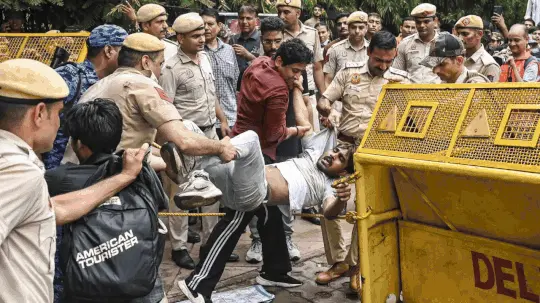
The student agitation has moved out of hostels and lecture halls and onto the road. Classes are being missed, campuses are tense, and the conversation has begun to spill into politics, which is exactly where most of the people who work with young people say it should not go.
Times Now Digital reached out to educationists, senior police officers who have handled , and lawyers who argue in the country’s . They do not agree on everything. Some were blunt about who should be held responsible; others stayed strictly administrative. But read together, their answers point to five things that could bring students back to their desks.
1. Talk to the students. Directly, and first.
Almost every expert began at the same place: someone in authority has to sit across a table from the students themselves.
Sunita Swaraj, a Harvard Graduate School of Education alumna, former principal and education reformer, put the diagnosis plainly. “Student protests reflect a gap in trust that cannot be resolved by enforcement alone,” she said, adding that “the priority should be meaningful dialogue, academic continuity, and a clear roadmap that reassures students while restoring normalcy.” Her first step is the simplest one on any list: “Start direct dialogue with student leaders.”
Supreme Court advocate Avishkar Singhvi argued the sequencing has already slipped. “The first and most important response should have been meaningful engagement through constructive dialogue to understand the students’ grievances and to formulate an appropriate response,” he said.
Dr Jyoti Gupta, Director Principal of The Shri Ram Universal School, Ghaziabad, suggested a way to make that conversation credible: a “Neutral mediation panel: Appoint trusted retired judges or senior educators to lead face-to-face talks.”
And Praneet Mungali, Trustee of the Sanskriti Group of Schools, framed it as something the government should offer rather than wait for. “Hold a genuine public conversation with the students, rather than letting them go as a last resort to the streets,” he said.
2. Independent probe in paper leaks: “Dharmendra (Pradhan) Out”
The trigger for the anger is the examination system, and the experts want that addressed on its merits rather than folded into a political argument.
Praneet Mungali’s first ask was accountability with distance from the system it is examining: “Establish credible and independent accountability for the alleged paper leaks and examination failures that gave rise to this movement.”
Dr Gupta wanted both speed and technology. “Ensure exam integrity: Fast-track independent investigations into paper leaks and implement airtight digital testing safeguards,” she said, and separately called to “Enact institutional accountability: Review structural failures within national testing bodies and enforce strict accountability for administration lapses.”
Dr Meeran Chadha Borwankar, a retired IPS officer, was equally clear about the destination – and sceptical of a popular shortcut. “Creation of special fast-track courts will not solve the problem, as pendency in such courts too is massive. And our conviction rate is quite poor,” she said. “We do need a merit-based examination system.”
Yashowardhan Jha Azad, former IPS officer who has served as Special Director, IB, and Secretary (Security), Government of India, went furthest. In a terse prescription he called for “Dharmendra (Pradhan) out. IAS cabal out. Academicians in. Drive against education mafia. Computer based exam. Those unsuccessful, get them something.” His summary of what is needed: “Massive education reforms.”
Singhvi’s version is procedural rather than personal. “A clear roadmap for comprehensive reforms to the system of central examinations, ensuring fairness, transparency and accountability”, backed by “robust institutional safeguards to prevent similar lapses from recurring.”
3. Take the lathi off the streets: De-escalate security measures
On how the protests themselves are handled, the language from the experts is careful but firm.
Swaraj listed it as a step in its own right: “Ensure peaceful campuses and avoid escalation.” Dr Gupta called on authorities to “De-escalate security measures: Halt aggressive crowd control tactics highlighted by monitoring bodies.”
Borwankar, who spent a career in policing, was direct: “Students need to be heard instead of being prosecuted.”
Singhvi’s list included “Withdrawal of criminal proceedings against students who participated in peaceful protests, while ensuring that their democratic right to dissent is respected.” Mungali asked for the mirror of that – “Independently examine every allegation of excessive force, fixing responsibility wherever misconduct is established.”
Senior advocate Akhil Sibal went a step further, suggesting a gesture rather than a procedure. “Especially after the violence suffered by peaceful protesters at the hands of the law enforcement personnel, a significant, symbolic gesture by the government, such as the resignation of the concerned minister would go a long way in restoring calm and dialogue, and will bring the government closer to the people it seeks to govern,” he said.
4. Protect the academic year and publish the dates
Beneath the politics is a very practical student worry: a year is slipping away, and nobody has told them what the calendar looks like now.
Swaraj’s answer is administrative and immediate – “Share a clear action plan and timeline” and “Protect classes and revise academic schedules if needed.”
Dr Gupta wants that commitment put in writing and treated as binding: “Publish transparent timelines: Release a clear, non-negotiable annual examination and recruitment calendar to eliminate student ambiguity.”
5. Build something permanent – and look beyond the exam hall
The last point is about what happens after the streets clear.
Swaraj’s fifth step is structural: “Create a permanent student consultation mechanism.” Singhvi similarly wants the process widened to “Meaningful engagement with student representatives and other stakeholders” and “Constructive and transparent dialogue to build consensus.”
Borwankar pointed to the pressure sitting underneath the exam grievance. “The high unemployment and under-employment rates have disturbed the ambitious youth of the day. That is bothering them & is indeed a cause of serious concern,” she said.
Mungali put it as a question of hearing rather than agreeing. “Understanding is more important than agreement. I do not know whether every demand these protestors are making is correct. That is not the point. A generation is asking to be taken seriously. We should be deeply concerned if our response teaches them that they will not be,” he said.
And Singhvi’s framing of the moment: “This is a moment for issue-based governance, not vote-bank politics.”
The classroom is watching
Mungali, who works with schoolchildren every day, offered the observation that lingers longest.
“We educators spend twelve years telling children that their questions matter, that disagreement is legitimate, and that they should think for themselves rather than simply accept what they are told. Then they turn eighteen, act on exactly those lessons, and some are met with batons,” he said. “That contradiction does not remain in Delhi. It travels back into every classroom in the country.”
The students on the street are not, by most accounts of the people quoted here, asking for anything exotic. They are asking for an exam they can trust, a timetable they can plan around, and an adult in the room willing to listen without a stopwatch running.
As Sibal put it: “All they want is to be heard, and for their grievances to be addressed, not to be patronised and talked down to.”
Five steps. None of them requires a new law, a new budget line, or a new committee to think about committees. Which raises the only question that really matters now – if the way back to the classroom is this clearly marked, what is stopping the first step?