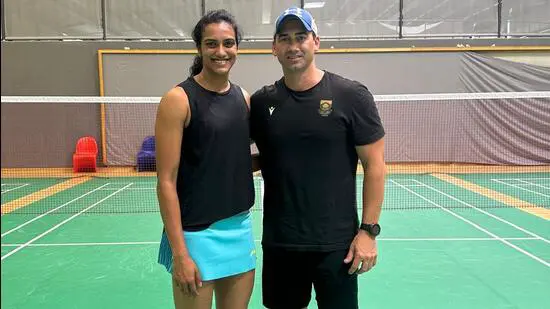
For nearly two years, a haunting question echoed through the halls of Indian badminton, growing louder with every tournament – is PV Sindhu done?
At 31, a lingering foot injury and a subsequent rehab setback had left the two-time Olympic medallist and world champion at a career crossroads.
But on Sunday in Tokyo, those doubts were dispelled. Defeating home favourite and reigning world champion Akane Yamaguchi in straight games to capture the Japan Open title, Sindhu’s triumph marked the culmination of a radical, data-driven transformation engineered by sports scientist Wayne Lombard.
When the South African was brought back into Sindhu’s camp last October, he found an athlete stuck at a physical dead end. His first move was drastic – bringing the curtains down on her season to clear the path for a complete structural rebuild.
He assembled a specialised crew – it included strength and conditioning coach Shreyasi, physio Heera Mundluru and nutritionist Nicole Kedia – and shifted the philosophy from exhausting, high-volume training to hyper-monitored, smart work.
To pull Sindhu out of her injury cycle, Lombard introduced a level of technological precision previously unseen in her routine. Because GPS does not work indoors, Lombard deployed Inertial Movements Analysis (IMA) data to eliminate guesswork and obtain a highly advanced measurement on her physical effort on court.
“What that allows me to do is start getting an actual objective measure of her load on court,” Lombard told HT from Cape Town. “How much estimated distance she’s doing, how much change of direction she’s doing, how many times she’s jumping, how many times she is going right to left, and with what intensity is she going into those movements. Not only during training, but now we’ve been able to get a real good mapping of what her intensity in matches looks like.”
Armed with this objective biometric mapping, Lombard completely flipped the traditional sporting philosophy of “training how you play” on its head. “I believe in the other way around,” Lombard says. “I want to play how we train because training needs to be more intense than the matches. But we don’t know what that is if we don’t have objective data.”
By using the IMA data to establish exact baselines of what Sindhu’s body endured during top-tier matches, Lombard and the coaching staff tailored training sessions to mimic and exceed those specific outputs. This ensured she trained at maximum required intensity without structural overload.
The data tracking extended far beyond court movements. Lombard began monitoring Sindhu’s internal loads to map exactly how her physiology responded to stress, tracking heart rate variability and recovery, along with sleep cycles.
Crucially, Lombard managed her recovery with scientific restraint rather than overloading her with artificial treatments. “What a lot of people think is that we just need to train, and then we need to go do as many different recovery modalities as possible, so we can train the next day,” he says. “But we also want physiology to learn how to adapt to certain stimulus. Because if physiology is not adapting, we’re not getting better and stronger and faster.”
By strategically restricting synthetic recovery tools, Lombard forced Sindhu’s body to naturally adapt to the training stimulus while aggressively prioritising the biological bedrocks of recovery – targeted nutrition and optimised sleep cycles.
This rigorous, data-first approach triggered a flawless, stepwise progression. Returning to the circuit in January, Sindhu’s physical metrics climbed tournament by tournament. Her immediate buy-in to Lombard’s scientific framework allowed her to remain entirely injury-free, bringing a distinct physical sharpness back into her game.
For Lombard, the data on his screen matters far more than any fixation on how old she is. “In India, it’s made too much of an issue with her age. That’s just a number,” says Lombard. “I don’t look at the birth certificates. I want to see the person in front of me and how she’s moving and adapting. If we put the programme together that’s best suited for her… physiology takes care of itself.”
With Sindhu returning to the top step of the podium in Tokyo, her eyes are already set on the World Championships here in August. Thanks to a revolution in sports science, the seasoned champion isn’t just surviving the physical demands of elite badminton – she is dictating them.