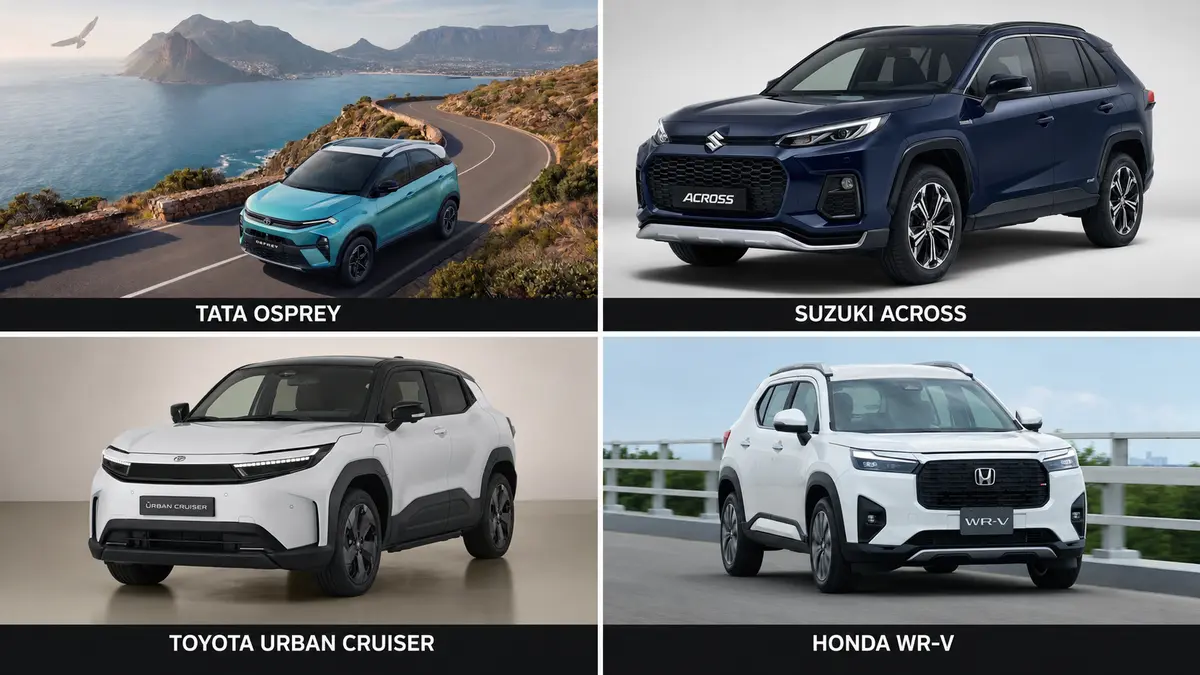
Tata Motors Passenger Vehicles will sell its India-made Nexon in South Africa as the Tata Osprey from the third quarter of 2026, giving the compact SUV a market-specific identity as the company rebuilds its passenger-vehicle presence in the country.
The move, inspired by the osprey, found in parts of South Africa, is more than a name change: the Nexon, which Tata says has crossed one million customers globally, reflects how vehicles developed or manufactured in India are increasingly being adapted for overseas markets through local branding, alliance partnerships and market-specific equipment.
The South African version will retain the Nexon’s core product identity. Tata’s announcement does not specify whether the Osprey will receive changes to its equipment, powertrain, suspension or safety specification. Any modifications are likely to relate to local homologation, market requirements or equipment levels rather than a substantially different vehicle.
“South African customers increasingly demand vehicles that combine contemporary styling, technology, practicality and safety along with excellent value for money,” Jeff Allison, General Manager, Marketing and Product at Tata Motors Passenger Vehicles South Africa, said.
The Osprey will join the Punch, Tiago, Curvv and Harrier in Tata’s South African range. The company returned to the country’s passenger-vehicle market last year in partnership with Motus Holdings and is expanding its offering as Chinese, Japanese and Korean brands intensify competition in the compact-SUV segment.
INDIA-MADE CARS GO STRONG IN GLOBAL EXPORTS
India’s passenger-vehicle exports rose 18.4 per cent to 4.46 lakh units in the first half of FY26, from 3.77 lakh in the year-earlier period. For the full financial year, exports reached a record 9.05 lakh units, up about 17.5 per cent year-on-year. The momentum continued into FY27, with first-quarter exports rising 8.8 per cent to 2.22 lakh units.
The figures point to a structural shift in India’s role in the global automobile industry. Domestic plants are no longer being used only to supply neighbouring markets; they are becoming production and export bases for vehicles sold across Africa, Europe, Japan, West Asia and Latin America.
MARUTI ACROSS JOINS TOYOTA URBAN CRUISER
Maruti Suzuki’s Victoris is the latest example. Manufactured exclusively in India, the SUV is being exported to international markets as the Suzuki Across, with the company targeting more than 100 countries and regions. Maruti Suzuki Managing Director and Chief Executive Hisashi Takeuchi has described the strategy as “Make in India, Make for the World.”
The Suzuki-Toyota partnership has led to several other name changes in India. The Maruti Suzuki Ertiga is sold in South Africa as the Toyota Rumion, the Celerio as the Toyota Vitz, the Baleno as the Toyota Starlet and the Fronx as the Toyota Starlet Cross.
The same approach is being applied to electric vehicles. Suzuki’s Gujarat-built e-Vitara is exported under the Suzuki name, while its Toyota counterpart is sold overseas as the Urban Cruiser.
HONDA WR-V HYUNDAI GRAND CRETA TOO MIRROR THIS TREND
Honda has also used India as the launch point for a product entering a developed home market. The India-made Elevate is sold in Japan as the WR-V. “This reaffirms our manufacturing potential and growing importance of Honda Cars India in Honda’s global business strategies,” Takuya Tsumura, President and Chief Executive of Honda Cars India, said.
Hyundai’s India-made Alcazar is sold in export markets as the Grand Creta, extending the better-known Creta identity to its three-row SUV. Nissan’s Tekton is being developed at the Chennai alliance hub for India and select export markets.
For Tata, the Osprey is therefore more than a South African name change. It is another sign that India-made cars are increasingly being designed, engineered, manufactured and adapted here for customers around the world.