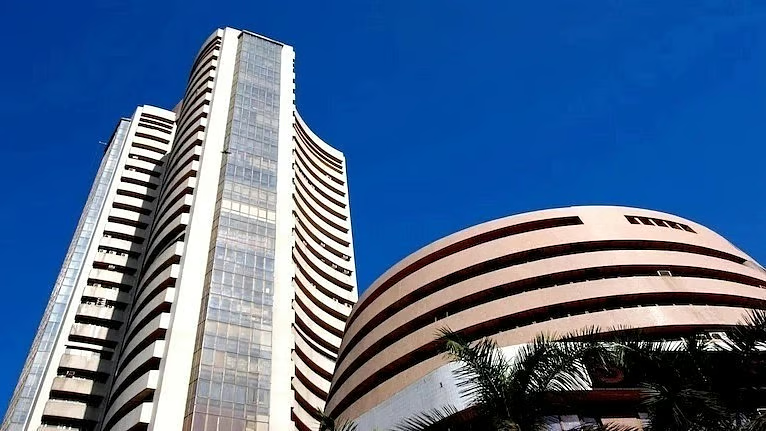
Indian equity markets suffered a major setback on May 29 after a strong start to the trading session. Benchmark indices erased early gains and ended sharply lower amid rising concerns over the monsoon outlook, foreign investor selling and MSCI index rebalancing.
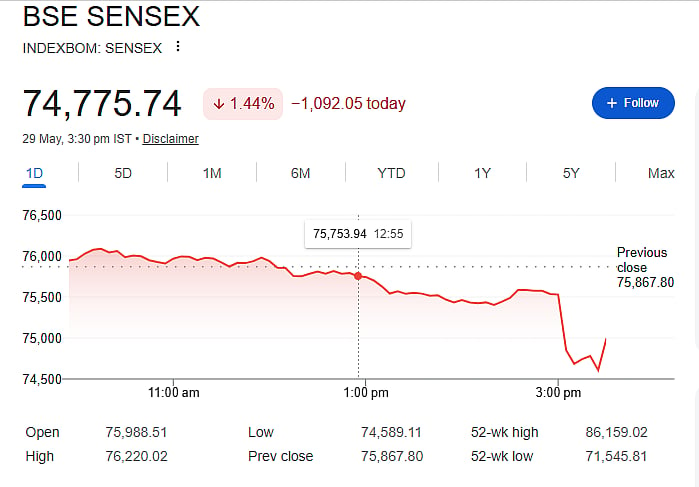
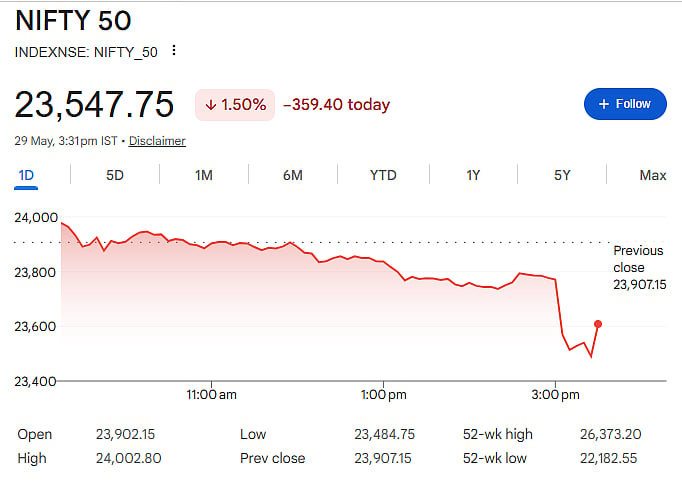
The BSE Sensex closed at 74,775.74, down 1,092.05 points or 1.44 percent, while the NSE Nifty 50 settled at 23,547.75, falling 359.40 points or 1.50 percent. During the day, Sensex touched a high of 76,220.02 before witnessing a steep decline, while Nifty hit an intraday high of 24,002.80.
Weak Monsoon Outlook Worries Investors
One of the biggest triggers behind the market weakness was the revised monsoon forecast. The India Meteorological Department (IMD) reportedly reduced its rainfall estimate for the June-September period from 92 percent to 90 percent of the long-period average.
The lower rainfall projection raised concerns about agricultural output, rural consumption and overall economic growth. A weaker monsoon can affect crop production and put pressure on food prices, creating challenges for policymakers and businesses.
Adding to the concerns, several regions of the country continue to experience intense heatwave conditions. Investors are also closely watching the possibility of El Niño-like weather patterns developing in the Pacific Ocean, which could further impact rainfall.
Drought Concerns Add To Market Pressure
In an interview, Managing Director Jatin Singh said there is nearly a 60 percent probability of drought-like conditions emerging this year. Although the IMD is not officially classifying the situation as a drought, concerns over below-normal rainfall have increased market nervousness.
At the same time, foreign institutional investors (FIIs) remained net sellers. FIIs sold shares worth around Rs 1,040 crore on Wednesday, extending the trend of foreign fund outflows that has weighed on investor sentiment throughout the year.
MSCI Rebalancing Triggers Final-Hour Sell-Off
The sharpest fall came after 3 pm when selling intensified across sectors. Market participants attributed the sudden decline largely to the MSCI May 2026 index rebalancing exercise.
MSCI rebalancing often leads to significant buying and selling by global funds tracking the index. As passive funds adjust their portfolios, volatility tends to rise, particularly during the final hour of trading.
The combination of monsoon worries, foreign selling and MSCI-related adjustments pushed markets sharply lower, ending the session on a weak note.